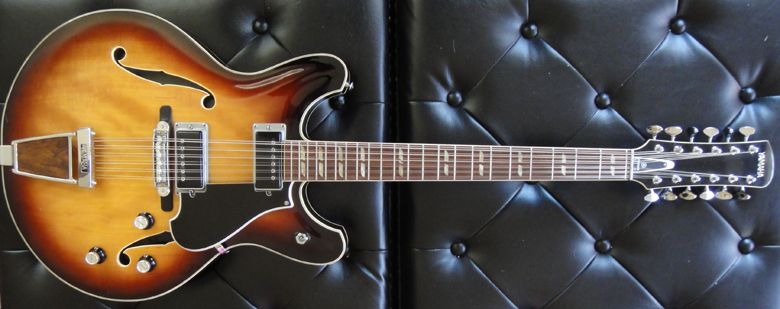
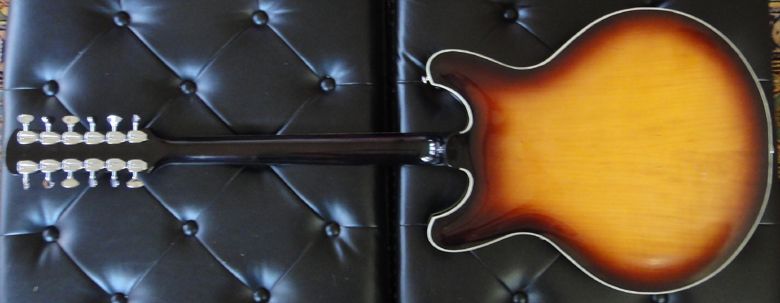
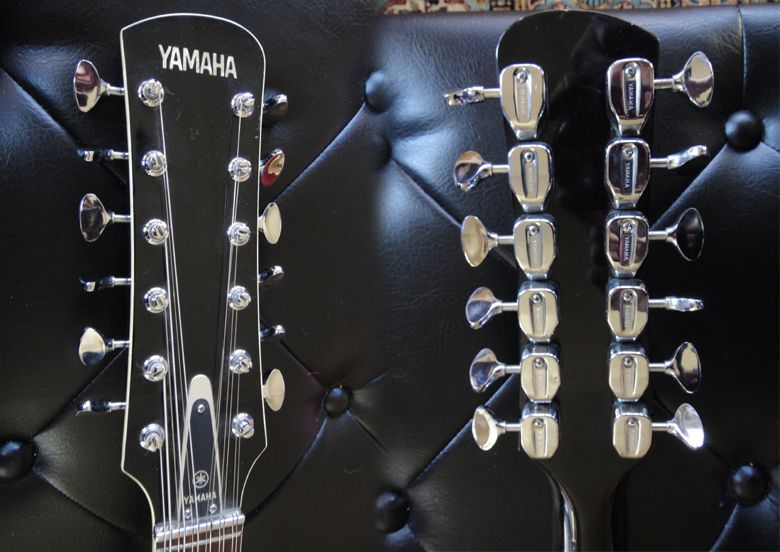
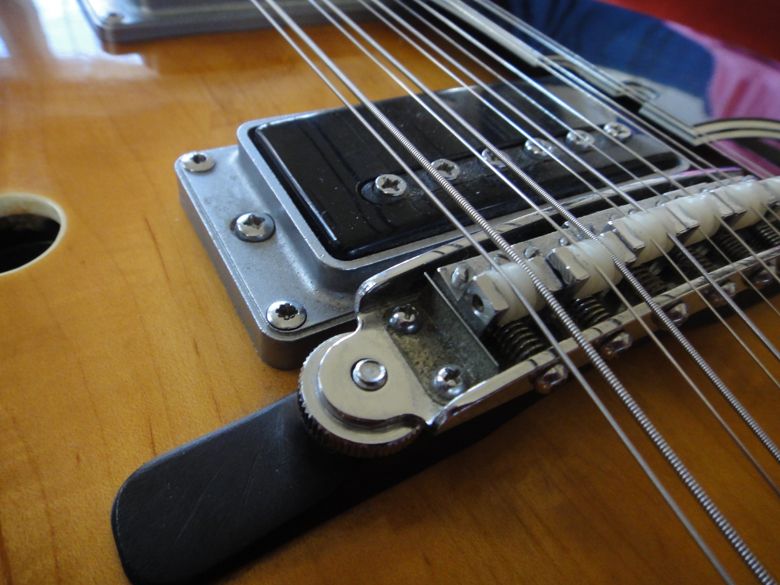
Regular readers of Guitarz will know of my enthusiasm for certain early Yamaha solidbody electrics, but being a recent semi-hollowbody convertee I am wishing I had the chance to sample Yamaha's early semis. In May 2011 we looked at this particularly nice example of a Yamaha SA-30 semi and now Derek has sent us photos and a few words about his Yamaha SA-20 which is the 12-string version. I'll let him tell you about it:
Having shown the Yamaha SA-30, I thought you might be interested in this 1968 SA-20; it's the same guitar (minus vibrato) as a twelve string. The price in 1968 was $315 according to a catalog you can view here, making it the most expensive of the SA (semi acoustic) line at the time, about $2000 in today's dollars.
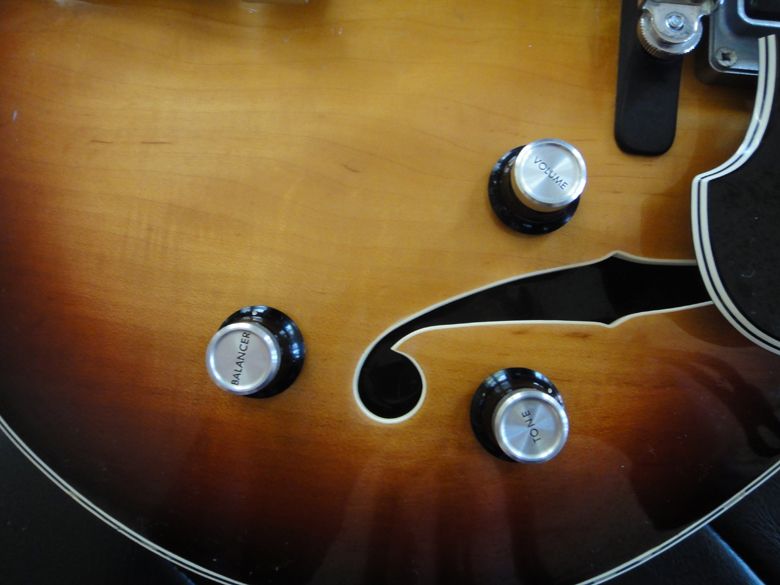
When I first got the guitar, I noticed that there's black plastic inside the F-holes; this, I learned from the catalog, is a baffle intended to suppress feedback (patent pending!). If you've both pickups selected the "mic balancer" lets you blend between the two; the pickups are the size of humbuckers but I think they are single coils. Either way, they're attractively fitted. The neck is very narrow, and the nut (which I don't believe to be original) makes it challenging to play; but overall the workmanship is superb.
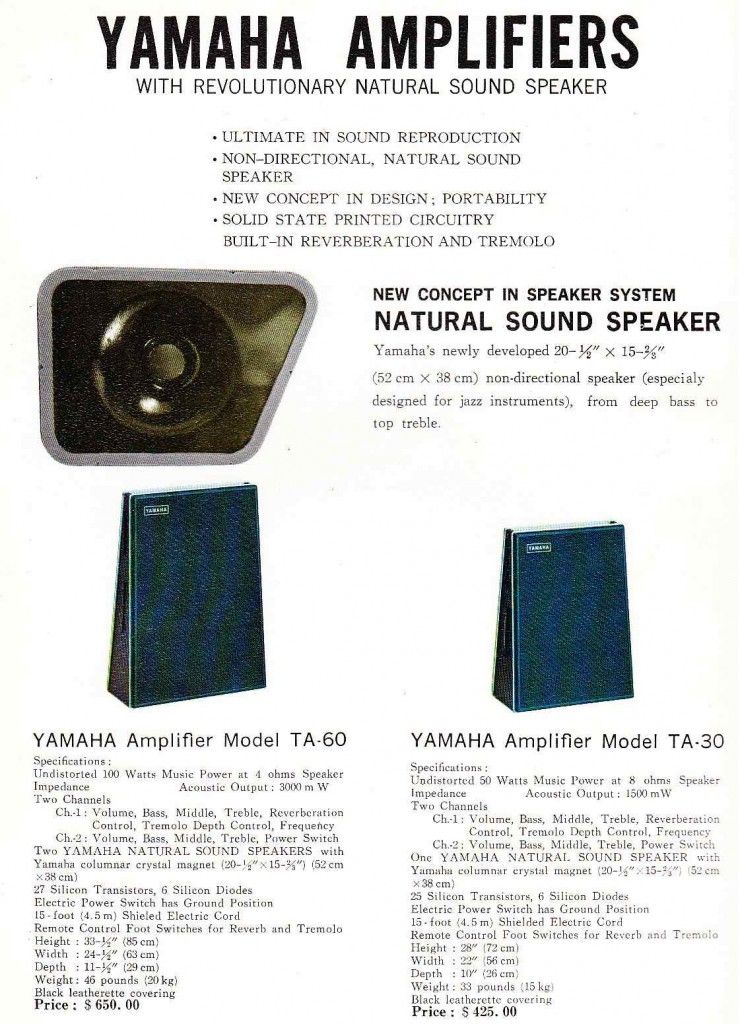
In that same catalog is a very interesting amplifier, the TA-60; I'm including a picture of that as well. I'd really like to find one to compliment the guitar.
Best Regards,
Derek
Thank you, Derek, for sharing this with us. Perhaps one day I'll get my mitts on a similar guitar!
Via the Guitarz Facebook page our friend Jarma asks what are the guitars being played by The Association in this 1960s TV performance.
Well, the bass is easy: it's a Gibson EB-2 semi-hollowbody bass. Initially I wasn't too sure what the rhythm guitar was, so I moved onto the solidbody lead guitar as I was sure we had featured one very much like it here on Guitarz. Sure enough, it's a Hagström Impala, and that made me think that perhaps the rhythm guitar is a Hagström too - a twin-cutaway semi-hollowbody design with a Strat-like head?... it's a Hagström Viking, surely? (As used by Elvis in the '68 Comeback Special).
It's a great video clip, by the way. Thanks for that, Jarmo!
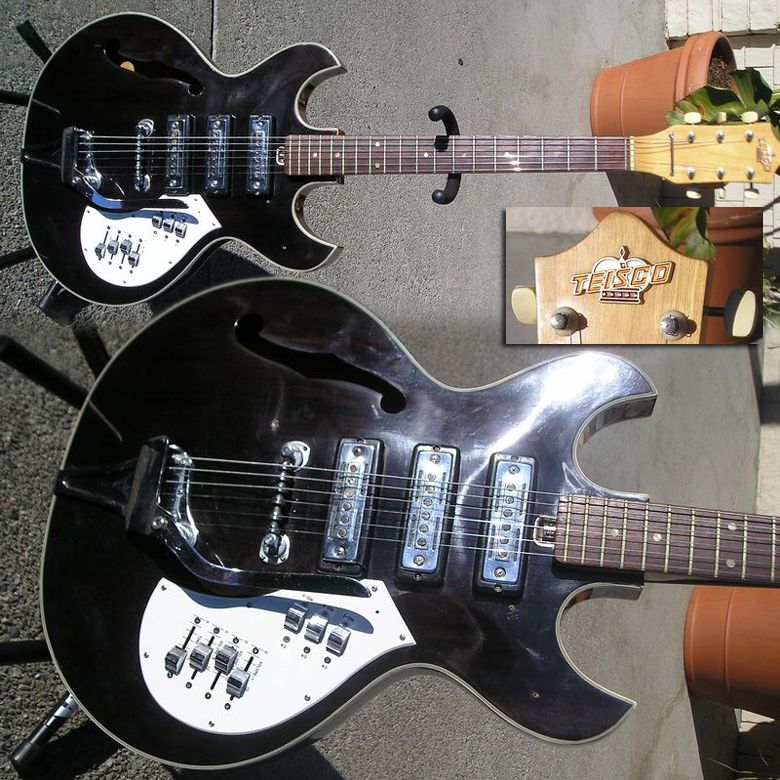
Something about this Teisco EP-93T hollowbody electric guitar makes me think it would play like an absolute dog. I'd imagine it would be boxy-sounding and the cheap hardware would make it rattle and buzz, and sure, there's three pickups, but did you ever try those pickups? They were hardly the best; "muddy" is the word I'd use to describe the tone. However, despite all that, I can't help liking the guitar. I like the shape and the general design of the instrument, not to mention those crazy slider controls - you just don't see stuff like that on guitars any more.
Perhaps I'm letting my prejudices have too much say, and maybe - just maybe - this is a great player. Still, I wouldn't like to be the one to shell out the $549 eBay Buy It Now price so as to find out one way or the other.
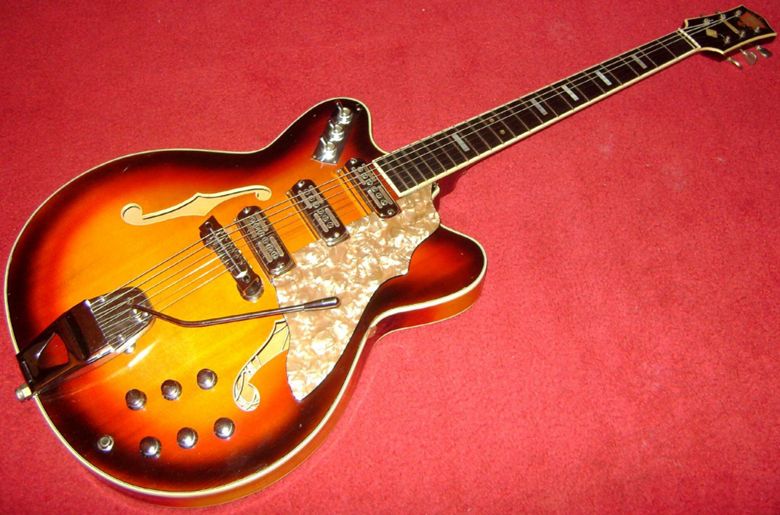
Here we have a 1960s vintage Fasan semi-hollowbody complete with vibrato, three pickups and a plethora of switches and controls. Fasan were a German manufacturer, but the seller of this example makes a big noise of that fact that it resembles the Welson/Dynacord DC-3V model and, I guess, is implying that it may have been made in Italy and re-branded with the Fasan name. Well, I can see the similarities, but they are not THAT similar and are certainly from separate manufacturers. The body shape is definitely quite different, with the Italian guitar having much more Mickey Mouse-style horns (Oh no, not him again!).
Fasan (which means Pheasant, by the way) were a German guitar manufacturer and I see no reason to doubt that this guitar was built anywhere but in Germany.
Currently listed on ebay with a Buy It Now price of $679.95.
Thanks to Luke Tildsley who saw this guitar on eBay and made us aware of it!
Regular readers may remember this collection of Dominoes that was being offered for sale on eBay back in September 2011 with a Buy It Now price of $11,000.
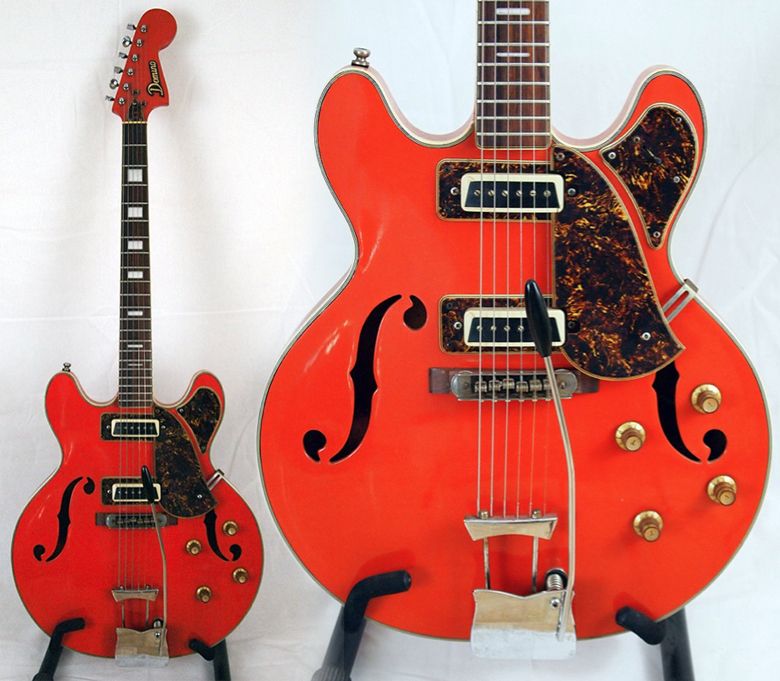
Unsurprisingly the collection of 12 Japanese-made Domino guitars and one Domino Combo King electric organ did not sell, and now it turns out that the seller is trying to sell the guitars individually. This 1967 Domino Dawson is a semi-hollowbody, obviously designed after the Gibson 335 although with a bolt-on neck and perhaps a touch of the Hagstrom Viking about it with its Fender-esque headstock.
This is listed on eBay which a not unreasonable Buy It Now Price of $525.
Like many instrument of this vintage Polish company, the Defil Malwa is a strange mix of elegance and crudeness: it has a subtle outline and Framus-like cats-eyes sound holes always look cool, but the gear and the finish feel rough - though the knobs and trapeze stoptail are without doubt replacements parts. These guitars have often bad reputation but I heard some demos on YouTube that are not that bad.
BTW, did you know that Defil stands for Dolnoslaska Fabryka Instrumentow Lutniczych (Instruments Factory of Lower Silesia)? And that Malwa refers to a plant genus that includes hollyhocks - those tall and beautiful flowers that grow all over Amsterdam in summer when girls are shortly dressed, air is perfumed with suave cannabis fragrance and life is light - and mallows - with which marshmallows are made?
Lately I was thinking: "OK, no more vintage German guitars - people will think that we're just a niche blog or that I'm obsessed or something, and there are so many wonderful guitars all over the world..."
Then BAM!, I discovered this magnificent Hopf/Glassl Allround that looks perfectly preserved (in better state than I feel myself, actually, though I'm younger!) You're probably familiar now with Hopf's nice schlaggitarren, Gustav Glassl was a renowned German luthier who sometimes collaborated in the 1950s/1960s with big companies for high end instruments.
I love the chromed vintage single coils, the strangely shaped florentine cutaway, of course the one-of-its-kind tremolo, and you couldn't have not noticed its very cool Saturn headstock - a classic Hopf design...
If this guitar was black, I would have to go and rob a bank and buy it! Well I'd have to wait until monday anyway...
I already told here and here how much I liked Ibanez Talmans, a short-lived nice no-nonsense guitar series from the 1990s than could have become a hit and disappeared without much legacy (but the acoustic model that still is in Ibanez catalogue - I have one, I wouldn't play it on a big stage, but I don't play on big stages anyway, and I've been happily traveling around with it).
I was aware that there's been a thinline version of the Talman in the early 2000s - silver finish ones show up on the Internet regularly with good reviews -, but I didn't know this TM 81 that belongs to both Talman and Artcore series. I have narrow taste when it comes to guitar finishes so I'm not a fan of the flameburst finish, but I have a good feeling about this guitar, that looks common but has something unique...
I know that I probably spend much too much time ranting here about how unimaginative guitar making became in the last decades, so let's cut the crap and rejoice over creative luthiers and small companies that can still produce guitars such as the Custom 77 Roxy, an original yet sober, timeless and classy semi-hollow wonder that has everything it takes to become a new classic.
I love this guitar, firstly for its beautiful bevelled outline, both sensual and dynamic, and the fact that it's a semi-hollow that doesn't have to be a copy of an ES-335 to have credibility. I also appreciate the Duesenberg-style bridge humbucker + neck P90 combination, the simple pickguard, the wraparound bridge, the old-school F-hole on this radical body, and the controls positions seem to be well thought - not just placed where tradition tells... I just wish it was bigger but it's just because I'm big and I'm still looking for my dream semi-hollow guitar!
Custom 77 is an interesting French guitar company that released nice original models, on top of producing the inevitable Fender/Gibson copies (it's probably necessary to generate basic income, but that's the buyers's fault, isn't it?) - all with Iggy/Ramones/Clash inspired names - plus basses and acoustic guitars, also drums and cymbals and they just started an effects boutique line. I will keep an eye on this company because I'm sure that they will keep releasing new cool stuff and one day I will want some of it...
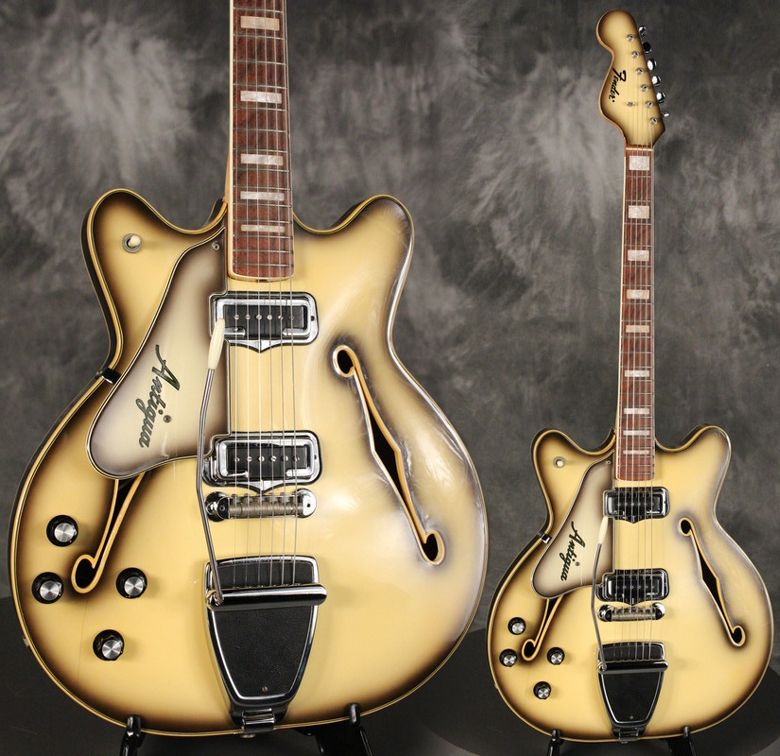
Here's another left-handed Fender in Antigua finish, this one being their almost forgotten first attempt at a semi-hollowbody guitar, the Fender Coronado II. The Coronado series was designed by Roger Rossmeisl, who had previously designed guitars for Rickenbacker, and were produced between 1966 and 1972. The Coronado models I and II differed in number of pickups (which, incidentally, were made by DeArmond), the Coronado I having a single neck pickup and the Coronado II having an additional pickup in the bridge position. There was also a 12-string model, the Coronado XII, plus a bass model. Antigua was not the only rare finish, as a number of Coronado II and XIIs were made in Wildwood editions with bodies constructed of highly grained beech wood from trees which had been injected with colourful chemical dyes before being harvested.
But back to the Antigua finish. Note how the 1960s Antigua differs from that produced in the late 1970s. The 60s version is almost a cream to black burst, whereas in the 1970s the whole burst effect is more "mushroom"-like. A few years ago I had one of the Crafted In Japan Fender Strat reissues in Antigua, and the colour was different yet again having more of a green tinge to it.
What's more, the eBay listing tells us that the above-pictured Fender Coronado II originally had a cherry finish before being refinished in the factory in Antigua. I had heard the the Antigua finish was originally developed to hide a mistake and wonder if this might be the reason for this guitar being refinished. (Anyone know the full story?)
Anyway, this guitar is currently being offered for sale on eBay with a Buy It Now price of $2,590.
G L Wilson
Additional: Via the comments Sam writes:
I have a book on Fender called The Fender Electric Guitar Book: A Complete History Of Fender Instruments.
Here's what it says: "Virgilio 'Babe' Simoni remembered a particular problem with the Coronados... 'We couldn't get the binding material to stick to the Coronados,' he said later. 'We'd bind them at night and come back in the morning and the thing would be popped loose. [So we had to] re-bind them several times, and the veneer is very thin on them.' In order to cover up the burn marks caused by this re-binding, the team had no choice but to devise a special white-to-brown shaded finish, which they called Antigua, to salvage the scorched Coronados."
So yeah, perfectly conceivable - and very likely - that this was one such Coronado originally finished in cherry and then refinshed in Antigua by Fender after the binding failure damaged the previous finish. - GLW
This excessively cool ES-335 style Ovation Eclipse has an interesting story (it it's a true one). It belongs to the late 1960s Storms series - the Tornado model being the most famous of them - whose bodies were actually made by Höfner in Germany. It seems that once they received a batch of bodies with painting problems, but all they had to refinish them was the Lyrachord they used to mold the round bodies of their acoustic guitars (I have this finish on my Breadwinner, it's great!)
That was a good starting point, add to this Höfner 513B blade pickups, classy chrome hardware, a bizarre pickguard and you have this dream guitar, that doesn't look like a 40-year vintage grandma but something Ellen Ripley could have used to smash a Xenomorph with. This guitar was a very short series, like just a few hundred items around 1970, and if there was fairness in this universe, one of them would be mine...
OK, it's the 11th November 2011, that is 11/11/11, and as such today has been designated Nigel Tufnel Day. To celebrate this day of Maximum Elevenness, we here at Guitarz - for this day only - will be posting an unprecedented ELEVEN blog posts! So, keep tuned throughout the day for eleven weird and wonderful guitars!
This Guild T-50 from 1982 is an absolutely beautiful guitar. It's a semi-hollowbody, thinline, non-cutaway design with timeless classic lines, an almost Art Deco-style pickguard, twin humbuckers and a gorgeous cherry red finish.
The non-cutaway body does seem a little at odds with the date of this guitar, seeing that the 1980s were known for hair metal bands and the rise of the Superstrat and pointy pointy "careful you don't impale yourself" guitars.
This guitar is currently listed on eBay with a Buy It Now price of $1490.
Thanks to Jeffrey Jones for bringing this guitar to our attention.
OK, it's the 11th November 2011, that is 11/11/11, and as such today has been designated Nigel Tufnel Day. To celebrate this day of Maximum Elevenness, we here at Guitarz - for this day only - will be posting an unprecedented ELEVEN blog posts! So, keep tuned throughout the day for eleven weird and wonderful guitars! I have a soft spot for semi-hollowbodies and I have a soft spot for vintage Japanese guitars, so this 1960 Electra 2228 ticks both those boxes. It is equipped with a brandless Bigsby-a-like vibrato; it's nice to see that still in place on an old Japanese guitar of this age. I like the way that the finish has crazed with age, which makes the guitar seem all the more venerable somehow. I can imagine it might sound a little bit boxy, maybe a bit rattley, but that does not stop the appeal for me.
OK, it's the 11th November 2011, that is 11/11/11, and as such today has been designated Nigel Tufnel Day. To celebrate this day of Maximum Elevenness, we here at Guitarz - for this day only - will be posting an unprecedented ELEVEN blog posts! So, keep tuned throughout the day for eleven weird and wonderful guitars!
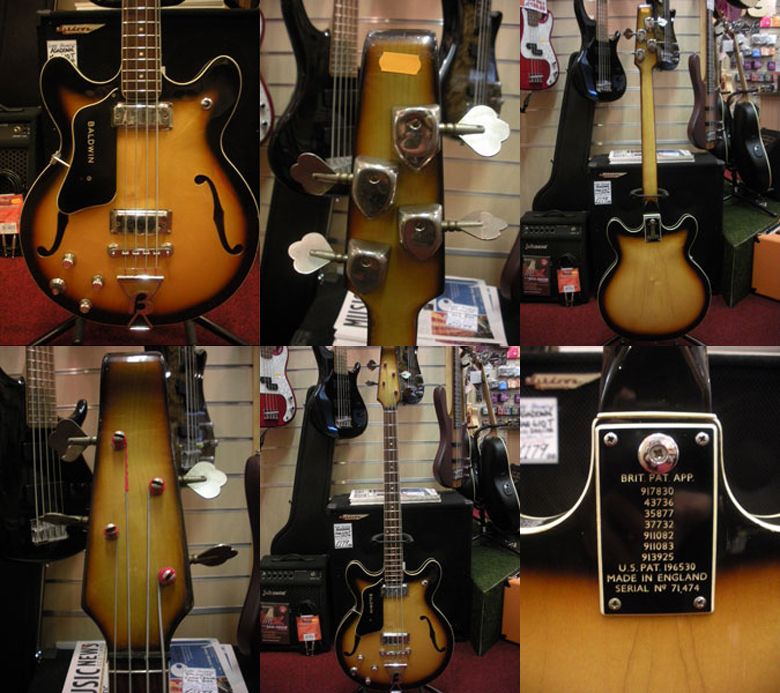
Here's one for our left-handed friends, a vintage Baldwin semi-hollowbody bass, although I'm not sure of the exact model number or name (it gets tricky with all the various Burns-related companies!) so if some reader could enlighten me, I would be very grateful.
The Baldwin Piano and Organ Company of Cincinnati bought out Burns London Ltd in 1965 and guitars and basses that had previously been badged "Burns" were re-branded "Baldwin". Most Burns aficionados agree that this was where the rot set in, with standards beginning to slip in quality of construction. The carved scroll headstock on this bass would indicate that it was one of the later Baldwin guitars, this type of neck being adopted across the range in the last few years of production, circa 1967-1969. Baldwin finally gave up on the Burns guitar line in 1970.
Currently listed on eBay UK with a Buy It Now price of £1,399.
You want vintage? You cannot find better than this worm eaten Egmond Lucky 7! Unfortunately this guitar is not playable anymore, but some wild luthier in love with authenticity, natural wood and zombie movies could be inspired and create the next super hype finish based on this - cannot be worse than the average paint jobs en vogue amongst teenaged metalheads.
You will note the typically budget instrument all-in-one-piece plastic pickup/pickguard/control plate/jack plate that allow to instal in one move all the electronic on the guitar. The Lucky 7 was one of the lowest end guitars of Dutch guitar brand Egmond that - if you remember well - provided budget guitars to many English young musicians who later changed the course of history.
You will find here a very interesting page about Lucky 7 and Egmond guitars.
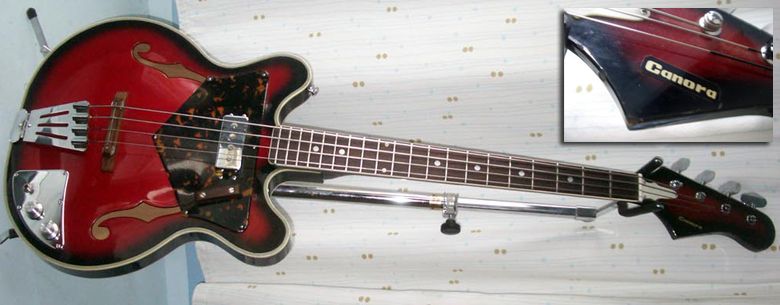
Here's a 1960s Japanese-made Canora semi-hollowbody bass. Anyone out there heard of the Canora brand? It appears to be the same model as the Sekova Vulcan and very likely was available under other brandnames too.
The eBay seller makes some really interesting observations:
While it is nearly impossible to exactly pinpoint the manufacturer of this bass, it is clearly an early product of Matsumoku, Kawai and the Teisco guitar factories as it has recognizable parts from each of those plants. It is well known that Matsumoku kept very poor records on the export models they produced, but it is known all of the Univox, Aria, and Guyatone guitars came from them as well as some Ibanez, Electra, Yamaha and dozens of other brands had at least a foothold in production there. It was clearly an odd time unlike anything that happens at US factories, because you'd often see different combinations of factories necks, bodies, pickups, and hardware all on the same guitar. Imagine a Fender neck on a Mosrite body with Gibson pickups and you get the idea of where I am going with this. It seems very strange but I think it went to a different sensibility employed in designing this guitars. There were a lot of orders to fill and many more coming down the pike! It seems that for the lines made for the Japanese market this was less the case, but the US imports often became a free for all. What results is many models with confusing slight or drastic variations in design that has made it almost impossible to get a solid handle on it. The guitars like Kent, Decca, Kingston, Guyatone, Audition, Lyle, and Melody all seem to morph and change model to model and year to year in this way. It is clearly not very easy for me to say with certainty much else about the history of this model...
The seller also tells us that the design is based on that of the Gibson EB-2. Personally, I'd have said that there was more of a hint of Kay going on in there. And where have I seen that shield-shaped pickguard before?
This is not a modern-sounding bass. It has that 50s/60s boom to it - as would would expect from a short scale bass with a single pickup mounted in the neck position - but it would probably be invaluable for re-creating that vintage vibe should you desire to do so.
Currently listed on eBay with bidding at $235.50 at the time of writing, and over 2 days left before the end of the auction.
I may well have said elsewhere that I find myself increasingly drawn towards semi-hollowbody or thinline designs these days. Earlier this year I bought myself a Korean-built Aria TA-40 with the Welsh flag on it (see this post), a rather modest example of this type of guitar, and my reaction was, "Wow! Why have I been playing solidbodies all these years?"
So, I'm always on the lookout for other semis; at the back of my mind I'm thinking that I could replace one of my other guitars with such an instrument. This Univox Custom semi-hollowbody definitely appeals to me; if I didn't have to pay the shipping from the USA plus the inevitable customs charges that would be incurred, then I could well see myself bidding on this.
The white finish brings to mind Gretsch's White Falcon, whilst the asymmetrical 3-on-a-side headstock design is bold and attractive. I like how the headstock facing, pickguard, truss rod cover, switch plate and pickup surrounds are all made from the same patterned material (what would you call that design? It's not quite tortoiseshell, is it?).
The vibrato arm is supplied, but needs re-assembly which hopefully shouldn't be too difficult. Pickups would appear to be a pair of singlecoils which I admit wouldn't be my first choice of pickup on a guitar like this, but of course the proof would be in the tones available when one actually gets to play the guitar.
This guitar is currently listed on eBay with a starting price of $390. There are no bids at the time of writing, and the auction finishes in less than 12 hours. Someone could get themselves a very nice Matsumoku-made Japanese guitar at a very nice price here!
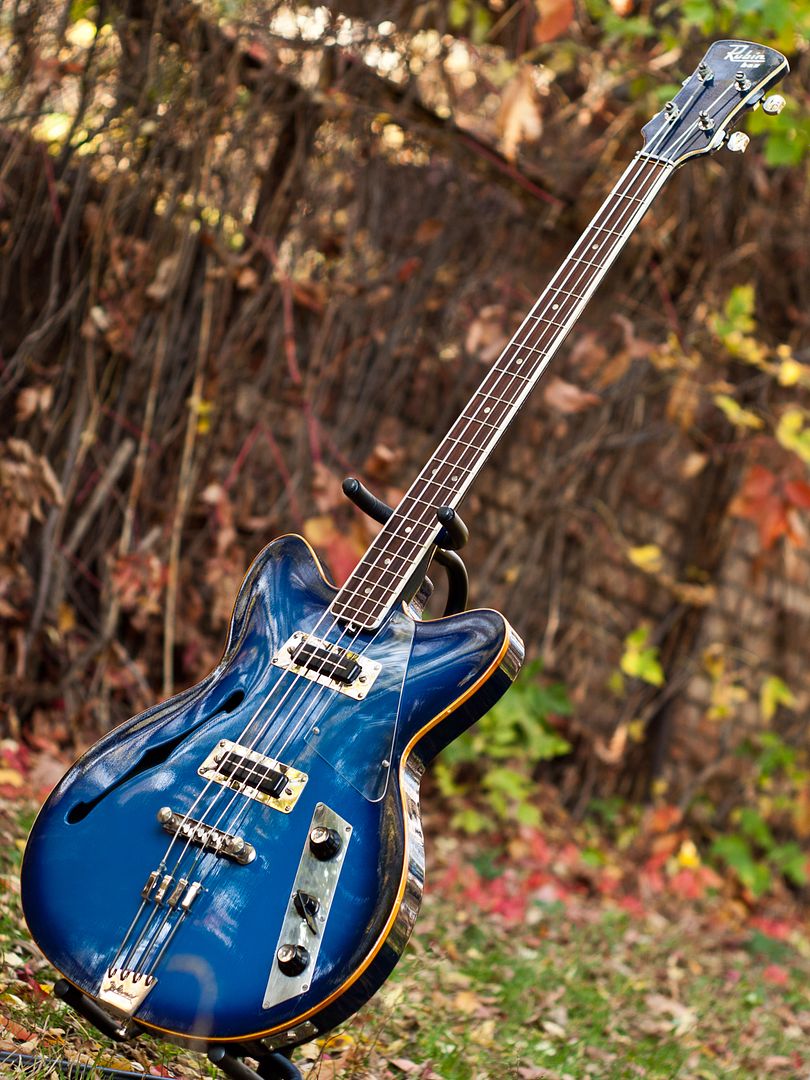
This Soviet-era Czechoslovakian semi-hollowbody Jolana Rubin short-scale bass really does look quite glorious. I've no idea what it sounds like or how it plays, but I want it.
I am reminded of the Orfeus Hebros bass from Bulgaria that we looked at in November 2009; it's similar, but if anything this Jolana is nicer. Note the single f-hole, the clear pickguard and trapezium-shaped metal control panel, not to mention the glossy blue burst finish.
This instrument is currently listed on eBay and with a day still to go before the auction finishes, bidding is at $350 (at the time of writing). These old Soviet-era Eastern European and Russian instruments are becoming ever more increasingly popular, and - as you may have noticed - we here at Guitarz have been fans for quite some time already.
This Japanese-made Marlin PB-26 bass circa 1968 is no relation to the Marlin brand that issued a range of colourful and cheap Chinese-made plywood-bodied Strat and P-Bass copies in the late 1980s. Put those out of your mind; we shall endeavour not to mention them again.
As with other guitars and basses coming out of Japan they were marketed with different brandnames. This same model was also available under the "Idol" brandname. There was also a 6-string guitar sibling, the PA-26, complete with vibrato. They would all have been built at the same factory, possibly the now legendary Matsumoku factory although I am not able to verify this for certain.
You have to wonder if some of B.C. Rich's designs were inspired by instruments such as this. It just goes to show that some ideas are not as original as you might at first think.
The seller assures us that this is one of the finest basses he has ever played (which begs the question why is he selling it?) and it is currently listed on eBay with a Buy It Now price of $1,899.99.
Thanks to Oinque guitars for pointing this one out to us!
I was making some research on Eko for my previous post, and thought I would check the new Eko website, and I figured out that they discreetly but steadily reissue all their vintage models - without big announcement in guitar magazine and reviews on professional guitar blogs...
I discovered this crazy guitar, the 295, a so far extremely rare semi-hollow version of the classic Eko 700 model - a dream guitar for all those bored with the classic designs. The reissue model differs from the original, mostly with its humbuckers that are much likely an improvement, and the stop-tail replacing the cool but probably unsteady tremolo.
Strangely the eccentric sound-holes have been modified, and not for the better, and the rotary switch is now a standard one - guitar makers, please reintroduce rotary switches, they are so much cooler and practical (I actually look for a 5 positions one for my next guitar project, anybody knows where to get one?)
You have like usually the best article about Eko 295 on fetishguitars.com and the vintage photos come fromguitarage.nl, another good resource for alternative guitar lovers - and you can find the contemporary version on ekoguitars.it. For me I still favor the Eko Kadett 67, it's on my list of must-have guitars, and I'm happy to now have the chance to get a contemporary version of it, for a guitar is meant to be played and I wouldn't be comfortable with a museum piece (and I also think, contrarily to common belief, that most nowadays guitars are better that they used to be).
 RSS