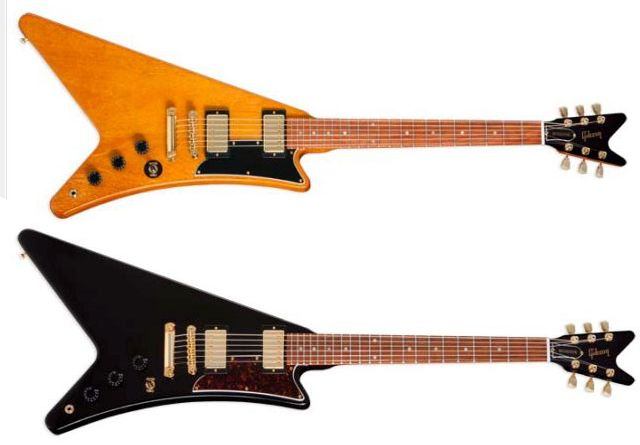
The Gibson Moderne is the closest guitar equivalent of the Bigfoot, in the sense that there is little evidence to prove its existence and there is yet to be solid proof of a real one anywhere on Earth. Guitar collectors consider the original Moderne the holy grail of Gibson collectable guitars. This is because the prototype designed in the late 50s as part of the ‘Futura’ range, along with the Flying V and the Explorer, failed to make it into production and simply vanished with no other prototypes appearing in pawnshops or even any trace of its existence until 1982 where it was released as part of the ‘Heritage Series’, and again later by Epiphone in Korea. Now decades later Gibson have released a new rendition of the fabled Moderne to start the hype, the mystery and the rumours all over again.
From what we know of this mystical creature, it appears to be almost identical to the original guitar. The very distinctive body, which looks like the cross-breed result of the Flying V and the Explorer, is made from mahogany along with its neck, which features a rosewood fingerboard and dot inlays. The Moderne is then finished off with a very cool forked headstock and to make sure it can replicate that vintage Gibson tone it has two ’57 Classic humbuckers.
The Gibson Moderne is going to pretty popular with collectors, as it’s the next best thing to the original, and people who simply like unique guitars. The guitar will be available in amber with a black scratchplate, or ebony with a tortoiseshell scratchplate. For more information on this guitar and its release date check out this site or sign up to the newsletter to be kept posted.
Via the Guitarz Facebook page our friend Jarma asks what are the guitars being played by The Association in this 1960s TV performance.
Well, the bass is easy: it's a Gibson EB-2 semi-hollowbody bass. Initially I wasn't too sure what the rhythm guitar was, so I moved onto the solidbody lead guitar as I was sure we had featured one very much like it here on Guitarz. Sure enough, it's a Hagström Impala, and that made me think that perhaps the rhythm guitar is a Hagström too - a twin-cutaway semi-hollowbody design with a Strat-like head?... it's a Hagström Viking, surely? (As used by Elvis in the '68 Comeback Special).
It's a great video clip, by the way. Thanks for that, Jarmo!
OK, it's the 11th November 2011, that is 11/11/11, and as such today has been designated Nigel Tufnel Day. To celebrate this day of Maximum Elevenness, we here at Guitarz - for this day only - will be posting an unprecedented ELEVEN blog posts! So, keep tuned throughout the day for eleven weird and wonderful guitars!
You know already the Gibson SG200, the early 1970s budget version of the SG - well worse than budget, a big flaw in Gibson's production from a bad phase era. Here is its bass equivalent, the SB300. I don't have more to say about it, but I see more and more of these guitars showing up on eBay and sellers starting to ask vintage prices for them, so I thought I should repost the comment that our reader Teh Gav posted about the SG200:
"I've played dozens of these crude, downmarket '70s SGs over the years, hoping to find one that had potential. I found nothing but sadness and humility. They are bad guitars.
I say this as a huge fan of Melody Makers and pre-Japanese Epiphone solidbodies. It's not a snob thing. It's like, "Oh my God, this guitar feels like it's nailed together from leftover firewood and finished with slapped-on shellac. Uh, let's see how it sounds..."
That is where the sadness generally comes in. The humility has come from watching the numbers on the price tags rise from the moderate three-figures and move steadily toward a thousand dollars. Someone is buying these things, and it makes me feel like a cranky old guy who can't stop himself from wagging an index finger and telling 'back in my day' stories.
Because see here, back in my day, if you needed a guitar and were stuck with a hundred and fifty bucks in your pocket, you would step straight on top of one of those suck-Gibsons whilst making a straight path through the music store to the wall where the used Cort, Fernandez, Hagstrom, and/or Aria Pro II guitars were hanging.
These had no cachet or 'mojo' at all, but for God's sake, at least they freaking worked properly -- and at least they didn't make you feel shallow and vaguely dirty for playing a guitar purely because of the name painted on the headstock.
Seriously, these guitars suck. They have caused many people to experience pain and confusion. Not worth it -- really."
I won't deny that there is a certain wild beauty in this bass's crudeness, but guitars are still meant to be usable for music playing, aren't they?
If you're feeling a bit flush this week, dole cheque come in early, hit the EuroMillions jackpot or made a stash from looting the local Apple store in the riots, you may be interested in acquiring an instant vintage guitar collection. Gibsons galore without the sweat.
This gleaming Aladdin's cave of vintage woodwork may well be right up your street. For a measly quarter of a million quid ($393,811.75 in funny money), you can adorn your den with someone else's lifetime of GAS. Go on. Hit that BIN button! You won't regret it! There are some interesting guitars there but, for someone asking that kind of dosh, you'd have thought he could have made the effort to take some better pictures.
David, sweating in overheated, tourist filled, indignados rioting on the doorstep, muggy, Barcelona
Via the Guitarz Facebook page, reader Grégory Gutierez asks if we can identify the guitar being played by Mike Oldfield in this 1980 performance.
It looks rather like a Gibson L6-S that has been customised with new metal pickguard, pickups, and a metal plate on the headstock. Oldfield was known to play this model Gibson, and there are photos of him playing such a guitar, albeit without the modifications.
Shaped like a rather wide-bodied Les Paul, the L6-S was the first Gibson to have a 24-fret neck. It was designed by Bill Lawrence and was in production from 1973 through to 1979.
The L6-S Custom model (which is, I believe, what Oldfield played) features a chicken head 6-position rotary switch for pickup selection allowing for various series, parallel and out-of-phase tonal options.
Pictured here we see a Gibson L6-S "Midnight Special" which is currently listed on eBay with a very low starting price. It might be one to watch if you want a "budget priced" Gibson, assuming that the bidding does not go too crazy.
The Midnight Special mainly differed from the other models in the series by having a bolt-on neck.
This guitar is sold on eBay as a genuine 1957 Gibson Les Paul Special (with serial number 74008), and it does like like one - same P90s, pickguard, characteristic yellow finish...
But I've never seen such pickguard and stoptail - not on a Les Paul Special nor any other guitar - anybody has information about this?
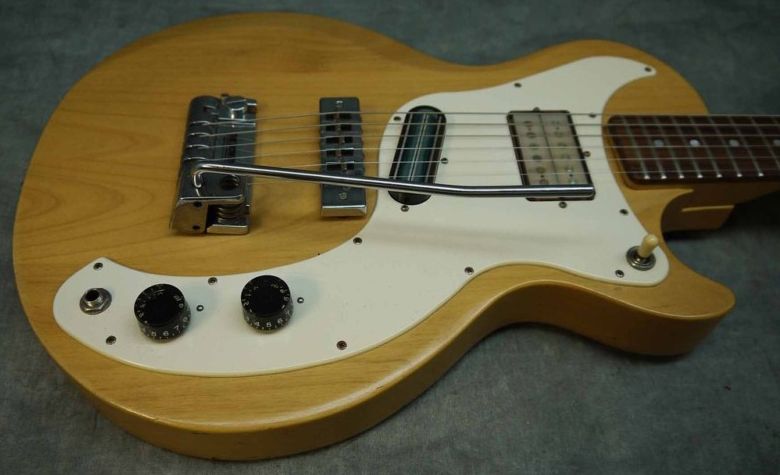
Further to yesterday's post about the Gibson Marauder, here is another example currently being offered for sale on eBay with a Buy It Now price of $859.99.
This is one of the earlier models with a 3-way toggle pickup selector switch. It also has a Rosewood fingerboard as opposed to the Fender-esque Maple as often found on these guitars.
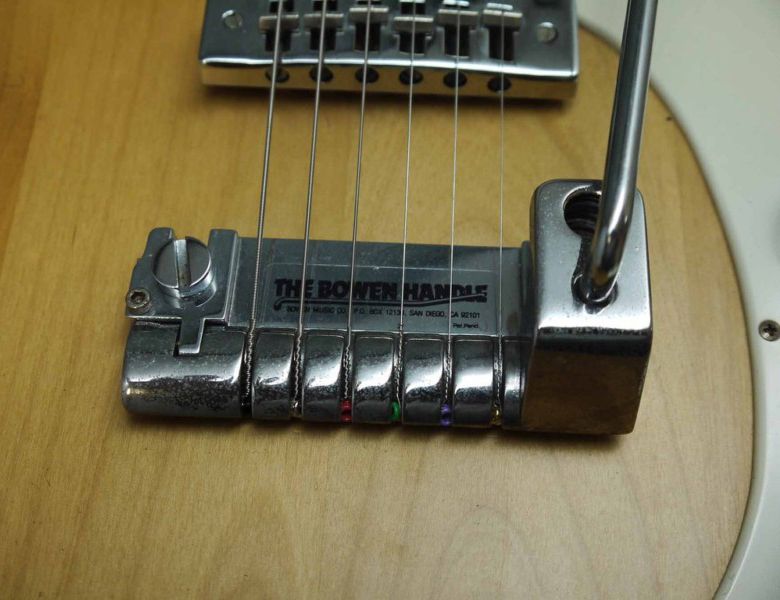
The most significant difference is that it is equipped with a tremolo, or rather vibrato, namly The Bowen Handle (almost certainly a later addition and not original to the guitar). This looks to be a top-mounted vibrato which wouldn't require any routing into the body, an alternative to the Bigsby perhaps. I wonder what ever became of this system? Obviously one would need to try it as to ascertain its effectiveness but it looks to my eyes as if it could be a very useable system. I do like vibratos where the mechanism is from behind the bridge rather than being integral to the bridge.
Our look at the new Modern Player series from Fender the other day generated a lot of comments, including one that said it was odd that Fender had borrowed the name of an unsuccessful Gibson from the 1970s. To be fair to Fender, they had originally used the name on prototypes in the 1960s, but indeed the Marauder name is best known to most guitarists as being firmly in the Gibson domain.
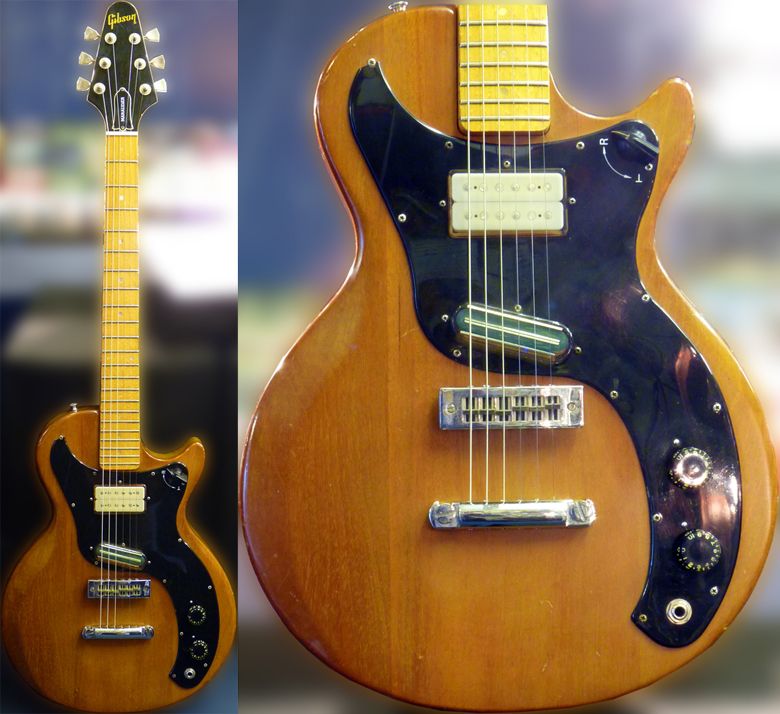
The Gibson Marauder was produced from 1974 to 1979 and originally sold for under $400 USD. The design is obviously derived from the Les Paul but has some Fender-ish traits in that the body is contoured and the neck is bolted on to the body. The fingerboard on the above-pictured example from 1978 is Maple which is another Fender-like appointment, although a more traditional Gibson-esque Rosewood fingerboard was also offered.
Pickups are custom designed Bill Lawrence units sealed in clear epoxy: a humbucker in the neck position and a solid-blade style single coil at the bridge (angled like the bridge pickup of a Tele or Strat).
The earliest examples produced had a 3-position pickup selector, but the Marauder pictured is a later model featuring a rotary switch allowing a blend of the two pickups to be selected. On even later models (from 1979, I'm guessing), this switch was located between the volume and tone knobs.
Often considered too Fender-like for Gibson players and vice versa, the Gibson Marauder wasn't a particularly successful guitar, although that didn't stop the Japanese producing copies of it. I remember in the punk days seeing The Buzzcocks using these guitars and I thought they looked very cool especially with that Flying V-style headstock shape. I guess they were reasonably cheap at around that time and would have been favoured by the punk bands.
This example is currently listed on eBay UK with a Buy It Now price of £699.50.
This Gibson ES-120 T is the cheapest ever Gibson archtop model. Produced between 1962 and 1971, it could achieve its budget price by having all its electronics mounted on its scratch plate - single-coil pickup, pots and jack output - this allowing only one F-hole.
Once a total cheapo, as a vintage Gibson guitar, it can nowadays be considered as a collector, but who cares?
This is a postscript to our blog post last week where we were asked to identify a Gibson bass which turned out to be a Gibson RD Artist Bass.
The example pictured here is currently being offered for sale on eBay UK, with a Buy It Now price of £2,150, which to me sounds a tad optimistic but I'll be watching to see if it sells.
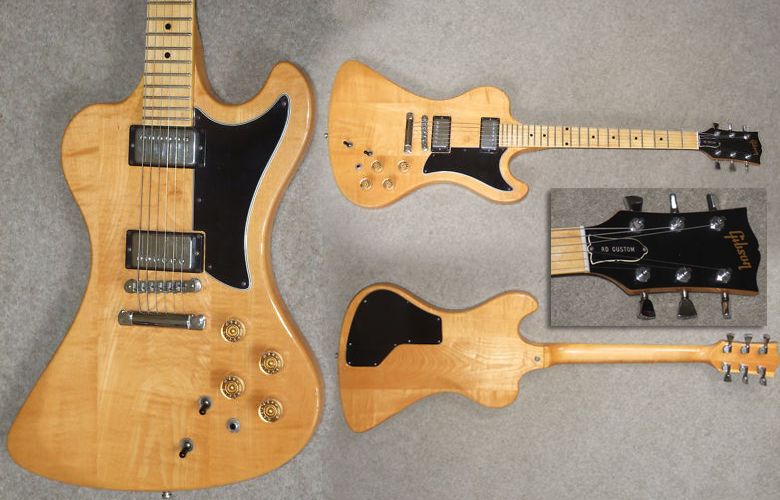
Further to our recent post featuring the Gibson RD Artist Bass, pictured above here we see a Gibson RD Custom guitar from the same series. Whilst it does have active circuitry, unlike the RD Artist, the RD Custom does not have the more complex active electronics by Moog. Possibly this is to its advantage, as many people disliked the RD Artist's electronics and examples of those guitars often have these components remnoved by previous owners.
Possibly the Gibson RD could be considered the Gibson most likely to appeal to certain Fender players with its 25.5" scale and maple fingerboard.
This guitar is currently being offered for sale on eBay UK with a Buy It Now price of £1,250. Unfortunately the seller will only accept collection in person, or will post to mainland UK only for £60 (which is about £45 too much).
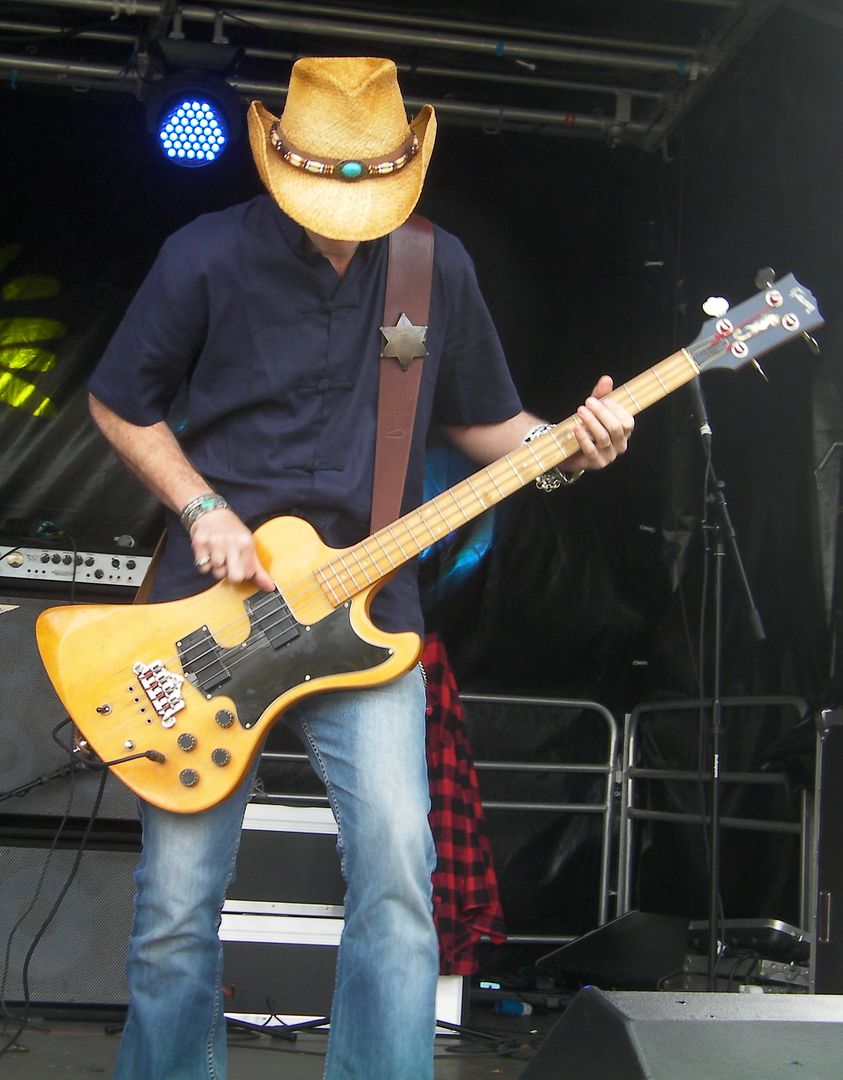
This is the best photo I could get and didn't get to ask the bass player - is it just a Thunderbird?
The band are The Idle Hands Band, a great blues rock band that I saw at Newark Blues Festival on Sunday.
cheers Gary
Ah, here is the bass version of a guitar I am often asked to identify. It's a Gibson RD Artist Bass, which was introduced in late 1977 and was Gibson's first bass to feature active electronics. Working in conjunction with Moog electronics and The Who's John Entwistle, the design team at Gibson consisted of Chuck Burge (woodwork), Tim Shaw (electronics) and was overseen by Bruce Bolen.
It was never a big seller, but did manage to outsell the Gibson Ripper as Gibson's bestselling bass in 1978 and 1979, which does say something about how little Gibson were shifting bass guitars in those days.
We looked at the guitar version of the Gibson RD Artist here, and you can read more about the bass here.
Always had a soft spot for hollow body archtops with florentine cutaway (not the budget though), and you cannot do better than the Gibson ES-175 (well yes actually, you could do better by avoiding sunburst finish), but watching at this 1979 Charlie Christian model, I realize that I've always associated rail pickups with loud guitars exclusively aimed at 1990s metal - and almost always see them doubled in humbuckers (or even quadrupled in double humbuckers).
So I wasn't aware that this elegant one rail pickup in hexagonal art deco casing to which bebop/pre-cool jazz guitar player Charlie Christian gave his name is actually one of the first modern pickups, introduced in 1936 and replacing the previous horseshoe magnet pickup created by Rickenbacker. It equipped the first ES (Electric Spanish) Gibson model - the ES-150 - and allowed Christian to more or less invent guitar soloing due to its louder output. Replaced by subtler six poles pickups, it was reintroduced in 1978 for this ES-175 that is not a signature model of course since Christian passed in 1942, but a tribute.
You will find more information on Charlie Christian pickups here.
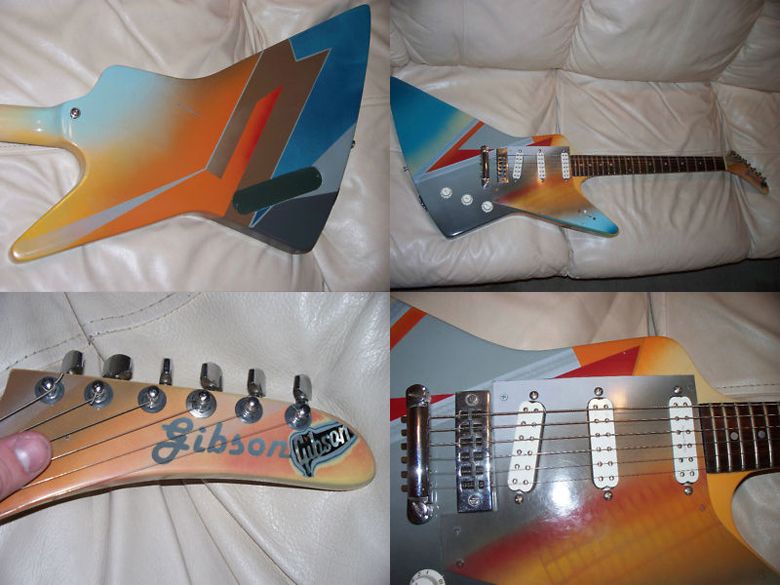
Bill Cesavice kindly flagged this guitar up for me on our Facebook page. Oh dear... where to start with this one?
OK... It's been given a paintjob that I guess might have been inspired by Clapton's CRASH Stratocasters. However, it strikes me as odd to go to all that trouble and then have such a crudely cut-out pickguard which looks as if it's been shaped using a kitchen knife. As for the Gibson stickers on the headstock (I guess because the original logo was painted over), well, the less said the better.
And WHY the three pickups laid out in a Strat formation? That is something that seriously bugs me, the way people think that if you have three pickups you MUST angle the bridge one. Why follow the Strat template? Just what is the logic? Yeah, I know these are singlecoil-sized humbuckers, but still...
So... Gibson or not? Well, it's a set-neck and the shape appears to be accurate so it's perfectly possible that there is a real Gibson beneath the paint, stickers and "customization". But we only have the seller's word on that.
With a Buy It Now price of $900 on eBay, I'd approach this one with caution.
I don't know if I like or not this Gibson M-III, a quite unique guitar in my opinion. This guitar released in the early 1990s was Gibson's late move to get its share of the then flourishing market of the superstrats - too late, Grunge played on vintage budget guitars was about to refresh rock music and close the era of hair metal (that was about to turn into thin hair metal - this joke is not mine but it makes me laugh a lot, if I was 15 and hiding my pimpled face behind long dyed greasy hair, I could even write LOL) - and initiated the current vintage cult.
The M-III was then short-lived - Gibson like the other companies won't wait for decades anymore for a new model to catch - but its design is quite cool, modern and elegantly aggressive - it even has a Rickenbacker vibe, that can never be bad. It has 3 pickups, HSH, and the humbuckers are splitable, so with its 5 positions blade switch it makes 9 pickup combinations, the 10th one being a killswitch.
The zebra humbuckers have a function, they make clear that this guitar can be a strat style 3 singlecoils instrument, as much as a more Gibsonesque HB one. The 'tigershell' pickguard is also nice, but is probably the source of very ugly pickguards proposed on Gibson failure models of the last 10 years... When the M-III was cancelled, its electronics went to the Les Paul Lite M-III with its super light balsa body, and its design was used to create the Epiphone EM series.
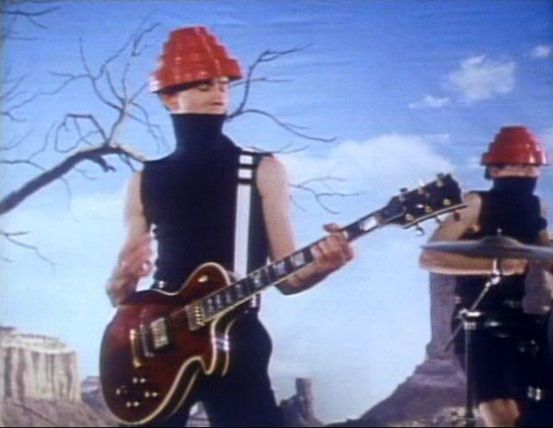
The previous blog post reminded me of this - another Gibson guitar with a part of the body sliced off and reversed. The photo shows Bob Mothersbaugh in the video for Devo's "Whip It" with a very peculiar-looking Les Paul.
With all the technology being dangled in your face when you hit it big, did you ever use a guitar synthesizer?
Back in 1979, I used a device made by 360 Systems. It was a big box that sat next to your amp and required a special pickup. The 360 Systems people recommended I use a Les Paul, and at the time I was horrified—I thought Les Pauls represented arena rock, long hair, and Puka shells. But I got a Les Paul and took a jigsaw to it with the intention of making it look like a skull. I cut the little horn off at the cutaway and flipped it over backwards and thought it looked a lot better. The 360 was a horrible synth and really didn’t sound good. I only used it for one tour.
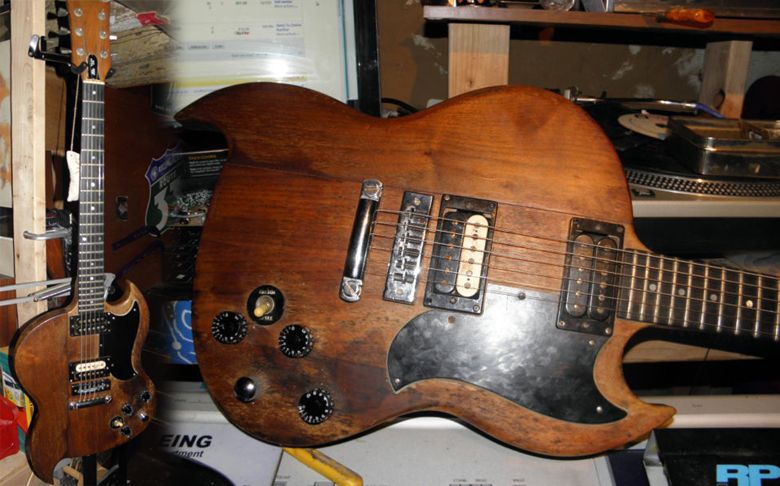
Here's a Gibson "The SG" from 1979 which at some point suffered some body damage so that the bass side of the body split away. The owner has stuck it back together again but reversed the top section for a certainly quite distinctly different look. You almost wonder why Gibson didn't think of it themselves, considering some of their recent design tweaks.
Gibson's "The SG" was a partner to "The Paul"; both were walnut-bodied budget-conscious versions of Gibson's two best-loved solidbody designs and were produced between 1978-1982.
Thanks to Colin Brown who suggested we look at this guitar via our Facebook page.
Recently here on Guitarz we've been discussing and looking at Gibson guitars with Fender influences (see here and here).
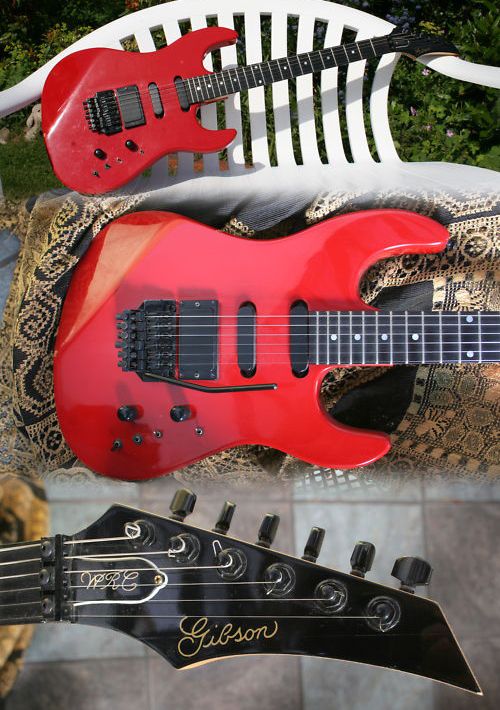
Pictured here we see a Gibson WRC, and there's absolutely no denying its Strattiness. Despite carrying the Gibson name, these were actually built by Wayne Charvel (his initials are W.R.C.) in 1987-1988. It's ironic in a way when you consider that Charvel is now part of the Fender empire. It's like some things come full circle.
In tried and tested Superstrat tradtion, the WRC is equipped with a Floyd Rose double locking trem. It has three pickups in SSH formation with a coil tap for the humbucker and individual toggles for each pickup allowing for a wider range of pickup combinations than the usual 5-position switch. In keeping with Fender-derived guitars it has a bolt-on neck, which is of the pointy headed variety as was the fashion when this guitar was made.
This guitar is currently being auctioned on eBay UK with a starting price of £795.
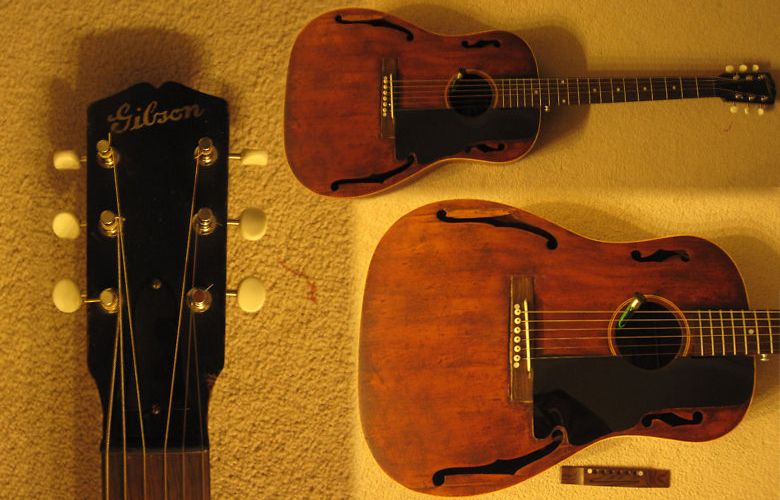
Here's an oddity that I've not seen before. It's a Gibson HG-20 from 1929, a 3/4 scale acoustic guitar with five soundholes. Apparently each of the four f-holes has its own chamber constructed within the guitar's body, giving the guitar its own unique voice. This guitar is currently being offered for sale on eBay with a Buy It Now price of $1,900.
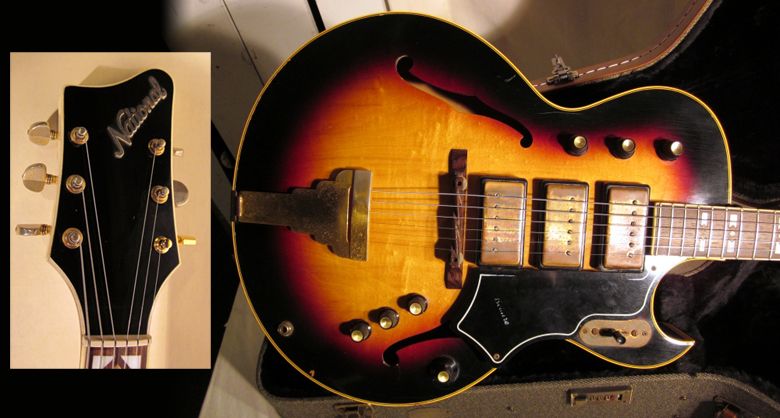
Here's a National Bel Aire from 1959 which may look strangely familiar to Gibson enthusiasts. Never mind the smokescreen provided by the triple pickups and myriad of controls, the body itself is identical to that of the Gibson ES-175 of the same era and indeed was made by Gibson for National.
This guitar is indeed a beauty, and is currently being offered for sale on eBay with a Buy It Now price of $2,995.95. The seller has provided some very nice photos on the auction page, but I only wish there was one of the whole length of the instrument in one shot.
 RSS
RSS