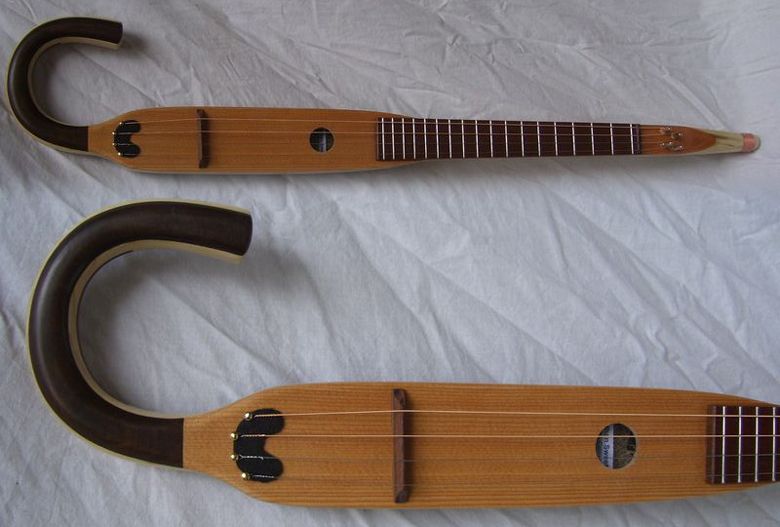
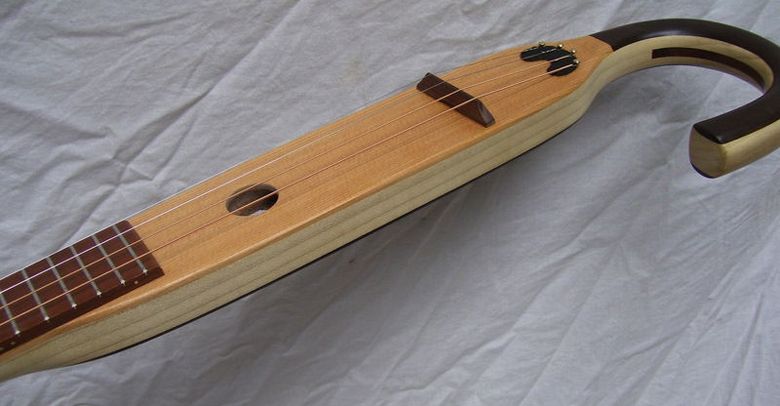
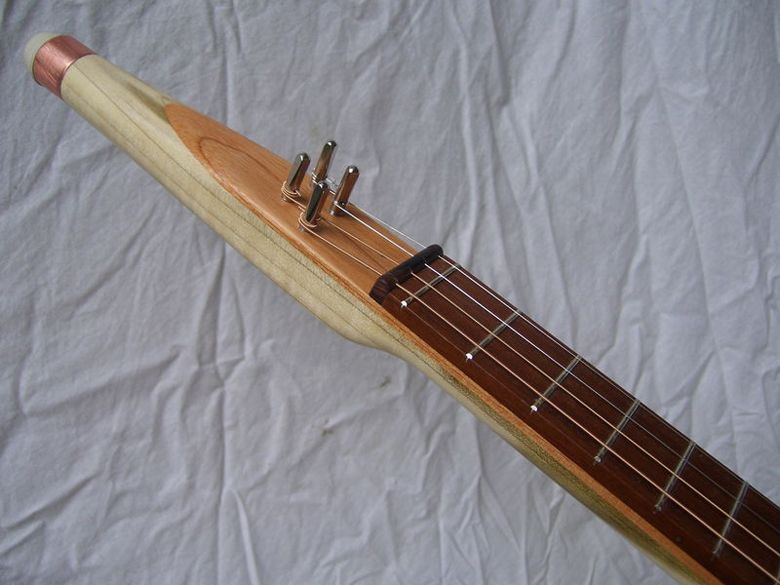
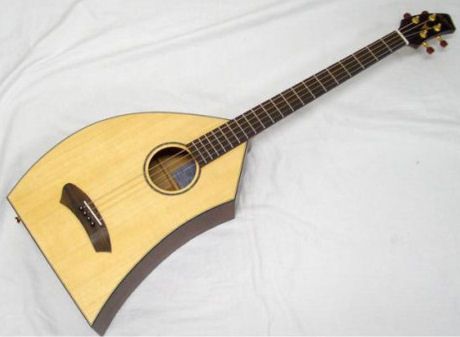
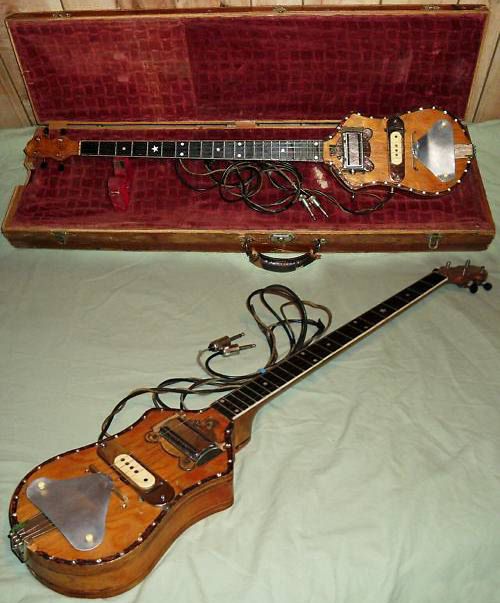
A truly unique instrument, functions as a cane and a Tenor Guitar or 4 string Mandola at the same time. Tuned C-G-D-A, 19 inch scale, so it is a little long for a mandola, and on the short end of a tenor guitar scale, but in the cane design it is very ergonomic. The cane crook acts like a armrest, and it is very comfortable to play. Very light yet strong enough for support, the sound is not as full as a full-bodied instrument yet very sweet and clear. This is a fully acoustic Tenor Guitar, not a solid stick. It has a Spruce soundboard, Mahogany headstock lamination, Rosewood back and crook laminations. The body is hollow. The crook-cane handle is cross laminated for directional grain strength.
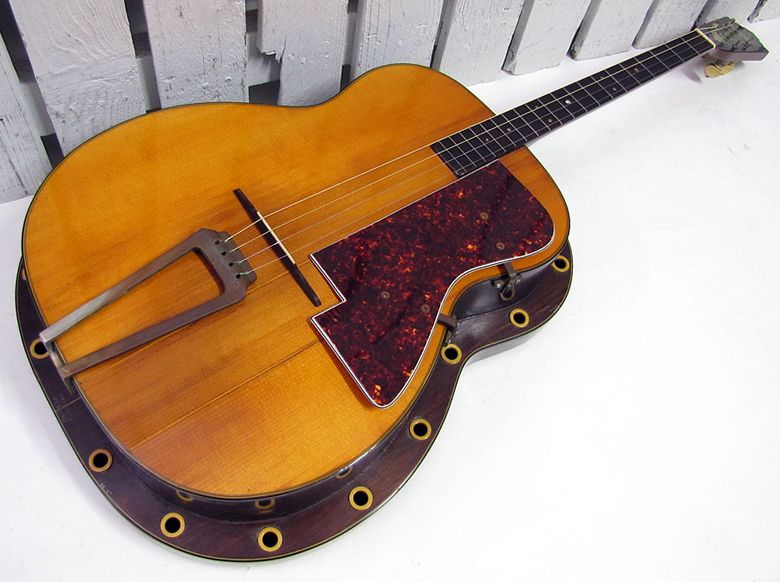
Here's one of those odd little footnotes from the history of the guitar. This 1930s Paramount L-Style Tenor guitar, made by Martin, has borrowed several design elements from the banjo. Beside the obvious banjo-derived headstock with banjo tuners, the main body is set into larger rim and back with a series of 20 small soundholes arranged around the lip. The back and rim make for an exceptionally large body for a short-scaled instrument. Apparently only 35 of these were made so it's quite a rare piece, and this is reflected in the $3,500 Buy It Now price on eBay.
Here's another instrument that looks to be a handmade one-off, although a lot more craftsmanship has gone into creating this than on the boat oar guitar we saw in the previous blog post here on Guitarz.
I'm not sure what instrument the maker thought they were building here, but for our purposes I think it's safe to call it a cross between a tenor guitar, a tenor banjo and a baritone ukulele. The headstock style is very banjo-like, as is the general shape, but the all-wooden construction and soundhole are more guitar- and/or ukulele-like. The scale length is 21 1/2" which is more akin to a tenor guitar or banjo than it is to a baritone uke, but I guess it's up to the player to decide how to tune it and play it. I do like the hexangonal shape at the back of the body. If you've ever tried playing a banjo you'll know that a round body is not the best shape for playing when seated; I'm sure a hexagon-shaped instrument isn't going to slip as easily.
It does need some minor repair work doing to it, but with a starting price of $0.99 on eBay it could provide a nice little project for someone which is unlikely to break the bank.
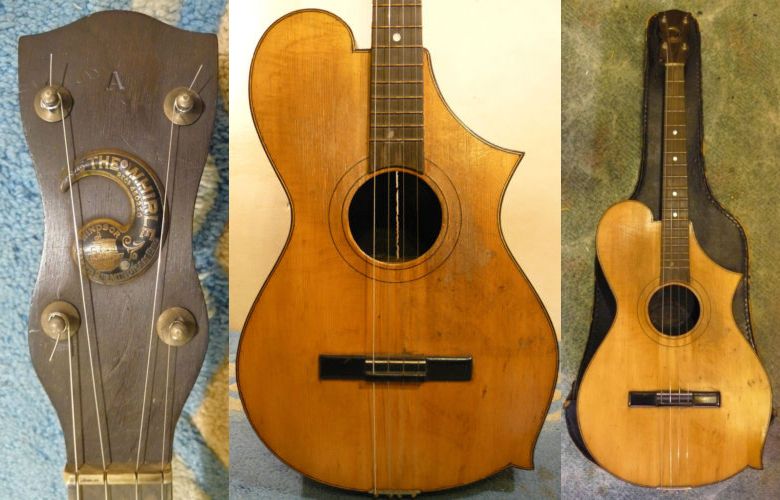
This Windsor Whirle was made in Birmingham, UK, according to the eBay seller in the 1920s. Myself, I'm not so sure about that, and would widen the timeframe to anytime in the 20th Century up until the 1940s. But perhaps the seller knows something that I do not.
The guitar (or whatever it is) is not in the best of condition having developed a split in the back right down the centre. However, I feel it is worth showing here because it's such an unusual-looking instrument.
Although the seller refers to it as a "tenor guitar", I wonder if it was actually intended as a baritone ukulele. Note the gut or nylon strings rather than a tenor's usual steel strings (you can see also that the bridge was never intended for steel strings) plus the relative compactness of the whole design. The scale length is said to be 52cm - that's nearly 20 1/2" - which is nearer to baritone ukulele scale than tenor guitar (usually about 23").
A Google search for "Windsor Whirle" will tell you that they produced a range of banjos in that name. Note also the banjo-like headstock on the instrument pictured here.
(For some reason I get a sense of deja vu about this whole blog post. I could swear I've posted something similar before but cannot find it in the archives).
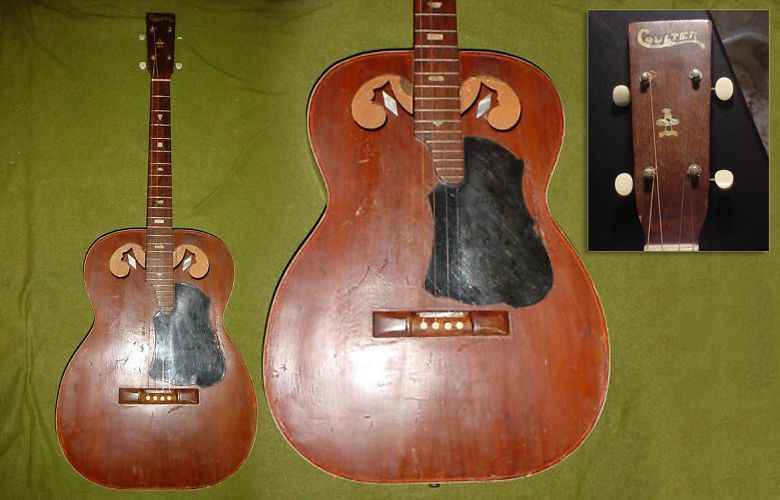
This Coulter tenor guitar, which the ebay seller tells us is from the 1930s and "plays great", is currently being auctioned with a starting bid of $699.99. Coulter is a name I haven't previously been aware of. The name on the headstock does look as if it has been painted on freehand; maybe it's been "re-touched" by someone at some stage in the guitar's life. The seller tells us that:
This guitar was built in Portland, OR, in the early part of the 1900s. F.E. Coulter was active from 1910 into the 1930s. Coulter built guitars, banjos, violins and mandolins, all of which featured his unique design sense.There are mother of pearl inlays on the neck, body and heel of the neck as as seen in the pictures. This guitar is very lightweight and loud. Not sure what woods were used, but I believe the top is redwood. There have been extensive repairs done by a local (Portland) luthier. All cracks and gaps have been sealed and braced and all the interior bracing has been repaired. The neck shows a bit of bowing, as should be expected, but is well attached to the body and not pulled in. More cosmetic restoration could be done, but I leave that up to the digression of the buyer. For more on F. E. Coulter check this link for a WPA Writers Project interview with the builder: http://freepages.genealogy.rootsweb.ancestry.com/~janeha/fcoulter-folklore.html
I have to say that those weird kidney-shaped soundholes are about the ugliest I have ever seen.
...speaking of Teisco guitars, this custom tenor guitar not only has parts from an el cheapo 1970s-era Japanese Teisco (often branded as Kay in the UK) but the body shape seems to be based on the same, although with an extended "bottom".
Despite the interestingly-shaped headstock implying that the wooden parts were all custom made, it looks as if it was originally intended as a 6-string guitar because the neck has obviously been whittled down to the width of a 4-string - witness the change in width where the neck sits in the neck pocket of the body.
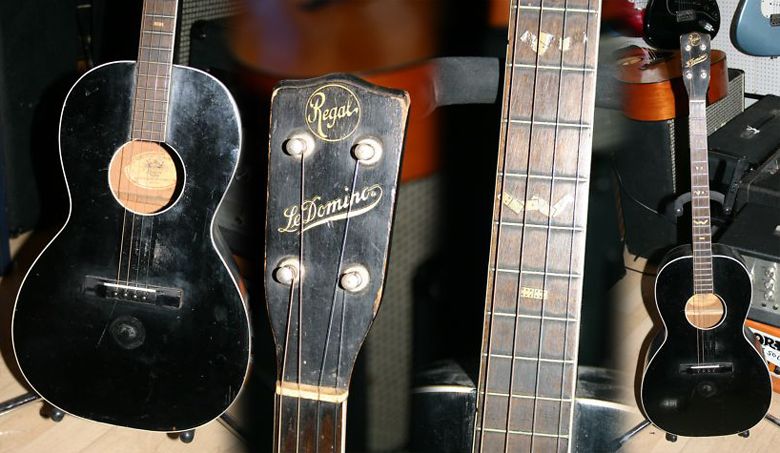
This 1930s Regal Domino tenor guitar is beautifully proportioned having a parlour-sized body, unlike many other tenor guitars where a skinny 4-string neck is attached to an body designed for six strings. Notice the domino inlays for fingerboard position markers, which sadly are all but worn away in places.
The Regal Musical Instrument Company, established in 1908 in Chicago, are perhaps best known today for their production of resonator guitars from their first development up until 1941. They produced components and bodies for both National and Dobro guitars and by the 1930s were one of the largest manufacturers of musical instruments in the world.
K. Yairi, a company overseen by Mr. Kazuo Yairi in Kani, a small community in the mountainside area of Honshu, Japan, are renowned for their high quality acoustic guitars. However, their guitars usually are more conservative in appearance than this one. This particular instrument's scale length of 24.8" puts it into regular guitar scale territory, rather than the usual 23" scale of a tenor guitar. It's an odd one, for sure. Alas, the eBay listing tells us very little about it.
G L Wilson
Guitarz - The Original Guitar Blog - now in its 10th year!
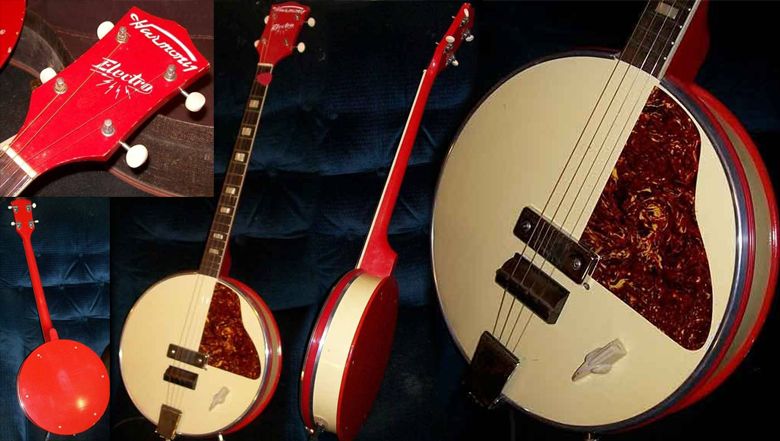
Here's another electric banjo, this time it's a Harmony 4-string tenor and, unlike the previous ones we have looked at, it doesn't have a skin top to it - so that purists may argue that it's actually a tenor guitar. It has an electric guitar style magnetic pickup mounted onto a spruce top. The seller has copied out the marketing blurb from the 1955 Harmony catalogue that this appeared in, and which I in turn shall reproduce here:
A completely NEW instrument!
Harmony Electro Banjo (Pat. Apppl'd For).
A new instrument in which banjo tone is created electrically - an achievement of Harmony research and ingenuity.
Tuned and played as the traditional banjo. Though the magic of an ingenious bridge and electronic pickup assembly, mounted on a resonant spruce sounding board, it produces the familiar crisp banjo tone so popular today - through an amplifier.
Finished in Jubilee Red and white. Harmo-metal band with fluted red plastic insert at top edge. Pearlette inlaid fingerboard, with edge binding.
Individual tuning keys.
G L Wilson
Guitarz - The Original Guitar Blog - now in its 9th year!
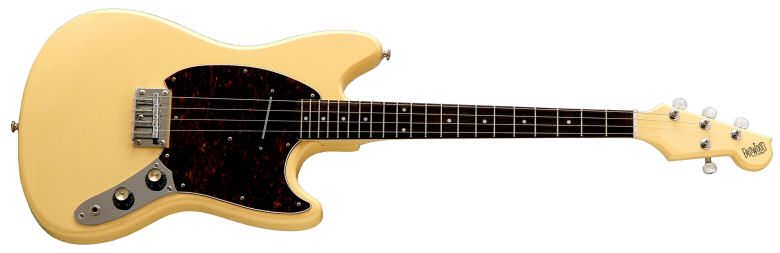
I was watching Later with Jools Holland the other night, and was intrigued by the session from Grinderman whose Warren Ellis was making an incredible sound with what appeared to be Fender Musicmaster or Mustang but with just four strings (see YouTube clip below - OK, so he's obviously using a lot of loops there too).
So, a quick search shows that it's actually the new Warren Ellis signature model tenor guitar from Eastwood Guitars. The alder body is offset like a Mustang rather than an even-waisted Musicmaster, although like the latter it has just a single pickup in the neck position, in this instance it's a blade style pickup. As is common with tenor guitars it has a shorter than usual scale-length of 23", for which the Fender student-model stylings seem all too appropriate.
G L Wilson
Guitarz - The Original Guitar Blog - now in its 9th year!
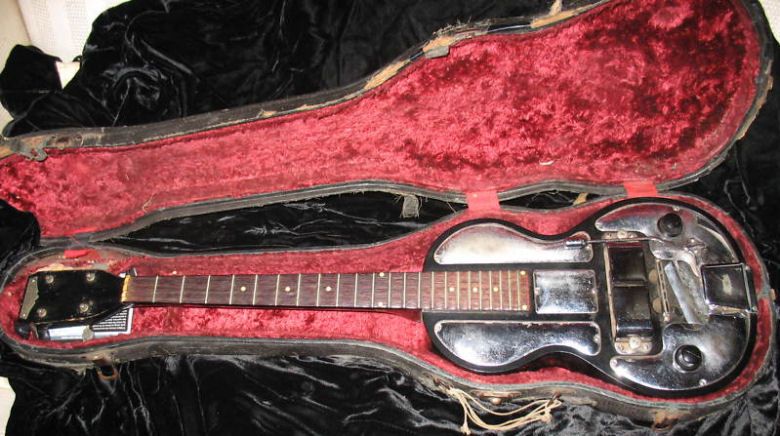
guitarz.blogspot.com: The Rickenbacker Model B lapsteel from the 1930s is one of the guitars I listed in the "500 Guitars" book; alas there was no accompanying photo published. The guitar was typified by its bakelite body inset with five chrome plates. In 1935 a "Spanish" version was introduced with a regular round-backed detachable neck.
Tenor guitars are in the air... Just found another one, a coolissima Framus Peter Kraus Thinline (actually it's nowhere called a tenor guitar, it has 4 strings and a small body but the scale is not mentioned)...
Peter Kraus was (apparently) the first German rockstar from back in the 50s, and this is one of his early signature models, you can learn more about him (like I just did) here and here.
NB: Please make sure you are reading this Guitarz post at guitarz.blogspot.com and not on a Scraper blog that copies posts without permission (and steals bandwidth) so as to profit from advertising. Please support original bloggers!
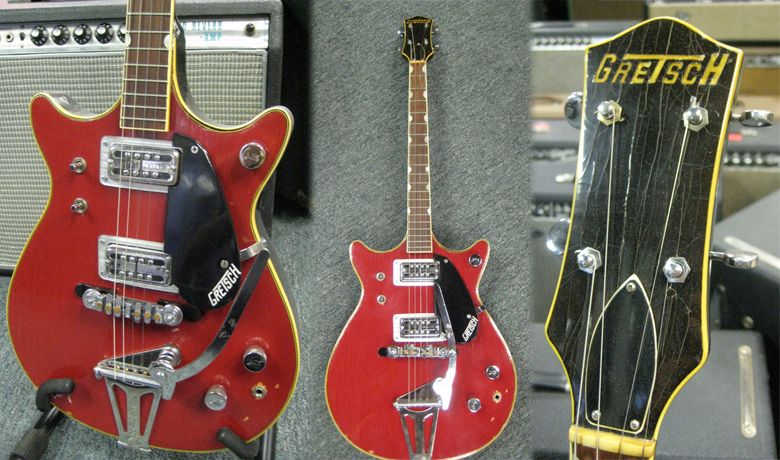
guitarz.blogspot.com: There was a time when big name manufacturers such as Martin, Gibson, Epihone and Gretsch would produce tenor versions of their popular six-string guitars. Pictured above is a Gretsch George Gobel Model tenor guitar from 1963. By the 1970s most manufacturers had more or less abandoned production of niche instruments such as this.
I have to confess that I didn't know who George Gobel was, so I had to look him up. It seems bizarre to think that a large manufacturer such a Gretsch had a signature model for a comedian and TV presenter! These days that would be so uncool. Gibson also had a George Grobel model, the L-5CT archtop.
Thanks again to Doug Barker for drawing my attention to this eBay find.
G L Wilson
NB: Please make sure you are reading this Guitarz post at guitarz.blogspot.com and not on a Scraper blog that copies posts without permission (and steals bandwidth) so as to profit from advertising. Please support original bloggers!
It has a 27" scale, and so is much longer than a tenor guitar which tend to have a scale length between 21 and 23".
I wonder if the neck has come from a 5-string banjo because of its length and because of the headstock shape (although it looks like a piece has broken off). However, it doesn't have the fifth string or the "step" in the neck at the fifth fret where the extra machine head would be located. It's possible that the neck has been reworked to give it an even taper along its length. The guitar is fitted with two pickups each of which has its own output lead. These would be the kind of magnetic pickups designed to be used on a flat-top acoustic. The rear pickup is quite a sought-after DeArmond unit (in fact, the same unit that John Martyn used to have on his Martin acoustic. I never did understand, by the way, the reason that there is a polepiece missing in the B-string position. Does anyone know?).
As this is a one-off instrument (apparently having belonged to the seller's grandfather), it's very likely that it was tuned to the player's own requirements and it doesn't necessarily have to adhere to the conventions of guitar, tenor guitar or banjo. Those are just labels that are convenient to help our own understanding.
G L Wilson
NB: Please make sure you are reading this Guitarz post at guitarz.blogspot.com and not on a Scraper blog that copies posts without permission (and steals bandwidth) so as to profit from advertising. Please support original bloggers!
Here at the Guitar Blog we love tenor guitars, because they only have 4 strings so they are easy to play, but you don't look silly like with a ukulele (OK uke fans, you can start the bashing!)
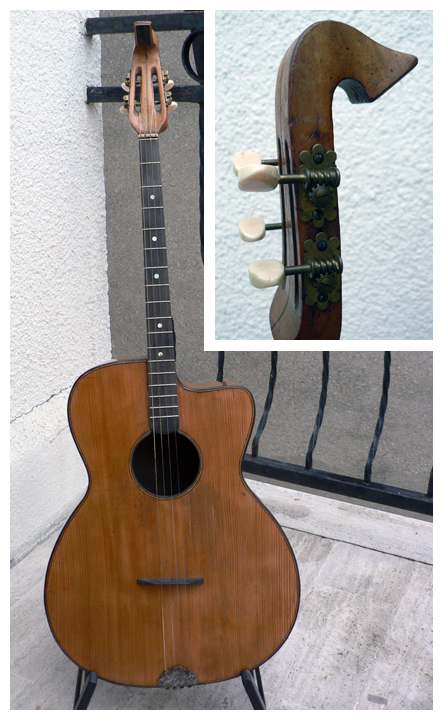
Look at this beautiful Jacobacci tenor guitar and its very special headstock. I don't have any details about it, but it looks pretty old, so it's probably Jacobacci's pre-electric era, also it's not a catalogue model but probably a one-off. These are only computations, anybody's information is welcome.
I found it on djazic.com, a French e-shop with some nice vintage stuff that's worth looking at. And if you want to know more about famous French luthier Jacobacci, you can check here.
NB: Please make sure you are reading this Guitarz post at guitarz.blogspot.com and not on a Scraper blog that copies posts without permission (and steals bandwidth) so as to profit from advertising. Please support original bloggers!
Hello GL, from snowy and cold Washington DC, where we're about to break our all-time record for snowfall amounts by Wednesday morning.
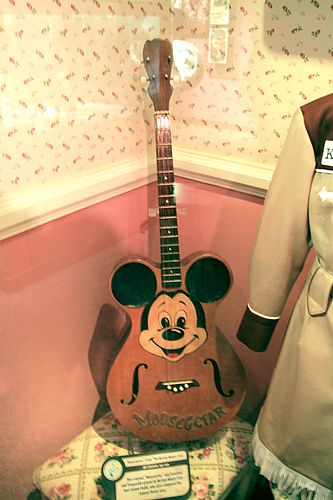
A guitar that's quite a curiosity is this nearly 60-year-old relic from American television's "Mickey Mouse Club" -- the original tenor "Mousegetar", played by host Jimmie Dodd. This particular instrument is in the Disney Museum in California, and the photo is credited to Megan Duffy, posting on Flickr.
The curiosity is that no one seems to know who built this guitar; whether it was a private luthier, the props department from the Disney organization, or a commercial maker preferring to remain anonymous. This is a perfectly playable instrument and can be seen in web videos from the old Mickey Mouse Club.
Disney manufactured plastic toy copies of this tenor guitar, but this one remains the "cool one". If your followers can contribute any info on this guitar, have at it.
Regards, Alan Peterson Broadcast Engineer & Proud Gretsch Owner Washington DC
Thanks for that, Alan. When I first saw the photo, I thought that the mouse ears were the soundholes (similar to the "modern" idea of positioning a large soundhole to the left and/or right of the neck on acoustic guitars) but on viewing the YouTube video below I see this is not the case.
G L Wilson
UPDATE (15 December 2011) - Carl writes:
Since Disneyland was in Southern California a nearby luthier was sought out to build a guitar for the Mickey Mouse Club show. They had to look no further than Brooklyn Street (since renamed Caesar Chavez Avenue) in Los Angeles.
Two brothers, Porfirio and Candalario Delgado sold guitars they had hand made in Juarez and Tijuana Mexico and they were very successful. They moved their business to Los Angles in 1948 and opened a store called Los Hermanos Candalas where they manufactured and sold their handmade custom guitars. They developed an excellent reputation. Disney Productions asked Candalario, known as Candalas, to build the Mickey Mouse Guitar to their specifications. In fact the store is still there and still selling wonderful hand made guitars and Latin string instruments.
NB: Please make sure you are reading this Guitarz post at guitarz.blogspot.com and not on a Scraper blog that copies posts without permission (and steals bandwidth) so as to profit from advertising. Please support original bloggers!
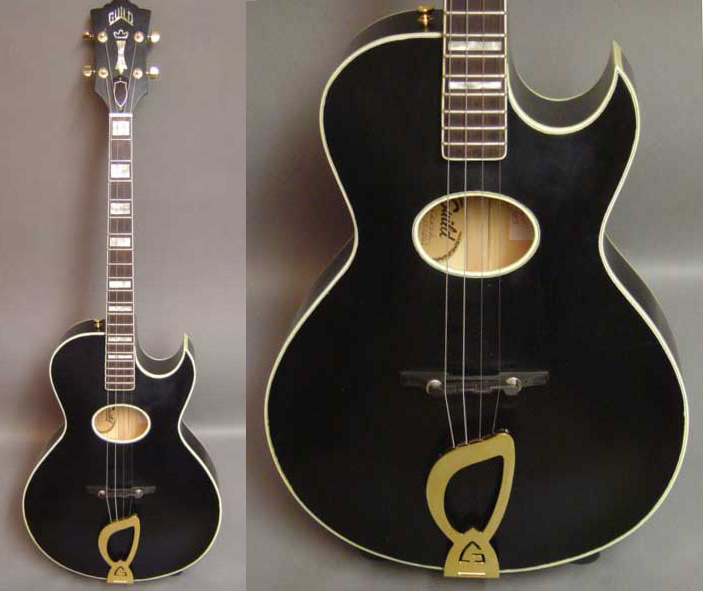
For the 'less-strings' lovers, this is a tenor guitar - here a 1974 Guild archtop one. It's a beauty, well balanced with its florentine cutaway, big headstock and elegant black finish - but not just a small guitar, it has its proper proportions.
It's not been very long since I've been aware that tenor guitars exist. I guess it's because it is a quite specifically American instrument - though I found a Portuguese company making some - for specific music. The neo-folk current hype on continental Europe brings this kind of instruments back in the light.
I can see why guitar players want to play other similar instruments - myself I'm a hidden mountain dulcimer player for almost 30 years!
NB: There are a lot of blogs STEALING content and bandwidth. If you read this anywhere else but on guitarz.blogspot.com then you are reading a blog that STEALS content. Please support original bloggers!
As older readers will know I am quite interested in guitars with reduced numbers of strings, and am a fan of the baritone ukulele which is tuned the same as the first four strings on the guitar.
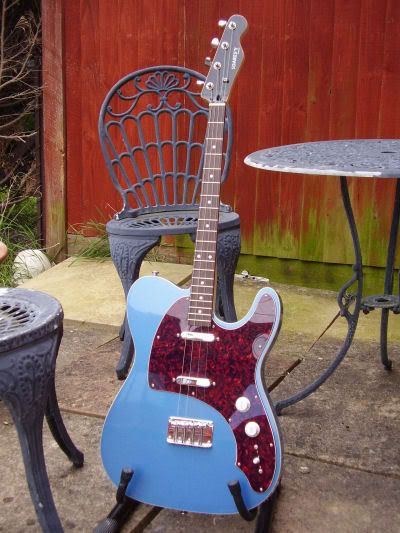
I was intrigued to try out a similar electric instrument, and I got a good deal on this Soares'y tenor guitar. However, I found the sound to be too bright for the usual DGBE tuning, so have been experimenting with open tunings on it and also trying to teach myself a little slide.
 RSS
RSS