Those Guitarz readers who were savvy enough to buy a copy of our limited edition Guitarz 2012 Calendar may already have flipped through the pages to October 2012 and seen a particularly stunning photo of a Gus fretless bass. However, I don't think that we have ever looked at Gus guitars on the blog itself before.
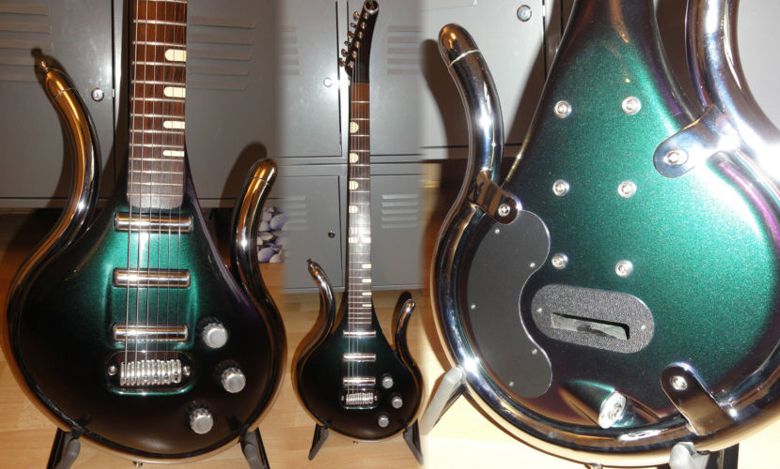
This particular example is a Gus G1 Baritone guitar with the serial number G1/B 001. Built by Simon Farmer in the UK, each Gus guitar or bass is essentially a custom order, although some instruments will have more specific custom features than others. The construction is of cedar with a skin of carbon fibre. All hardware is fabricated in-house a the Gus workshop so these guitars are not going to carry all the same generic hardware that we see everywhere else. The body is basically a teardrop shape and - most notably - is mounted inside a chrome-plated aluminium tube (actually welded in 5 sections). This tube helps give the instrument a more recognisable guitar-like shape and provides the familiar body horns.
The G1 Baritone has a 30" scale length and is designed to be tuned down to B (a fourth below 'normal' guitar pitch). This example has been finished in "Plum Crazy" purple to green flip flop paint from House of Colors.
For years now I have been an avid follower of the Crimson Guitars Workshop Diaries, religiously updated by luthier Ben Crowe of UK-based Crimson Guitars. Considering the incredible detailed hard work he puts in to each and every guitar, I am amazed he seems to be able to document everything he does. Previously on Guitarz, back in 2010, we looked at a Crimson 8-string fanned-fret guitar. I also included two of his guitars in the 500 Guitars book - alas the publisher only used a photo for one of them.
For anyone with even a passing interest in how a guitar is built, I cannot recommend the workshop diaries highly enough: they provide a fascinating - and never boring - blow-by-blow account of each and every aspect. They also show Ben Crowe to be a fastidious luthier; he really is a perfectionist and will insist on getting every last tiny detail absolutely right. As well as building complete guitars by hand from all manner of beautiful timbers - and occasionally he's carved guitars from acrylic too - Ben will also often create the hardware - bridges, tremolos, tuners, control knobs - by hand in the Crimson Guitars workshop rather than using generic off-the-shelf components. Ben is also a keen advocate of ergonomic guitars. Even his classic-looking Robert Fripp model single cutaway guitars (yes, Robert Fripp is an endorsee) have beautifully carved rear-sides, all in the name of comfort! You don't get that on a Les Paul!
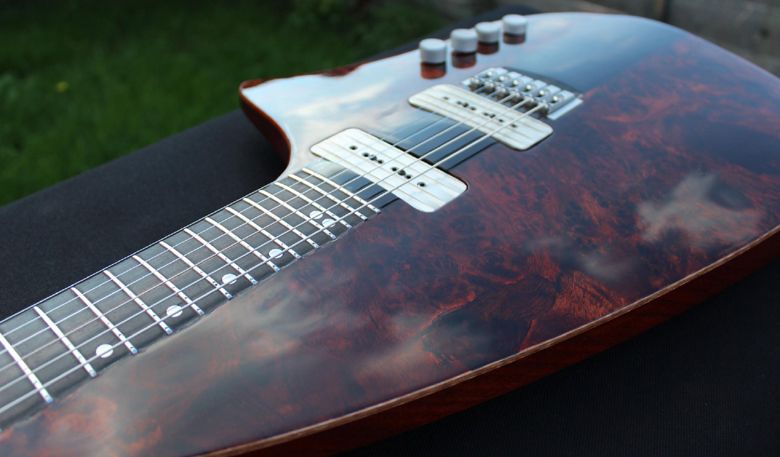
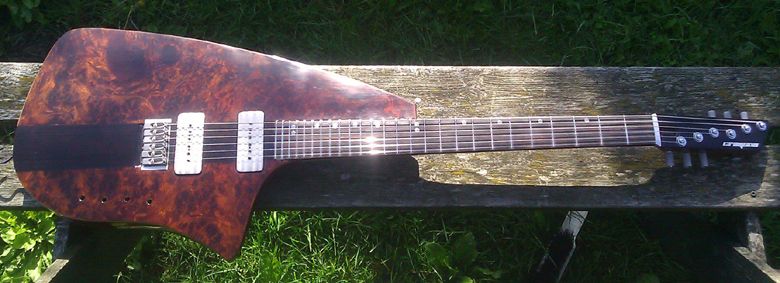
The guitar pictured here, the Delta 1, is - as you may surmise from the shape - an ergonomic design. It was the brainchild of the customer, James Mitchell, who worked with Ben Crowe in the Crimson Guitars workshop upon his own design in the early stages of the guitar build, leaving Ben to complete and finish the instrument when he had to return home.
I asked James if he could tell me what his original brief for the Delta 1 was, and the general concept behind it. James kindly replied, in detail, as follows:
I have always had a 70s Strat which I love and I had never really owned or played anything else. A work colleague, Kevin Deane, makes guitars just for himself for the look and the pleasure. So it got me thinking, why have another Strat or Les Paul? I had recently come into a few guitars which all had features I really liked but none had everything. So, as an architect, I couldn't resist but doodle. There is a tendency for custom guitars to be over-wrought or gilded lilies in my view. I wanted something purposeful, sleek and unique to me.
I overlaid pictures of guitars I enjoyed playing and made hand sketches combining the elements, from each marque, that felt best to me. I then started to read a bit about construction and tone. Around this time, I went to London for Chapman Stick lessons. Out of that, came a conversation with Paul Davies of Tollbooth Studios, who said there was this guy who would build anything. I had approached other builders and they kept re-interpreting the design back towards a known design and would put it together from stock parts. Now, even I can bolt bits together, so I was underwhelmed. The other path of a bespoke instrument prototype was looking very very costly.
The key features of my design where to keep it simple and incorporate:
A longer scale length for tone and I am 6'6'' so something at my scale. Les Pauls are mandolins to me and my chubby fingers have trouble above fret 15.
Through neck construction for tone transfer.
Tight radius fretboard at nut and 700mm radius at the intonation point, reflecting my strat but slightly flattened like a Parker.
A "D" neck profile.
Quite a bit of body beyond the bridge for my arm, balance and as a tone reservoir.
Flush neck and body with same radii.
Parkeresque slimness.
Full 24 fret access like a Stick.
A tone transfer bar reaching up to twelth fret, like a Skjold bass.
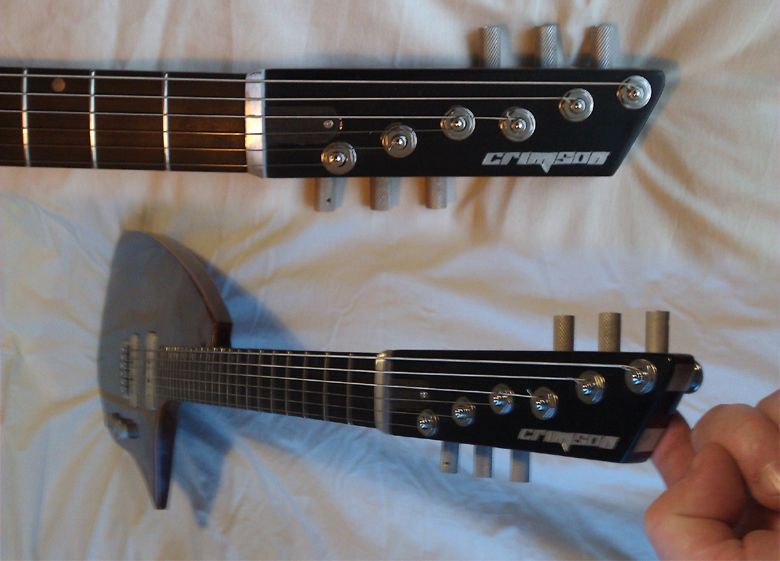
A headstock without fripperies, like a Seagull guitar but less shapely. I considered headless but it seemed counter intuitive to me.
I liked the tuners on a Japanese shamisen and thought something like that could be achieved. Ben turned bespoke parts for the Sperzels.
These disparate thoughts were worked through in sketches and 5 or 6 full size blanks from polystyrene and filler. I then made the final sketch, measured drawings and a 3D-rendered computer model and sent these to Ben as a brief.
We kicked the details around for three months exploring ideas for a full contact tremolo, woods, frets, pickups etc. In the end it worked out I could go meet Ben and stay for two weeks to develop the build with him. I don't think it could have been done remotely really because the dialogue between us was very dynamic and fruitful. I had a good grasp of what I wanted but Ben brought the reality and craftsmanship to examine, interpret and realise my thoughts, to create the final guitar. Working on the guitar with Ben also allowed me to see other possibilities. This was so successful I have asked Ben to make a semi-acoustic version. This time he knows where it's headed and I await something based on Delta 1 yet distinctly different.
Some have pointed out it is Teufell Tesla-esque, which I take as a compliment, considering it's my first design. It owes more to the Chapman Stick, Breadwinner and Parker/Strat. The controls have evolved since I have had the guitar to play. Andy at Wizard Pickups made 2 bespoke match P90s to work with Ben's stunning bespoke pickup covers and not produce hum. I have fitted 2 volume pots, 1 tone pot and a blender. The guitar produces a lot of rich tones and the blender allows me to exploit the all the gradients of tone between bridge and neck.
I would say that this is where Ben's unique selling point lies. With so much CNC'd or assembled from parts suppliers it's a precious thing to find someone who will start from scratch. Ben buys and selects timbers just for the instrument qualities you specify. The construction then is further informed by his knowledge and your aspirations. Start off with an idea, informed as best it can be from a player's perspective, then brought to reality through real craftsmanship. Exciting and the result is an instrument that is everything I wanted it to be and having other characteristics that couldn't be known. So now I have something to play and explore with.
I have been asking proper guitarists to try it out, mainly at my local music store, KnB Music Maynooth. So far, very positive results. Some are freaked by the shape or the flush neck and body. But once they have 5 minutes playing that all fades away and the balance, playability, comfort and the tone come through.
For even more details, check out these YouTube videos produced by Crimson Guitars:
I would like to thank both Ben Crowe of Crimson Guitars and James Mitchell for their cooperation and help in producing this blog post.
For more information, see Crimson Guitars - bookmark it and visit often!
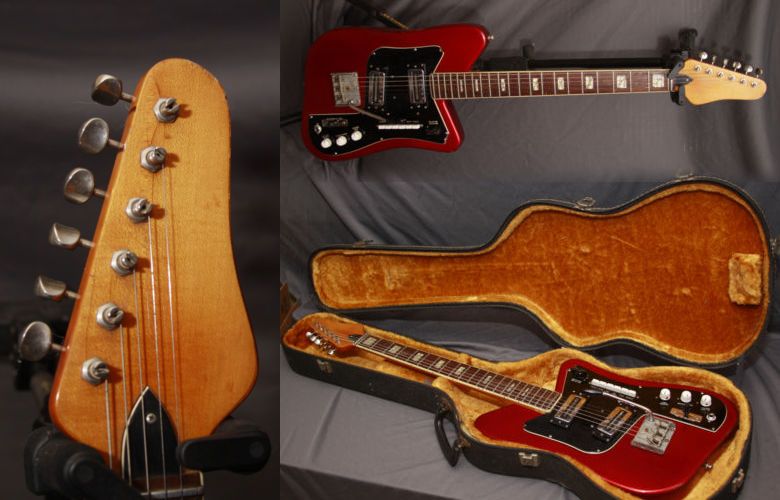
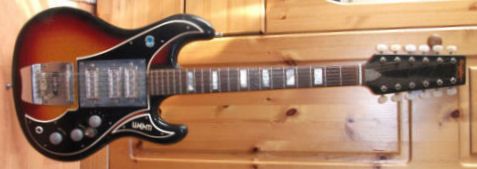
This guitar, currently listed on eBay with a Buy It Now price of $299, presents us with something of a conundrum. The seller lists it as follows:
Vintage Rare Hofner Electric Guitar
I bought this guitar around 2002. I suspected it was a Hofner though it did not have anything on the headstock to indicate that. At the Dallas guitar show that year there was a Hofner guy that confirmed for me that indeed it was a Hofner and offered a substantial amount of money for it. I declined because my intentions had been to get the guitar working for my own use but it's been sitting around, I've had some financial problems, and now I want to sell it.
I think that the "Hofner guy" at the Dallas guitar show doesn't know what he's talking about. I'd swear that it was a Vox Marauder. Unless Hofner had a near identical model, or Vox/Hofner had guitars built at the same factory and branded them afterwards (which is something I'm not aware of, but I'm not ruling it out).
Can anyone confirm or deny my suspicions?
G L Wilson
EDIT: The listing has ended already. I guess someone used the Buy It Now option. I did, by the way, email the seller saying I believed it to be a Vox Marauder.
I'm enjoying your site now that I have some time off. You will remember the pearlescent pinkEgypt Karnak Osiris 1 which was on eBay a year or so ago masquerading as a Luxor. Well I have hopefully sent you a picture of an Egypt Luxor by way of comparison (I'm a terrible techoluddite unfortunately!). This is an Egypt Luxor in Aurora Nile Blue, it's mostly maple with a hornbeam/wenge core. It has a nice ebony fingerboard and lovely graduated pearl pyramid markers. But the thing to notice especially are the special Egypt "Cleartone" pickups custom made for Jimmy by the great Kent Armstrong.
Kind Regards
Alex
Thanks Alex, it is indeed a very cool guitar. The 1980s don't seem to have been so very long ago to me, but isn't it weird how many have already so quickly forgotten some of the guitar brands of that decade?
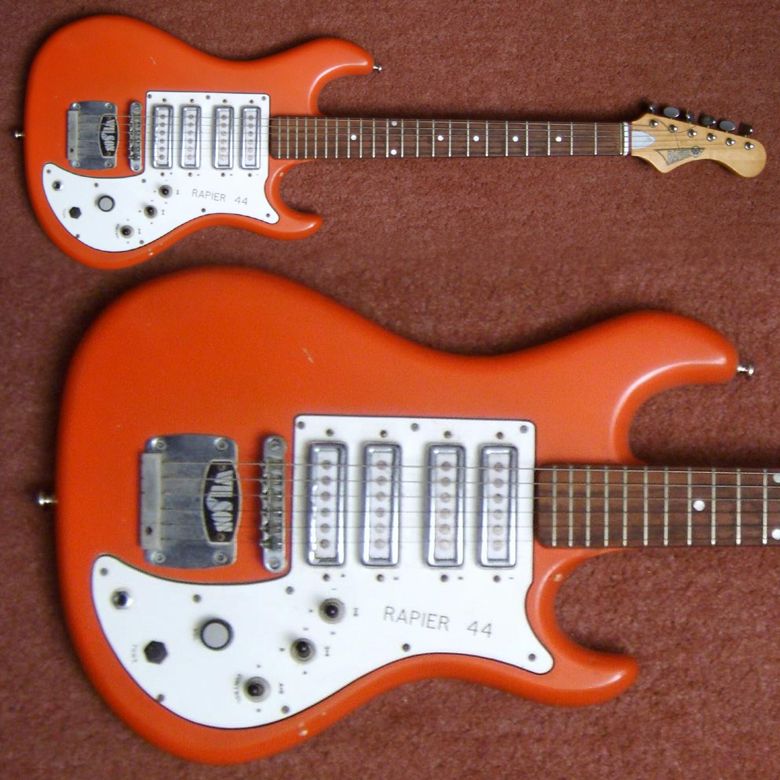
Thought you might like this one - an old 4-pickup Wilson Rapier 44 which I was given around 28 years ago. The Watkins company made guitars and amps, and in 1968 they decided to badge their guitars as Wilson, so this is obviously a post-'68 model. The vibrato block is damaged as the arm has been drilled out at some point, there's some damage to the finish, the chrome on the pickups has bubbled a little and there's a control knob missing, but overall it's in decent nick - it's playable, and the electrics work fine. Not bad for a 40-year-old freebie anyway.
Thanks for that, Dave. The Wilson name was chosen, apparently because it was Reg and Charlie Watkins' mother's maiden name.
OK, it's the 11th November 2011, that is 11/11/11, and as such today has been designated Nigel Tufnel Day. To celebrate this day of Maximum Elevenness, we here at Guitarz - for this day only - will be posting an unprecedented ELEVEN blog posts! So, keep tuned throughout the day for eleven weird and wonderful guitars!
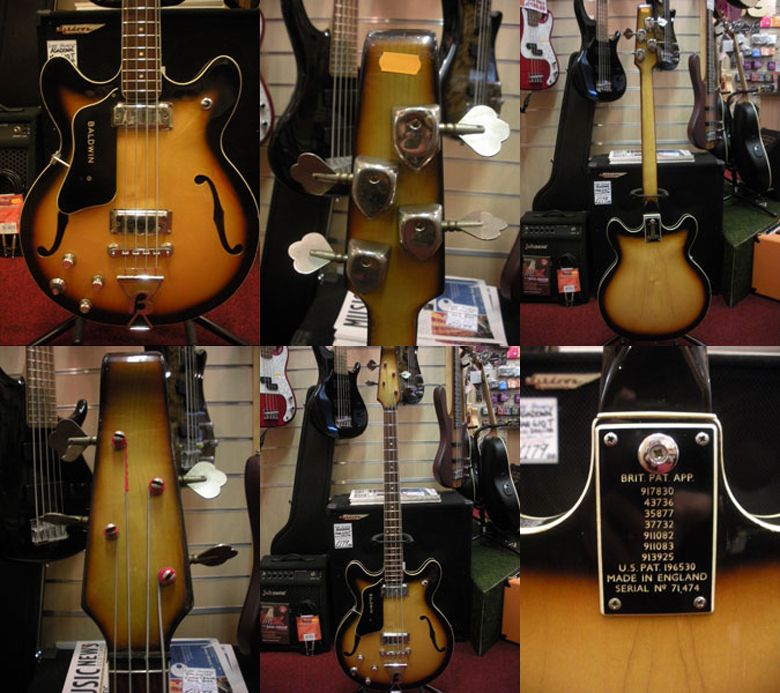
Here's one for our left-handed friends, a vintage Baldwin semi-hollowbody bass, although I'm not sure of the exact model number or name (it gets tricky with all the various Burns-related companies!) so if some reader could enlighten me, I would be very grateful.
The Baldwin Piano and Organ Company of Cincinnati bought out Burns London Ltd in 1965 and guitars and basses that had previously been badged "Burns" were re-branded "Baldwin". Most Burns aficionados agree that this was where the rot set in, with standards beginning to slip in quality of construction. The carved scroll headstock on this bass would indicate that it was one of the later Baldwin guitars, this type of neck being adopted across the range in the last few years of production, circa 1967-1969. Baldwin finally gave up on the Burns guitar line in 1970.
Currently listed on eBay UK with a Buy It Now price of £1,399.
Balazs Prohaszka is a luthier from Hungary who has been building musical instruments since 1994. He has much experience of repairing and building guitars, violins, lutes and double basses so he surely knows his way around the anatomy of acoustic instruments. Prohaszka's fine guitars are made from exotic and choice tonal woods, and he believes that they are amongst the finest in the world. Employed as a senior craftsman with N. Ireland's Avalon Guitars (formerly Lowden Guitars), he builds approximately six or seven "personal" guitars in his own name each year during his spare time.
This Prohaszka silver-sparkle fronted flat-top acoustic guitar is currently being offered for sale via Vintage & Rare and is priced at £2600.00 (approx. €3101.00). The guitar has an original design that should find favour with electric players whilst still retaining the full acoustic body depth. I particularly like the "split" f-hole and the cut-out 6-in-a-line headstock which is quite elegant.
It's an instrument that you can imagine being played in the hands of the singer of a glitzy rock band. However, it might be considered sacrilege to subject a fine luthier-built instrument like this to the rock 'n' roll lifestyle where perhaps some cheaper generic electro-acoustic guitars would be better suited to the role. (Having said that, it doesn't look as if the Prohaszka Sparkle is actually fitted with any electronics, despite the design. I believe it is purely an acoustic guitar.)
This Staccato MG bass from 1986 is one of approx 200 guitars/basses built in the UK by Pat Townshend. I recall these guitars well from when they were first introduced, and remember seeing them at a music show in London, I'm guessing, in 1986. As I remember Chris Jagger (Mick's brother) was also involved in the company, and no doubt it was through his connections that these guitars were used by Mick Jagger and Bill Wyman in the Rolling Stones. Other endorsees included Gene Simmons of Kiss, and Motorhead's Lemmy (and if memory serves me correct, I saw Lemmy's bass exhibited at the above-mentioned music show).
The neck and centre body section is cast in one piece from magnesium alloy. Perhaps some more knowledgable readers can confirm this, but I seem to recall reading something to the effect that all the magnesium used in these guitars was filtered from sea water (magnesium being an element dissolved in sea water) and as such provides a material that made these guitars very environmentally friendly. Depending on the process employed to extract magnesium from water, that is.
The outer part of the body is made from fibreglass and seems to have been sculpted to provide for an ergonomic and body-fitting shape. Note that the strings are anchored at the headstock whilst the tuners are situated at the other end of the instrument behind the bridge. Pickups are double-bladed sealed units which are concealed within the magnesium centre body block with only the blades themselves protruding through to the front.
The fingerboard is made from an industrial plastic material and is fitted with 22 very low flat frets, which almost brings to mind the strange fretboard of the Lane Poor bass.
Unless my memory is playing more tricks on me, I believe Staccato offered basses and guitars with exchangable bodies / necks where the centre neck section could be swapped out for another guitar or bass (or converserly the body could be changed for say one in a different colour).
This eBay auction for this bass is finishing in 11 hours as I write; the starting price is $1,999 and Buy It Now price is $2,499.
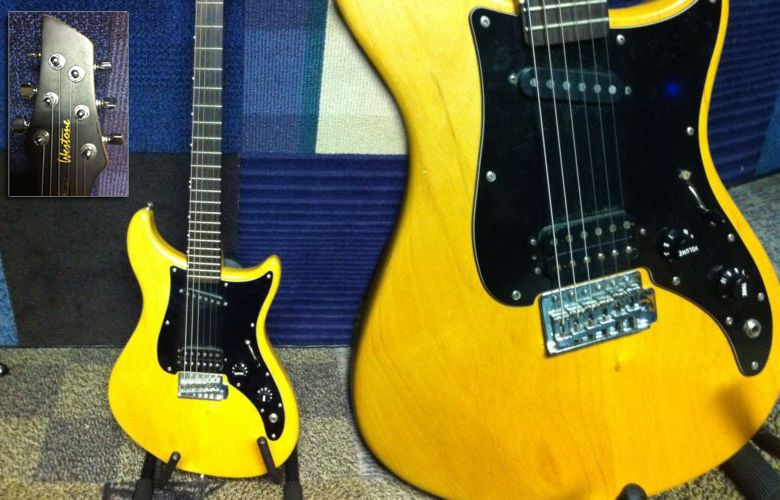
On seeing the Westone name you'd be forgiven for thinking that here was another Japanese Matsumoku-made guitar. However, as part of Westone's 1990s-era Prestige series, the Westone Cutlass was actually made in the UK by Status, known for their Status Graphite basses which started out as a headless design in the 1980s.
(The Westone Cutlass pictured here however, is not headless. It's just a bad photograph. I do wish that eBay sellers would always include at least one photograph of the entire length of the guitar, face-on, and not cut parts off, e.g. the headstock as in this case.)
The design, which appears to be somewhere between a Fender Lead II and a G&L SC-2, was by legendary British guitar maker, Sid Poole.
This is a quality British-made guitar, which would have orignally retailed at around £500. The auction for this example is ending very soon; with bidding currently at less than £100 at the time of writing, someone could end up with a very nice guitar at a very nice price.
I've not heard of Krozka Guitars before. According to the seller of this Krozka Sharpe with handwound P90 pickups, Bigsby vibrato and relic gun metal finish:
Krozka Sharpe Guitars of Northumberland, England [were] manufacturers of electric guitar originals. Founded in 2004 by Joe Krozka and Dave Sharpe, the two designers/luthiers have produced some of the UK's most original and exciting guitar designs including the Atom Ray, Raider and the Scar. All Krozka Sharpe Guitars are designed and handmade personally by Joe Krozka and Dave Sharpe, featuring their own handwound pickups.
Sadly Krozka guitars went bust and so no more of these fine instruments will be made.
Sad news indeed; we here at Guitarz are always keen to celebrate the original designs of the "little guys" of the guitar world.
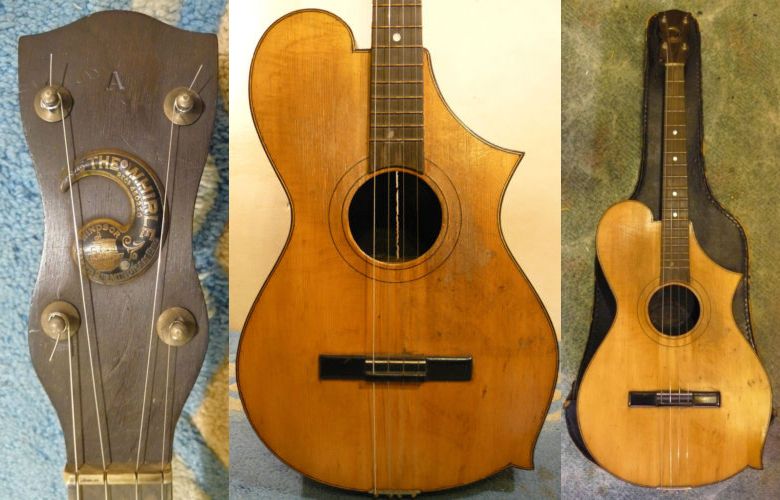
This Windsor Whirle was made in Birmingham, UK, according to the eBay seller in the 1920s. Myself, I'm not so sure about that, and would widen the timeframe to anytime in the 20th Century up until the 1940s. But perhaps the seller knows something that I do not.
The guitar (or whatever it is) is not in the best of condition having developed a split in the back right down the centre. However, I feel it is worth showing here because it's such an unusual-looking instrument.
Although the seller refers to it as a "tenor guitar", I wonder if it was actually intended as a baritone ukulele. Note the gut or nylon strings rather than a tenor's usual steel strings (you can see also that the bridge was never intended for steel strings) plus the relative compactness of the whole design. The scale length is said to be 52cm - that's nearly 20 1/2" - which is nearer to baritone ukulele scale than tenor guitar (usually about 23").
A Google search for "Windsor Whirle" will tell you that they produced a range of banjos in that name. Note also the banjo-like headstock on the instrument pictured here.
(For some reason I get a sense of deja vu about this whole blog post. I could swear I've posted something similar before but cannot find it in the archives).
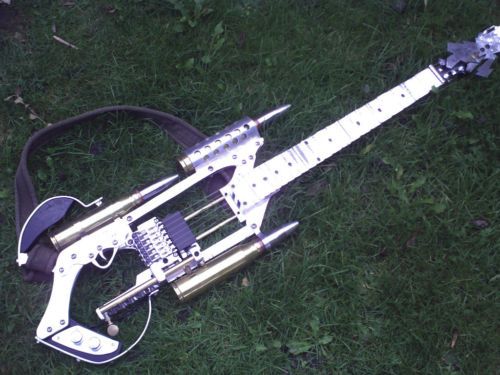
I make no secret of the fact that I dislike guns intensely and have absolute contempt for that old cliche, the guitar shaped like a gun.
However, this 30mm Lock n Load custom guitar, which still looks like some piece of military hardware, I find quite intriguing. It does have a "steampunk" feel to it.
It has a sliding pickup on a bolt-action system allowing it to be set in any one of six positions. The neck is aluminium (it looks like it could benefit from some wooden inserts on the rear - see video) and the integral fingerboard is stepped, a laBond Electraglide.
In the seller's favour is his refreshing honesty when telling us that the guitar weighs a whopping 15.4lbs/7kg and would be "only good for one song at a gig".
See more of the guitar here:
It's not really to my taste, but is still worthy of including here on Guitarz as an example of something quite unusual.
EDIT: As Big Red X points out in the comments, this would appear to have been made by British Custom Guitars.
Watkins Electric Music was formed in 1949 in London by the Watkins brothers, Charlie and Reg. Their first solid electric guitars appeared in 1957.
Guitars made by the Watkins brothers have appeared under the WEM (Watkins Electric Music) brand and, after 1968, the Wilson brand. The Watkins brothers had decided to market their guitars under a separate brand from their amps, and chose Wilson as it was their mother's maiden name.
This WEM-branded Sapphire 12-string is a rare model and should appeal to collectors specialising in this maker or of British guitars. This guitar, with bidding on eBay currently at a measley £25, ought to fetch some good money but I feel that the seller is shooting himself in the foot by demanding "Cash on collection, No post collection only".
Some eBay sellers are - how shall we say this politely? - very naïve. It's not as if it is difficult to arrange to send a guitar. You don't have to lug it down to the Post Office. It's easy enough to book a collection online, have the courier pick up the guitar from your house and deliver it in 24 or 48 hours to the destination given. And you can track the whole thing online. Some people don't seem to realise that we are living in the 21st Century yet.
However, you DO have to package the guitar carefully. Perhaps this seller is too lazy to do this. "I haven't got a box big enough," is a poor argument. I have sent guitars packaged in boxes I have made from an assortment of pieces of cardboard that I have found, and have been complimented afterwards by the buyer on how well packed the guitar was. I once sent a Vox AC30 piggyback head to Madrid in a box made out of bits and pieces of cardbaord and that survived the journey admirably and the buyer was extremely happy with it.
So, this is a tip to eBay sellers: Don't be lazy! If you insist on "collection only" then be prepared for your item to sell for peanuts, if it sells at all. Be prepared to do a little work, and package your item carefully. Oh, and good clear, preferably LARGE photos on the eBay listing are a must. The above photo, was the best I could lift from the Sapphire 12 auction. Quite frankly, it's bloody awful.
Enough of the rant. For more on Watkins/WEM/Wilson guitars, see Watkins Guitar World (where there are some better photos of a similar Sapphire 12-string).
Peter Cook developed the Ned Callan range in the 1970s, guitars being initially handcrafted by Cook himself from his small workshop in London's Notting Hill, and later for Shaftesbury with Shergold Guitars being commisioned to make Ned Callan guitars as designed by Peter. Shergold produced both the "Cody" and "Hombre" models under this arrangement and these odd-looking guitars earned themselves the nickname "Nobbly Neds".
This Ned Callan bass is, I'm guessing because of the lack of the Shaftesbury name on the headstock, one of Peter Cook's earlier hand-built instruments, which seems to take its cues from the early Gibson EB-0 designs.
This rare piece of British guitar-making history is currently being auctioned on eBay UK with a starting bid of £150 (and with no bids currently as I type this), although I would warn prospective buyers that the lacquer is very cracked which could present the buyer with a dilemma: to leave it as it is so that it is as original as possible, or to refinish it?
Peter Cook is still in the guitar business, but these days he sells them via Peter Cook's Guitar World rather than making them himself.
As as aside, the Shaftesbury name was also used by Rosetti Music as a brandname on various imported guitars from Japan and Korea.
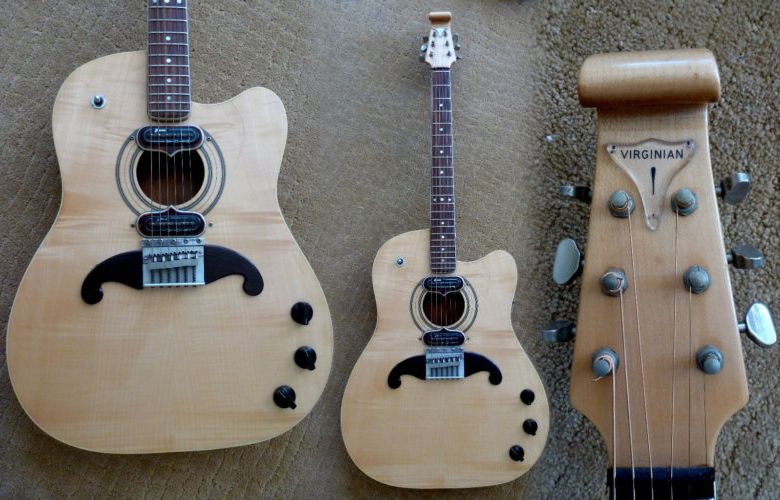
We previously looked at a prototype Virginian from Jim Burns' involvement with Hayman guitars at the beginning of the 1970s, but the design predates that era and was previously issued in the late 1960s when Burns London Ltd had been bought out by Baldwin. This 1960s Burns/Baldwin Virginian is currently being auctioned on eBay, and is another Burns guitar I would dearly like to bid on if I had the available money. Design-wise it's a cross between an acoutic and an electric, and whilst for me such hybrid designs often just do not work, there is something about the Virginian that silently screams its coolness factor at me, in much the same way that Kurt Cobain's Martin D-18E seemed so cool during Nirvana's MTV Unplugged sessions.
I can't help thinking also that this guitar must have been the inspiration behind the later Burns Steer.
Feast your eyes on these guitars by Burns London Ltd, as used by The Honeycombs performing their No.1 Joe Meek-produced hit single "Have I The Right" from July 1964 (when I was only 6 months old). Originally The Sheratons, the band was re-named "The Honeycombs" by Pye Records chairman Louis Benjamin making a sly reference to drummer Honey Lantree's job as an assistant in a hair salon.
Thanks to Jeremiah for recommending this clip (pun not intended).
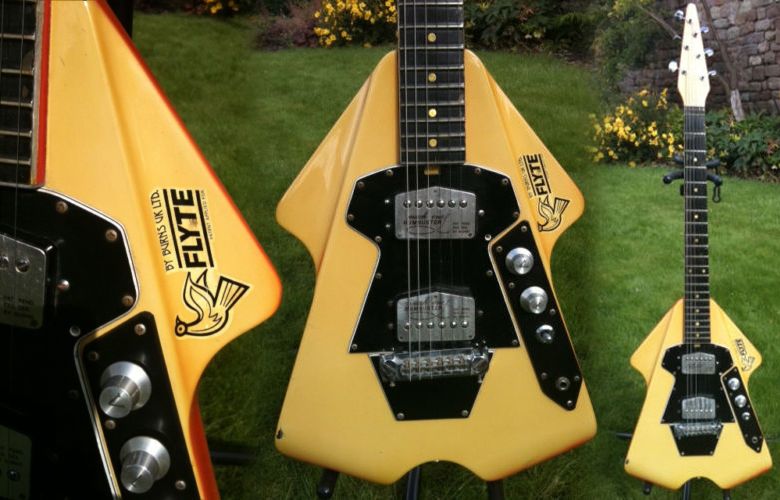
When we talk about Burns Guitars here on Guitarz, I confess we are often being lazy and lumping the various differnt Burns companies together into one gestalt entity. In fact there were a succession of companies within which Jim Burns was associated, beginning with Burns London in 1960 which was bought out by Baldwin in 1965. Baldwin-branded Burns guitars appeared until 1970. Jim Burns was involved with Hayman from 1969-1973, that company being the forerunner of Shergold. From 1973 to 1977, Burns UK Ltd produced guitars including the above pictured Flyte model. Then in 1979, "Burns" guitars were produced by Jim Burns Actualizers Ltd producing such models as the Steer and the Scorpion, and this company lasted until 1983.
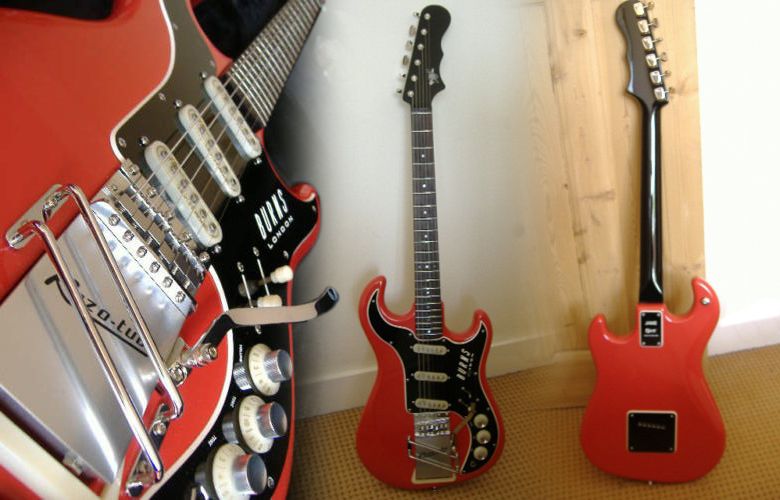
The present-day Burns London Ltd company was started in 1992 by Barry Gibson, with Jim Burns on board as a consultant. This company re-issued many of the older designs from previous incarnations, as well as producing completely new instruments. In 1999 they began outsourcing production of instruments to Korea, so sadly these days not all Burns guitars are UK made (although it's the same story everywhere of guitar companies having to resort to Far Eastern production in order to compete in the marketplace).
All that may sound complicated, but I was in fact simplifying the story. For a fuller picture please see the Burns Guitar Museum website which has pages dedicated to the "different Burns companies and their guitars and basses".
From the "Burns UK" period (1973-1977), the Burns Flyte in gold finish pictured above has just been listed on eBay UK with a very low starting price. I was going to comment that I'd never seen a Flyte with this finish before until reading in the listing that the seller had played this guitar in the band Age Of Chance. Then I realised I had seen it before when that band appeared on BBC2's Whistle Test in 1987 performing their version of Prince's "Kiss". What's more, Flyte fans, the bassist is also playing a Flyte.
Or if you prefer, here in much better quality is the promo video of the same song. You get to see the guitars much more clearly, although obviously here the band are miming.
Apparently this gold Flyte was also loaned to Lee Ronaldo of Sonic Youth back when it wasn't for sale. Anyway, I shall be watching this auction with interest, and wishing I was able to bid myself.
This Burns Marvin/Bison hybrid was made by Barry Gibson at Burns during 2009/2010 and combines the features of two classic Burns guitars from the 60s. It is supposedly the only Marvin type guitar with a Bison headstock in existence.
The guitar features an Ash body in the Marvin shape with an extended lip on the neck pocket. The neck is of plain maple with an unbound rosewood fingerboard, 10" radius and 6105 fretwire. The headstock, modelled on a '63 Bison, has an Old Ormston Burns (OB) headstock decal instead of the Marvin type, standard MOP neck markers, and is painted Jet Black with 21 frets plus a Zero fret.
The pickguard is a unique black one piece similar to '63 Bison and features an oversized Burns London logo. Other appointments include chrome hardware, chrome Rez-O-Tube vibrato, and chrome van Ghents machine heads, while electrics are Burns hand-wound UK made Rez-o-Matik pickups, twin selector switches (offering 7 combinations), 1 volume, 2 tone controls (one with new rez-o-tone 5 way pot active when selectors are in bridge position).
Currently being auctioned on eBay UK with bidding currently over £300 as I type this (auction ends Sunday).
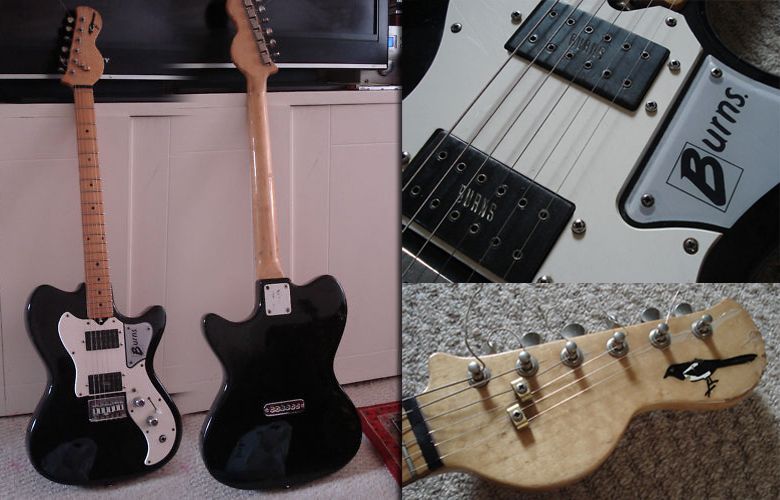
This is a Burns Magpie guitar from 1980. Apparently this is quite a rare model, and this one seems to be even rarer with its 6-on-one-side "Magpie" headstock; others I've seen pictured have the same 3+3 headstock design as the Burns Steer.
The seller tells us that:
The guitar sounds amazing. [The pickups] completely scream. So much attack, yet very full sounding. Great clarity and power.
Unfortunately I can't find out much else about this guitar. If anyone reading this has more info, please don't be shy in letting us know!
This guitar is currently up for auction on eBay. It had a starting price of £0.99 and the bidding has already begun. It'll be interesting to see what it sells for (so long as the reserve price is met).
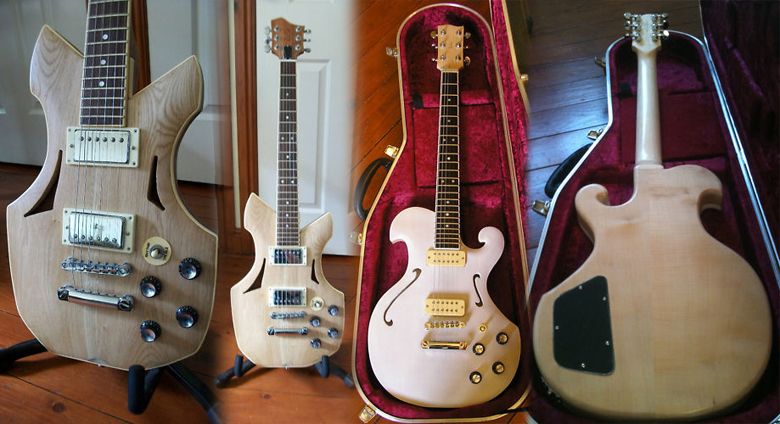
Here are some interesting original guitar designs by T Carter of Shropshire. Both of these he refers to as being prototypes. I'm not sure as to the extent of his operation, but that would imply that there are future models to come based on these designs. I particularly like the guitar in the third and four images of the above montage, with its scrolled body horns and offset asymmetrical f-holes.
 RSS
RSS