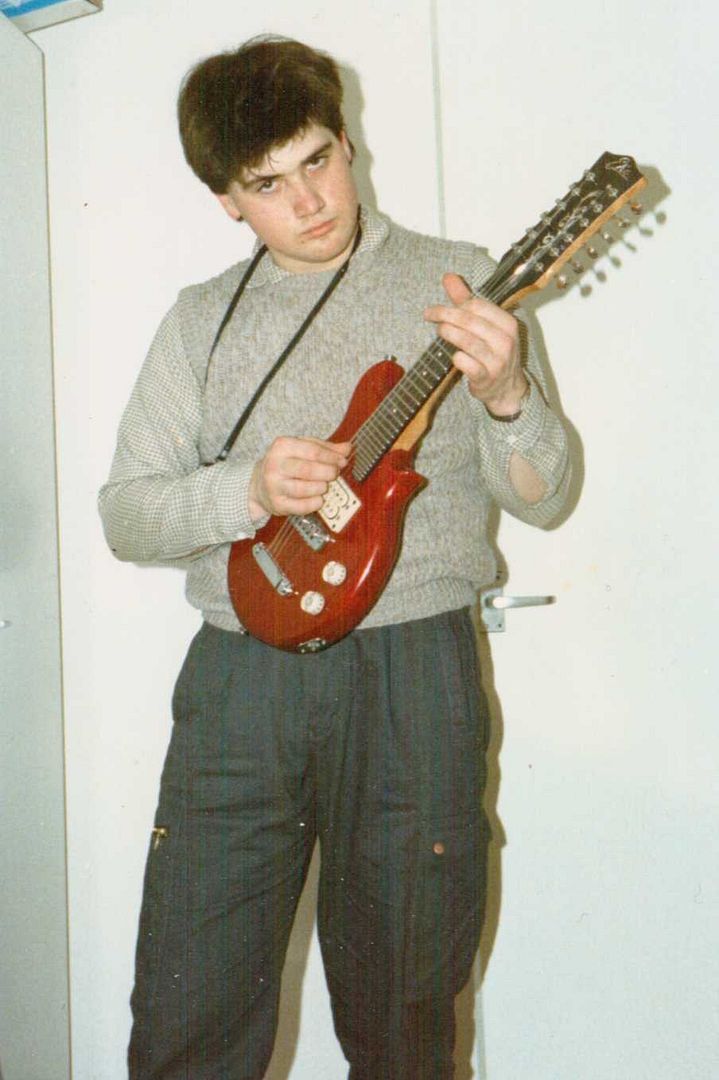
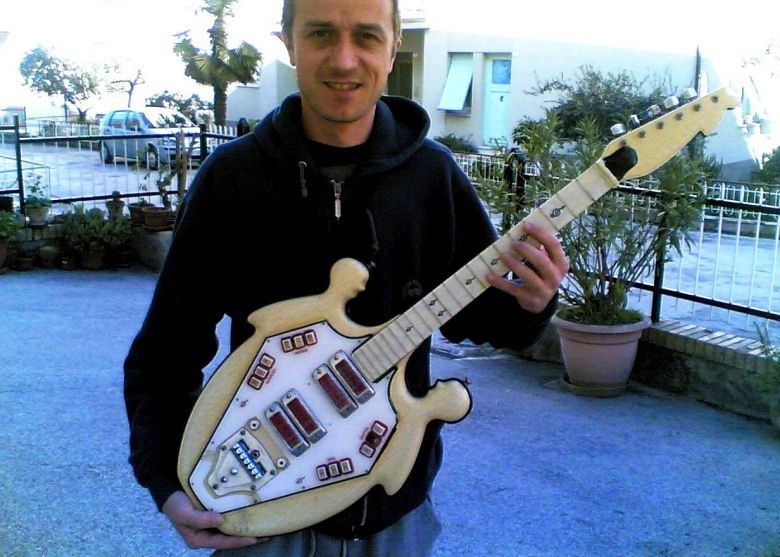
Further to yesterday's post about the Robin Ranger octave guitar, just through sheer coincidence this morning I found this photo featuring an Eko Mando Guitar which is essentially a half-scale electric 12-string. No doubt this was an instrument inspired by the Vox Mando Guitar, the Vox and Eko companies having previously had very close ties in the late 1960s when Vox shifted guitar production to Italy's Eko factory. Unlike the 6-string Robin Ranger, the Eko with 12 strings arranged in 6 courses allows for a more realistic mandolin sound.
"New old stock" Eko mando guitars are still available today via Brandoni Guitars, if anyone is interested in purchasing such an instrument. They also have 8-string Eko electric mandos.
As for the identity of the 1980s kid in the photo (nice tank top and balloon pants!), I have to put my hand up and admit it is me.
The 7-string guitar has in recent years gained much popularity but I hope that most Guitarz readers will appreciate that the instrument was not a creation of the new metal movement, nor was it invented by Steve Vai or Alex Gregory. The first electric seven-stringer was probably a Gretsch hollowbody made for jazz guitarist George Van Eps in the late 1960s, although he had been playing acoustic 7-string jazz guitar since the late 1930s when he used a custom-made Epiphone.
But 7-string guitars were around long before this. Both Russian and Brazilian music had developed 7-string guitars as part of their culture. The Russian 7-string dates to beginning of the 19th century and utilised an open G tuning (DGBDGbd). It was said to have been invented by Russian guitarist and composer Andrei Sychra who wrote a method for the 7-sting guitar and a whole wealth of compositions for the instrument.
In Brazil the 7-string guitar was introduced in the early 20th century as an accompaniment instrument in choro and samba music. It is traditionally tuned as a standard 6-string with the addition of a low C string, although some guitarists took this down to a (more logical perhaps) low B.
In 18th century Europe, the baroque guitar evolved from an instrument with 5 courses to one with 6 courses - initially the courses were paired strings but later the consensus of popularity favoured single strings as is common today - so it was perfectly natural that someone would take this a stage further and add a 7th course (or string). Those advocating the 7-string guitar included French guitarist Napoleon Coste (1805–1883) who composed specifically for the instrument, and the Italian guitarist Mario Maccaferri (born 1900) who used additional unfretted bass strings (known as diapasons or bourdons) on his guitars.
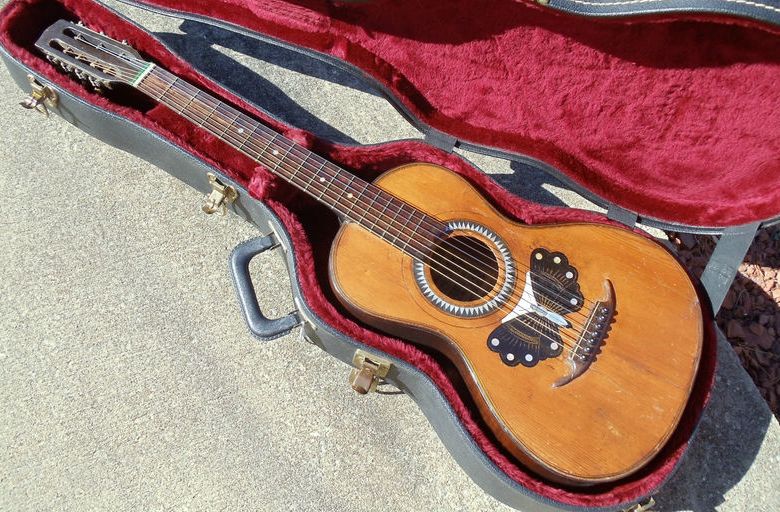
The above pictured guitar is an Italian 7-string by Ermelinda Silvestri and dates to the mid 1890s. In keeping with most of Silvestri's instruments it bears the butterfly inlay which was a trademark of sorts. The seventh string seems to be very close to the edge of the fingerboard, which suggests that it wasn't intended to be fretted and would have been a diapason (or bourdon if you prefer).
This repaired but still playable antique 7-string guitar is currently listed on eBay with a Buy It Now price of $1,450.
Can't help it, if there's a Wandrè available around, I have to show it here! And the Scarabeo is not the less amazing creation of wild Italian luthier Antonio "Wandrè" Pioli! Actually it's also one of the rarest, so I have no more info about it, but looking at it is enough, isn't it?
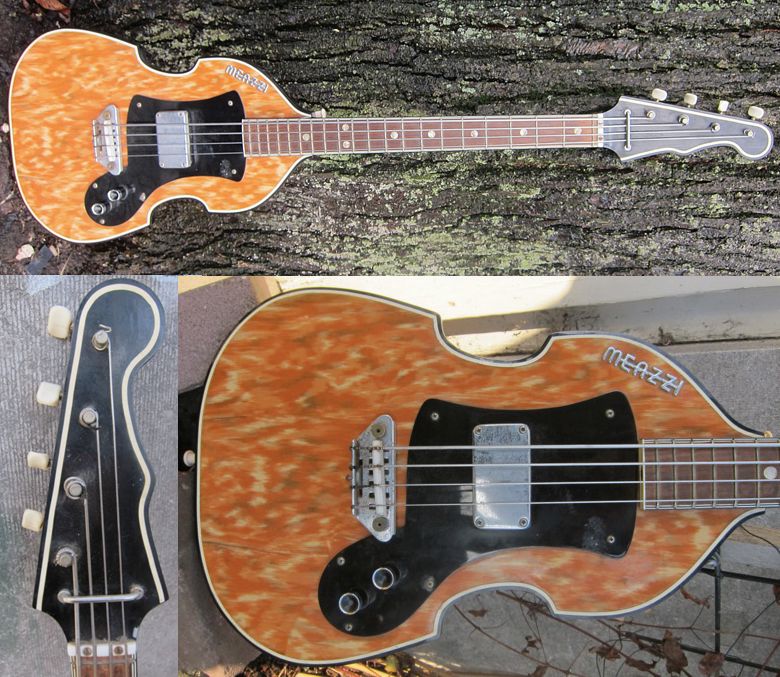
Here's a slightly different take on the much copied and reinterpretated violin bass. From Italy in 1962, this is a Meazzi Basso Profundo, which in keeping with many Italian-built guitars and basses from that era has a beautifully crazily coloured celluloid finish to the front of the body.
Meazzi is one of the most popular labels of musical instruments in Italy, set in Milan rather than in the Castelfidardo area like the Eko & Co. It produced also drums and distributed a range of imported brands until few years ago.
Some late 50s/early 60s Meazzi guitars were produced with assistance from Wandré Pioli, who of course went on went on to produce his own idiosyncratic series of guitars and basses in partnership with Athos Davoli.
This bass is currently being offered for sale via Vintage & Rare, priced at €695.
At first sight, this Meazzi Zodiac looked to me like a small body travel guitar à la Eko Short Gun, then I found this picture of Swiss musician Lili Zeller playing the Zodiac (on fetishguitars.com, like usually when one needs info about Italian vintage guitars), and like me you can see that despite its unusual design, it's a well proportionate and well balanced instrument. I'm happy to have found this guitar today, it's exciting and inspiring, for both a musician and a guitar maker, not to mention a collector...
Unfortunately this one lacks its bridge and trem arm, but they should be easily replaceable, mostly if you take the opportunity to install an upgraded model of bridge, after all, what matters is how well it plays! Meazzi guitars had all you can expect from Italian vintage ones: odd designs, unique pickups and trems, strange controls and plenty of chromed plates! Meazzi started in the 1950s with Antonio Wandré Pioli for designer, who released his first instruments as Framez - a Meazzi sub-brand.
OK, it's the 11th November 2011, that is 11/11/11, and as such today has been designated Nigel Tufnel Day. To celebrate this day of Maximum Elevenness, we here at Guitarz - for this day only - will be posting an unprecedented ELEVEN blog posts! So, keep tuned throughout the day for eleven weird and wonderful guitars!
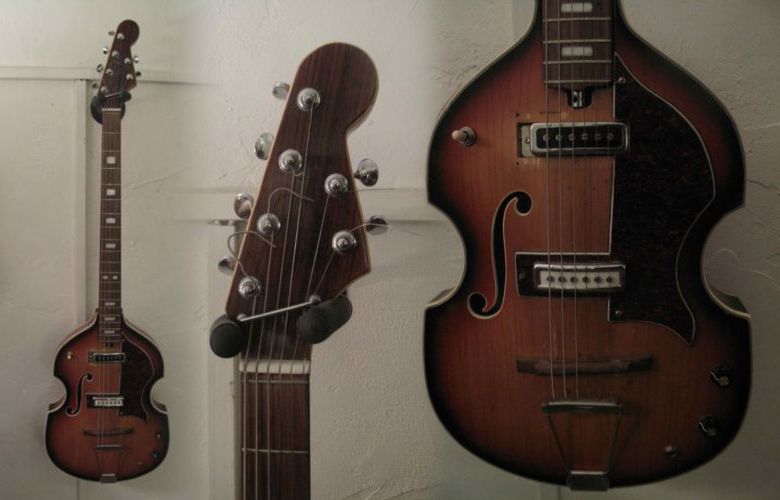
Here we have what the seller describes as an "Eko Baritone Guitar 1960s Rare". To my eyes, something doesn't look quite right about it. Yeah, sure the body could well be an original 1960 Eko violin-style body and the pickups and other hardware look to be of the correct vintage. However, the short-scale bass neck, drilled for two extra tuners, is out of place here. You can see that it was originally intended for just four strings by the string angles over the headstock.
It's not uncommon to find these Frankenstein guitars put together from old Eko and Vox parts. Brandoni Guitars of London have made a whole business out of doing just that. Possibly this violin-style baritone is one of theirs. I am pretty sure that it is not a vintage guitar in its original condition.
Currently listed on eBay UK with a starting price of £170.
I was making some research on Eko for my previous post, and thought I would check the new Eko website, and I figured out that they discreetly but steadily reissue all their vintage models - without big announcement in guitar magazine and reviews on professional guitar blogs...
I discovered this crazy guitar, the 295, a so far extremely rare semi-hollow version of the classic Eko 700 model - a dream guitar for all those bored with the classic designs. The reissue model differs from the original, mostly with its humbuckers that are much likely an improvement, and the stop-tail replacing the cool but probably unsteady tremolo.
Strangely the eccentric sound-holes have been modified, and not for the better, and the rotary switch is now a standard one - guitar makers, please reintroduce rotary switches, they are so much cooler and practical (I actually look for a 5 positions one for my next guitar project, anybody knows where to get one?)
You have like usually the best article about Eko 295 on fetishguitars.com and the vintage photos come fromguitarage.nl, another good resource for alternative guitar lovers - and you can find the contemporary version on ekoguitars.it. For me I still favor the Eko Kadett 67, it's on my list of must-have guitars, and I'm happy to now have the chance to get a contemporary version of it, for a guitar is meant to be played and I wouldn't be comfortable with a museum piece (and I also think, contrarily to common belief, that most nowadays guitars are better that they used to be).
The Goya Rangemaster in not unknown to Guitarz readers, since GL showed one with blonde finish last year (with detailed information). Here is a magnificent 12-string version with good photos allowing to enjoy all the details of this great guitar: the split pickups, the twos switches plates (nine switches all together!) , the strangely shaped pickguard and the bizarrely placed small F-holes.
For me who have a soft spot for double florentine cutaways semi-hollow guitars, I cannot find a better combination of classicism and vintage Italian eccentricity: I just love this guitar!
Following on from our previous post, here is another example of 1960s Italian luthiery.
From what I am able to work out, Bartolini produced guitars under the brandname Dega on behalf of Alberto Morbidoni, accordion-makers of Castelfidardo, for export into the USA.
This Dega Safari Bass appears to be a model that not even Fetish Guitars have pictured on their excellent website. In fact, stylistically it is more similar to the Eko Cobra than any of the other Bartolini guitars pictured.
This particular bass, still located into Italy, is currently listed on eBay with a starting price of €499.
Wandre Guitars were designed by Wandre Pioli (1926-2004) and built in his factory in Cavriago from 1959 to 1969. The Wandre Doris is a beautifully eccentric example, featuring Wandre's aluminium neck covered in polystyrene coating. Note the 6-in-a-line timber and aluminium slotted headstock and note also how the neck is almost parallel along its length, which is common on Italian guitars of this vintage. The moulded pickguard is resplendent in 3-dimensions and incorporates pushbutton pickup selectors and and angled output jack. These guitars were from a day and age when you didn't see the same old generic components on each and every instrument. The tremolo is quite a wonderful affair looking as if it's been assembled from motorcycle parts.
The Doris model has been re-issued by Eastwood Guitars (and kudos to them for reviving all those retro designs) but you wouldn't really mistake it for the real thing unless seen from a distance.
This original 1960s Wandre Doris is currently listed on eBay with a Buy It Now price of $5,500.
For me there is nothing worse design-wise on an acoustic guitar than weird soundholes that just don't work aesthetically. A number of modern guitars have soundholes of different shapes placed in various different positions - no doubt for tonal properties rather than for aesthetics - but often I just think how dreadful they look.
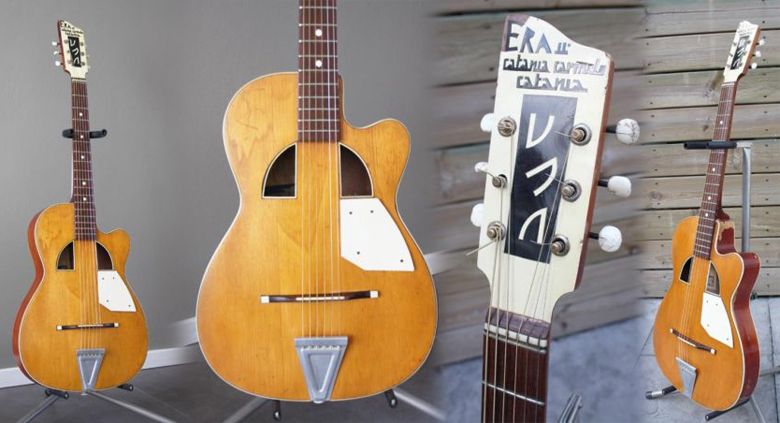
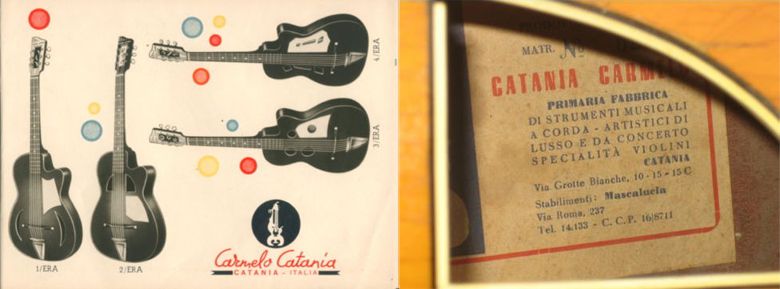
I do however, quite like this design on this 1950s Carmelo Catania Era II. It seems so weird to see an archtop jazz guitar with anything but f-holes, but look at the photo from Carmelo Catania's catalogue (below) and you'll see that their basic jazz guitar was offered in four versions each with different soundhole designs.
The eBay seller tells us this about Carmelo Catania:
Throughout the 900 Sicily was one of the most relevant production centres of musical instrument together with The Marches and Lombardy. Set so far away from the high standards of the arch instruments made in Cremona and from the quality of the Neapolitan mandolins, Sicily was quickly renown as the land of luthiers. Curiously, all Sicilian luthiers were born in Catania, at the feet of Etna, the volcano.
The poor economy of the region highly contributed to the huge migrant wave in the 20s towards France that gave birth to an extraordinary school of French luthiery. The luthiers from Catania are to be mentioned: Pappalardo, Di Mauro, Amico, Anastasio, Busato, Bucolo, Castelluccia, Favino, Olivieri, Burgassi, Martella, Grizzo, Rossito, Petillo...among many others.
Luthiers in Sicily were always open to both the Baroque influence from Spain and to the innovations coming from Europe and The States. The first great star among Sicilian luthiers was surely Carmelo Catania who was the only one to understand that the image of the luthier had to become more of a businessman to survive on the internal and international market. Carmelo Catania’s golden age was from the end of the war to the 60s. The cultural and economic situation brought Carmelo Catania to produce an incredible wide range of crafted instruments on industrial scale. The few pages of his catalogue here reported show his skills in bringing together all the different external influences in a typically Sicilian sensitivity. Carmelo Catania was probably the first luthier to organize himself industrially, promoting himself, exporting guitars, settling commercial alleys and trades. He created a real production headquarter in Sicily making instruments or parts on behalf of third parties.
Currently listed on eBay UK with a starting price of £350 and Buy It Now price of $675.
Can't resist showing another Brigitte Bardot model by Wandré Davoli (you can't have forgotten this one, can you?) but it's no so often that you find such fine pictures of such a well preserved model - and we are complete fans of Wandré's crazy guitars here.
Like usually when it comes to rare Italian vintage guitars, all the information I would write would be copied on the excellent Fetish Guitars website, so I prefer to let you have a look there yourselves... And here come a few more photos.
What I love about some of these old brands from the 1960s and earlier, is their prodigious output; there are so many different models left to be discovered. This Eko Modern semi-acoustic guitar, recently offered for sale on eBay, is a joy to behold with its pushbutton pickup selectors, pearlised plastic pickguard, and bold "Modern" legend. I couldn't say what it's like as a player, but cosmetically it's fantastic.
This guitar serves as a convenient reminder that you can't believe what an eBay seller tells you, even if they are someone who supposedly knows a thing or two about guitars, a guitar dealer or a guitar shop for example.
This glittery orange beast festooned with pushbutton pickup selectors is currently listed on eBay with the title:
There seems to be a tendency to proclaim any vintage guitar coming out of Italy as being an "Eko", much as vintage Japanese guitars will get labelled "Teisco" or "Matsumoku" without any foundation whatsoever.
So, having said that it should come as no surprise that this guitar is NOT an Eko and neither is it a model named "Panther" despite the Panther picture on the nameplate on the headstock. The major giveaway as to its true name is the actual NAME on the nameplate. (D'Oh!)
It's a Diamond Ranger 3 (the number denoting number of pickups), and from what I can ascertain is actually a guitar AlbertoMorbidoniCastelfidardo produced by Bartolini. The Diamond brandname was applied for export to the United States and in particular Washington. Other brandnames such as Dega and Samferri were used for guitars supplied to distributors in other states.
Follow that? It is all rather convoluted and I think I got it correct. Italian speakers can check for themselves here. Anyway, it's currently being offered for sale on eBay with a Buy It Now price of $1,195.
Following Bertram's blog post yesterday about the Eko Kadett guitar, there were some great comments that I felt should be given more prominence on the blog. Jozef Porazen tells us that:
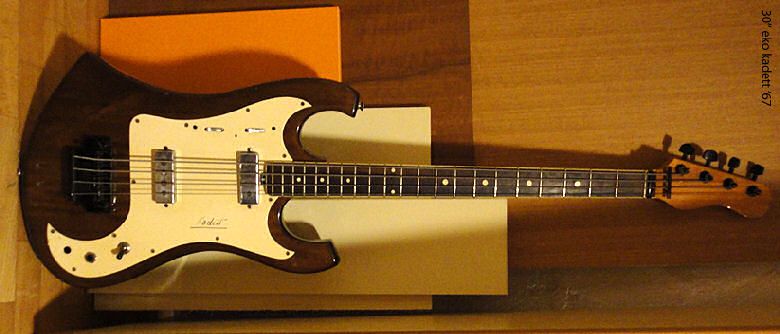
I have bass version of Kadett - made in '67. Honestly, as far as bass goes, the body is horrible. Neck dives like mad, body is too small, that body 'horn' goes right under your right hand and it hurts :-P
The neck is pencil-like, strings are floppy, due to short-scale, but overall its nice little funky bass nonetheless :) I did change the bridge, coz original was broken and the tuners (put in some small schaller ones, just like the guitar-ones, but for bass). Here's the pic [see above], bad one, I used phone.
So, it seems that sometimes these vintage quirkily-designed guitars come at a price other than the purely financial; that is to say that if you want to play one you have to compromise and/or upgrade components to make them practical usable instruments.
Ryan Waldron also commented about Eko guitars:
From album covers and pictures, I've noticed that EKO guitars seemed to be omnipresent in West Africa in the late sixities and early seventies - they must have been heavily distributed there. Here's a great clip of an orchestra in Mauritania rocking a three Eko line-up:
I know I've shown an Eko Kadett before, but I can't resist to show again this one, for it is one of my favorite guitars ever. The square horns and pointy top are so strong and sexy, without pointless extravaganza! No wonder that weak souls favored the vapid stratocaster, this is just too much for them, this guitar had to die...
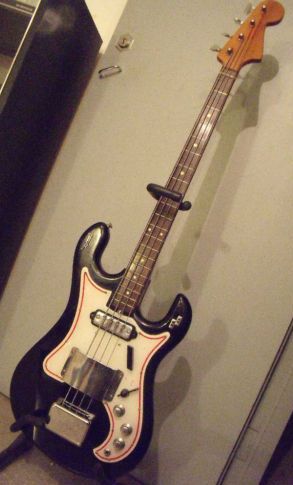
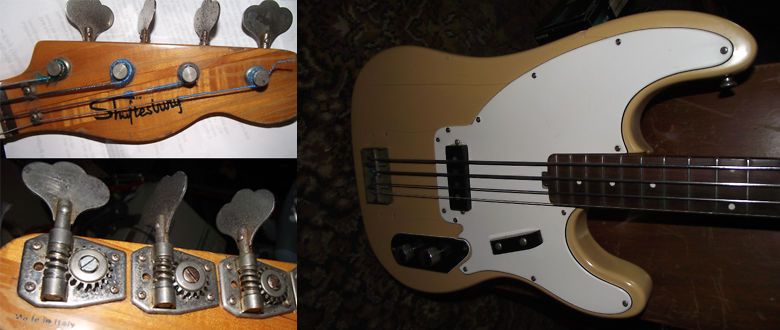
Ahhhh... now this one brings back some memories. It's a shortscale Shaftesbury bass, roughly modelled on the original slab-bodied Fender Precision/Fender Telecaster bass, and I guess it's from the mid 1970s.
I remember back in the early 1980s when I was first getting into starting bands with my mates and doing a spot of home recording on the then-new Fostex X15 multitrack cassette recorder; one day a couple of my friends came round wanting to record a demo. They brought a couple of cheap guitars with them. I don't remember what the six string was, but the bass was one of these. It was bad. I remember thinking it how dreadful it was. It was boomy, as you'd expect from a short-scale bass but I've played many that were streets ahead of this. I don't think the flat wound strings helped (I've never liked them and never will). I can't explain exactly what was wrong with it, just that it felt bad and it played bad. It was a cheap and nasty bass and performed accordingly.
This one on eBay UK has a starting price of £199. That is what I'd call seriously optimistic. Don't be fooled by the fact that this was "Made in Italy". It's not one of their finer moments.
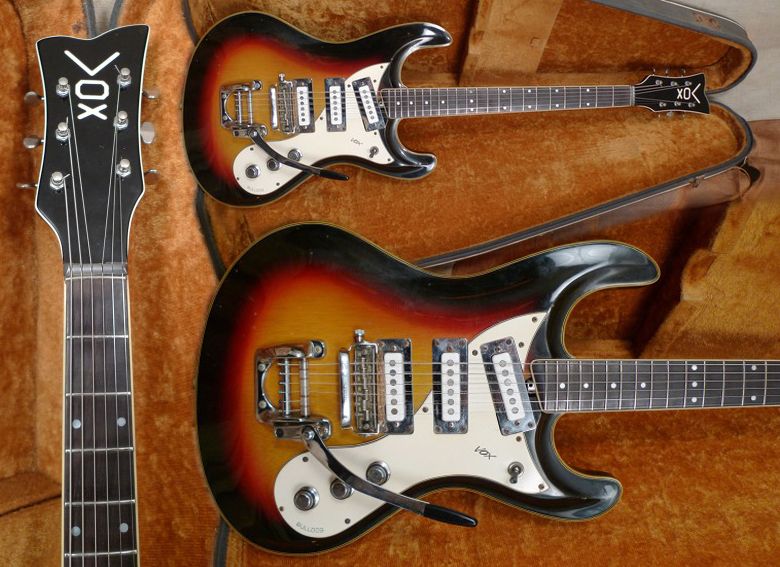
The Vox Bulldog is one of the later 1960s Italian-made Voxes, and it seems that with this model they are trying to evoke a Mosrite vibe, with its slanted neck pickup, carved top, assymetrical headstock, and even the shape of the body although here it's not quite so "upside-down Strat". This example in excellent condition was recently being offered for sale on eBay with a starting price of $1,895 but failed to sell.
In the current financial climate that is probably too much to ask for a vintage guitar such as this, despite the condition. People simply aren't willing to pay out for a vintage instrument that isn't a sure-fire investment, and unfortunately in this ultra-conservative area that means vintage Fenders and Gibsons, maybe one or two other key brands. The quirkies like this one, just aren't going to be seen as an investment. And for anyone interested in a guitar such as this as a player's instrument, well, the price is probably too prohibitative.
Cannot find anything about this Mini Beat small format guitar for children, but that it's probably italian, and that it has a built-in amp and speaker in its case like the Silvertones back in the 1960s, though looking much cheaper!
Andrea Dellonti posted this photo on our Facebook page. It's a Gemelli from 1960s Italy, and - as our very own David from Barcelona already pointed out on Facebook - "Gemelli" is Italian for "twins". Gemelli guitars were appropriately named, being founded by twin brothers Umberto and Benito Cingolani. You don't have to look too closely at this guitar to see the twins facing one another. The symmetry in the design was supposed to appeal to left or right handed players.
 RSS
RSS