Posts RSS RSS

Welcome to our site

You can replace this text by going to "Layout" and then "Page Elements" section. Edit " About "
Showing posts with label hybrid guitar. Show all posts

Vintage & Rare guitar of the week: 1968 Rickenbacker 456 6/12 Convertible

/

guitarz.blogspot.com:

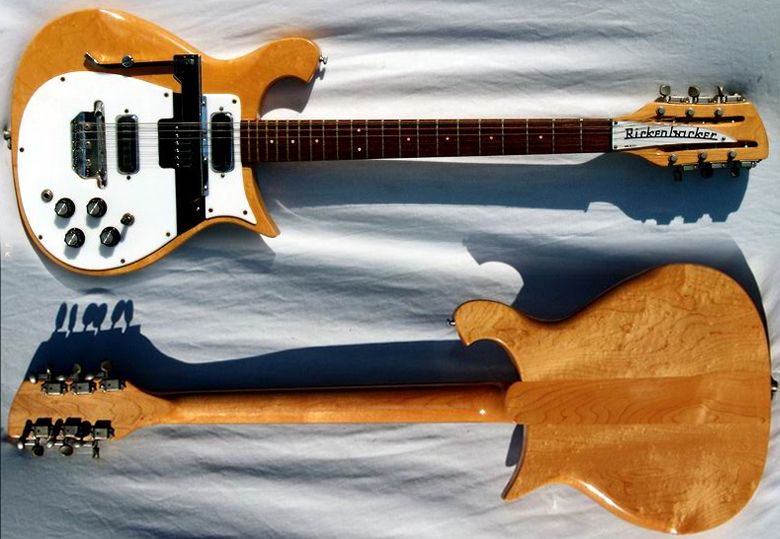
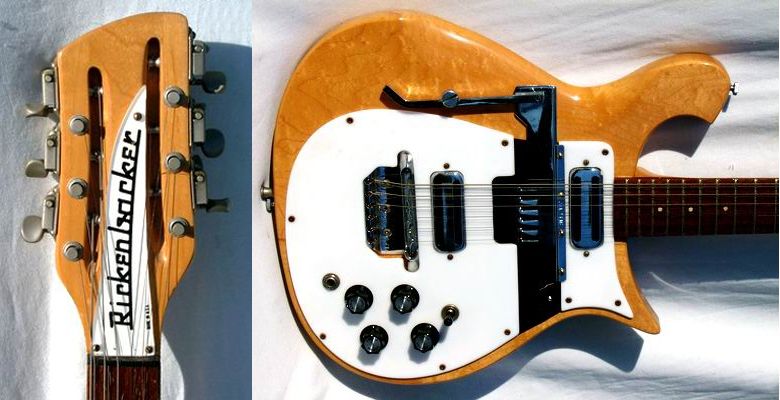
Just over a year ago we looked at another Rickenbacker 366 featuring this cunning mechanism to switch between 6-string and 12-string playing. I've seen similarly equipped Rickenbackers before, but never before have I seen the same mechanism on this model of guitar, the above-pictured Rickenbacker 456 6/12 Convertible. I don't think the mechanism looks quite as awful on this model as it does on the 366, but still I can't help being reminded of a very pretty girl who has to wear corrective braces to allow her teeth to grow straight.

Looks aside, you have to wonder why a contraption such as this wasn't more successful and why it didn't spawn much imitation. It must surely be a much more convenient way of switching between 12-string and 6-string guitar than using an unwieldy and back-breaking doubleneck guitar. Maybe I have just answered my own implied question, as the Rickenbacker Convertible lacks the visual impact and sheer stage presence of a doubleneck. I guess that rock'n'roll isn't all about the most sensible way of doing something.

This particular Rickenbacker 456 6/12 Convertible is from 1968, is finished in "Mapleglo", and is currently available for sale via Vintage and Rare with a price of €2800.

G L Wilson

© 2012, Guitarz - The Original Guitar Blog - now in its 10th year!

Budget ergonomic guitar is a Klein/Telecaster hybrid

/

guitarz.blogspot.com:

Ergonomic guitars don't usually come very cheap. They are specialist instruments and are very often luthier built. It's little wonder that many people have sought to build their own, which is where the resources available at the Building the Ergonomic Guitar website make themselves invaluable.

The one design that crops up time and time again is that based around the Klein guitar as designed by Steve Klein (no doubt using the Ovation Breadwinner as inspiraton). Kleins have long been out of production with existing examples changing hands for many thousands of dollars, so it's not surprising that the design has been appropriated by other builders.

The above pictured guitar, however, is currently listed on eBay for $199 Australian dollars, which is approx £132.40 GBP, and a little over $206 US dollars at the time of writing. The body design, although a bit "blocky" and under-sculpted is copied from the Klein, although unlike the Klein guitar it is not headless (note the cutaway area behind the bridge - that's where the headless tuners would be on a Klein). The bridge, pickups and controls are borrowed from the venerable Telecaster.

Now, at this kind of price I couldn't comment on the quality of the guitar, but suspect that seeing as it utilises readily available Telecaster components, that it could be upgraded very easily and may well appeal to those on a strict budget wanting to experiment with guitar ergonomics.

G L Wilson

© 2012, Guitarz - The Original Guitar Blog - now in its 10th year!

Telecaster hybridized with Rickenbacker lapsteel pickup - a real ugly duckling for sure

/

guitarz.blogspot.com:

I'm going to be really lazy today (hey, it IS the holidays) and copy extensively from the eBay listing for this Tele/Rickenbacker hybrid:
This is a guitar which was constructed using:

Fender MIM neck Serial Number MZ4013361 (hard rock maple)
Non-Fender Tele style Mahogany body
Rickenbacker horseshoe pickup from a Rickenbacker (old spelling is Rickenbacher) Model 100 lap steel
Lipstick pickup (4.9K) GFS from Guitar Fetish
Brass nut

Other misc parts from Guitar Fetish, staggered tuners and string tree, 3 way switch, tele jack cup, Tele dome knobs, cloth wiring.

This guitar was born in a Hamtramck second hand store where I found the Rickenbacker lap steel. At the time I could not even tell what brand it was because there were no tags, markings, or serial numbers on it. Also the body had been crudely modified, some wood cut away, strap buttons put on so it could be played slung around your neck more like a regular guitar. The store owner told me it had been owned by a friend of hers that had passed away. who was from the coal mining fields of Tennessee. He had also painted numbers on the metal fretboard. That genesis gave me the idea of putting this pickup on a telecaster style body.

Since the Rickenbacker is an old pickup with usage marks, I bought a Fender neck which showed a little natural wear. I then yellowed the face of the neck over the logo to make the neck looka little further aged. It is a very subtle effect. (I used gunstock oil infused with a little walnut dye.)

I picked up a mahogany body and modified it so the Rickenbacker pickup fit on it. At first I used a Gibson style wraparound bridge behind the rickbacker pickup. But it seems like some of that lap steel singing quality was missing. So I filled those holes, cut a little more wood and used the bridge integrated into the pickup. I also more tightly attached the neck to the body by using threaded steel neck inserts instead of the standard wood screws. You can search on ebay to see what inserts are are like.

The end result is that this thing sings like a woman! I took the guitar to my sister's house in Michigan's UP and played with her old-timey, bluegrass band. With the bluegrass band, I had to use the lipstick pickup because the Rickenbacker was too powerful, too bluesy. We were just playing an instrumental, but after the end of one song, someone asked "Who is singing?" No one was singing. It was the TeleRick. I was playing on the next song, and I thought I heard a woman singing vowels, I looked up from the fretboard and no, my sister (the only female musician present) was not singing. It WAS the guitar.

I had configured the guitar with a brass nut at first. It sounded great. I then switched to a solid plastic nut, and the open notes sounded more muffled than the notes held with the slide did. So, I put the brass nut back on. Also, when you play I think the brass affects the tone even more than just the open notes. I mean, the string does vibrate from the slide back to the nut unless you dampen it. The lipstick pickup loves the brass nut. I think the singing woman tone is a combination of the brass nut, lipstick pickup, mahogany body, threaded steel inserts, and the very solid Rickenbacker bridge. As I mentioned, the bluegrass people were not into the powerful Rickenbacker sound.

I put a 3 way switch on the guitar so you get the raw lipstick pickup, lipstick and Rickenbacker combined, and Rickbenbacker by itself. The tone and volume knobs only affect the Rickenbacker pickup. I did it this way for a couple reasons. If you wanted you could physically move the Rickenbacker pickup from the tele body to the Rickenbacker body, by only by snipping two wires. If I had integrated the tone and volume with the lipstick pickup, then more wires would have to be cut. Tonewise, the guitar rocks this way. The lipstick is a kind of a hollowed out singing acoustic sort of sound, you can play 4 strings together and they blend like a gospel choir. The Rickenbacker pickup has twice the output of the lipstick and is more raucous so you would only want to play 2 notes together (unless you are going for the heavy distortion). So you can do this multiple string sliding with the lipstick, and then flip the switch and go into a real heavier tone on the Rickenbacker pickup. You can tone down the Rickenbacker pickup with its controls to more closely match the lipstick if you want. The one pickup sounds like a logical extension of the other.

This guitar sounds so good, it could be the basis for a whole new unique style of playing. You can get lost flipping back and forth between them for hours..

The string height (action) is such that you can play the classic boogie woogie on the low strings from open to the 7th fret, and if you are sliding at the 5th fret, you can press down the strings behind the slide to get the missing notes in the scale, but when you are at the 12th fret you will be all slide all the time. Now, the action could be lowered a little. The bottom of the brass nut could be filed, maybe the neck truss rod could be used, but the Rickenbacker bridge is a little higher than the tele bridge, so the action will always favor the slide player. But that is not a loss on this guitar, because this is a slide players guitar.

In my heart of hearts, I believe that is a guitar born for slide and it will need a slide guitarist to properly appreciate it. That is why I am putting it on a month long listing. This special guitar requires a special person...
Likely this guitar is as amazing as the seller claims, but it's sure not going to win any beauty contests. Personally I think the placement of the volume and tone controls is a mistake - and I appreciate this was dicatated by the plate used from the Rickenbacker lapsteel. Nevertheless, I think he should have put the controls in the usual position for a Tele, and maybe plugged the holes in the lapsteel plate - else not used the plate at all if it is detachable from the pickup. I'm not just talking aesthetics here, those controls would get in the way where they are.

Currently listed on eBay with a Buy It Now price of $1,000.

Thanks to Andrew who saw this listed on eBay.

G L Wilson

© 2011, Guitarz - The Original Guitar Blog - now in its 10th year!

The Rockin' Chair (for anyone whoever thought that a Flying V or a doubleneck or whatever was an awkward shape!)

/

guitarz.blogspot.com:


The Rockin' Chair was invented on a coffee break at a newspaper in Värmland, Sweden, back in 1984 by the journalist Kjell Palmers and noted by his college Stefan Markebo. Many years later Stefan thought it would be a good idea to really build this handy instrument.

The guitar chair is played through the nice Volkswagen amp and the bass chair is played in a cheap little Hellborg amp.

Stefan Markebo


© 2011, Guitarz - The Original Guitar Blog - now in its 10th year!

1967 Rickenbacker 6000 Bantar Electric 5-String Banjo

/

guitarz.blogspot.com:

This instrument is unmistakably a Rickenbacker with its gently contoured upper body edges, the back's checkered binding, the varnished rosewood neck with distinctive triangular inlays, the fireglo finish... but it's a banjo!

Indeed it's a Rickenbacker 6000 bantar, a hybrid between a solid electric guiar and a 5-string banjo, as played be legendary banjoist Bela Fleck. It doesn't feature the skin as found on a traditional banjo so is not going to have the same percussive tone, so soundwise its classid Rickenbacker all the way, just utilising banjo stringing and tuning.

Another weird Rickenbacker hybrid instrument of the time was the Banjitar, which according to the promotional literature:
"...combines the sounds of the plectrum banjo, mandolin, Hawaiian guitar and Spanish guitar. Two harmony string pairs and two single strings plus a vibrato unit create this incredible range of tones."
To look at the Banjitar you might think at first glance that it was a standard Rickenbacker guitar, but the very narrow long neck might cause you to do a double take.

G L Wilson

© 2011, Guitarz - The Original Guitar Blog - now in its 10th year!

El-gitarrorgel - a hybrid guitar/electric organ from Sweden

/

guitarz.blogspot.com:

Hi, thanks again for maintaining such a great blog. Here is something you might like from a swedish auction site:
Below is a translation, some info is repeated and the first line is a classic, but you get the idea:
This is a unique instrument! It is also the only one of its kind!
It is constructed as a guitar with all the possibilities of an electric organ. The instrument contains the circuit board of an electric organ, which is controlled from the strings and fretboard. Basically the organs "lower/under manual" (not sure what he means here) is replaced with a fretboard and strings.
When a chord is played on the fretboard and strings, a preset rhythm, background and bass line starts. The strings work as they would on a conventional guitar.
An organ keyboard is built into the instrument, with different harmonies.
The construction is a easy to handle electric guitar, with all the possibilities for rhythm, backgrounds and bass lines of an electric organ.
The builder was a musician and telephone electrician, who for years had been thinking about how to build a guitar with backgrounds, just like an electric organ. In the end he built this prototype. Technical drawing is available.
Price: £142 / €165

Kalle Mattssonwww.hijackyourlife.com
Thank you, Kalle. That is, indeed, a classic. Love it. - G L Wilson

© 2011, Guitarz - The Original Guitar Blog - now in its 10th year!

BC Rich NJ Series Made In Japan electro-acoustic jazz guitar

/

guitarz.blogspot.com:

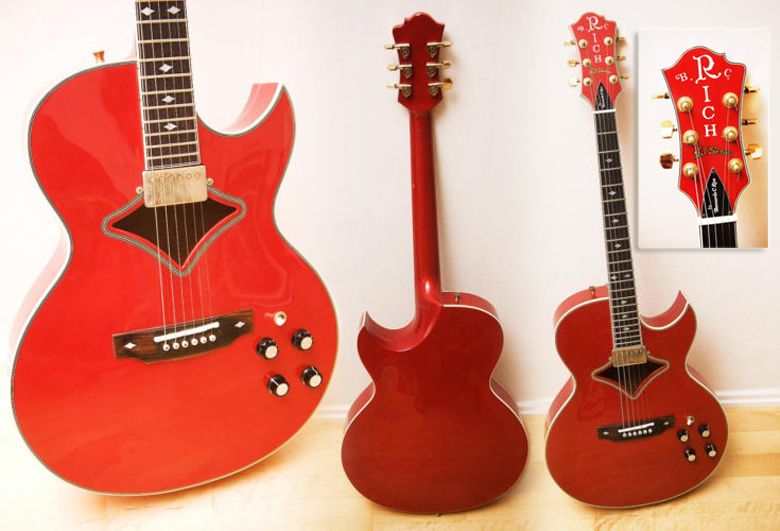
B.C. Rich's NJ Series replaced the B.C. Rico brandname that originally appeared on their Japanese-made instruments and which had been the subject of a lawsuit from the Rico Reed Company. Although the initials NJ stood for "Nagoya, Japan" where the first NJ instruments were built, later Korean-made guitars also received the NJ Series designation.

This B.C. Rich NJ Series electro-acoustic jazzer, reminiscent in some ways of Gibson's Howard Roberts model, is a Japanese-made example which the seller claims was made by the Daion company. (Check here for other Daion guitars that we have looked at previously here on Guitarz). Daion guitars were manufactured from the lates 1970s through to 1984 by the Japanese company Yamaki, so I guess that it was this same company who built these B.C. Rich models rather than Daion specifically.

The guitar features a humbucker pickup at the neck plus a piezo in the bridge, controlled via volume and tone pots for each and a 3-way pickup selector switch all boldy mounted on top of the guitar. The soundhole is a suitably angular shape considering the brand, as is the sharp Florentine cutaway. The heel of the neck is comfort contoured so as to facilitate playing at the top of the neck.

This guitar is currently being offered for same on eBay UK (although the item is actually located in Sweden) with a starting price of £599.99 and a Buy It Now price of £999.99.

G L Wilson

© 2011, Guitarz - The Original Guitar Blog - now in its 10th year!

Vintage & Rare guitar(s) of the week: Deimel Guitarworks Firemaster

/

guitarz.blogspot.com:

Luthier Frank Deimel of Deimel Guitarworks based in Bautzen, Berlin-Schöneberg, has been building boutique guitars since 1998 and his customers have included such lumineries as Sonic Youth, Nikki Sudden, Shellac and the John Spencer Blues Explosion.

I particularly like the Deimel Firemaster guitar, a hybrid design which melds together elements of the non-reverse Gibson Firebird and the Fender Jazzmaster.

The Glade Green-finished Firemaster pictured above features two Curtis Novak P90s, one of Deimel's own self-made single Coils in the neck position, and a piezo by the bridge "to collect body vibration". There are various switches to activate series/parallel modes, ON-OFF for each P90, ON/OFF for the piezo, plus a killswitch. It also features a Jazzmaster style vibrato. This guitar is currently being sold via Vintage & Rare and is priced at €2850.

The Burgundy Mist-finished Firemaster pictured below is outfitted with an aluminium pickguard anodized in gold, two P90 pickups and a Duesenberg Tremola. Tuners are Kluson type Gotohs with the Magnum Lock mechanism. The body is made out of american red alder, and the neck is riftsawn hardrock maple plus rosewood fretboard. Also being sold via Vintage & Rare, this guitar is priced at €3400.

G L Wilson

© 2011, Guitarz - The Original Guitar Blog - now in its 10th year!

Burns/Baldwin Virginian from the late 1960s

/

guitarz.blogspot.com:

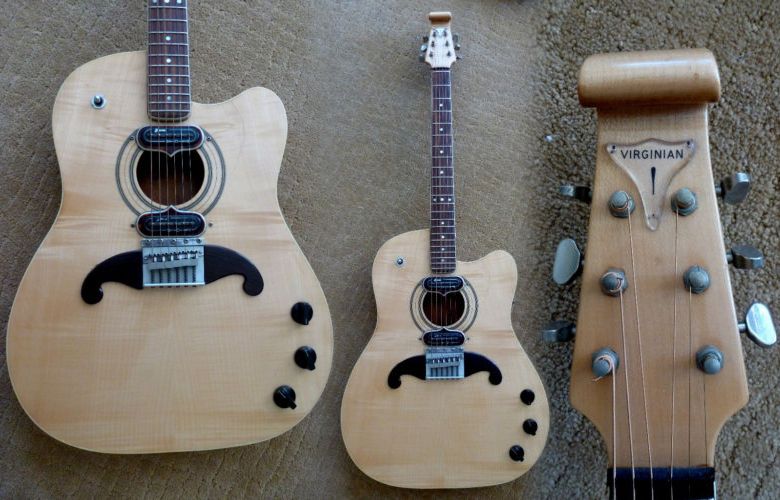
We previously looked at a prototype Virginian from Jim Burns' involvement with Hayman guitars at the beginning of the 1970s, but the design predates that era and was previously issued in the late 1960s when Burns London Ltd had been bought out by Baldwin. This 1960s Burns/Baldwin Virginian is currently being auctioned on eBay, and is another Burns guitar I would dearly like to bid on if I had the available money. Design-wise it's a cross between an acoutic and an electric, and whilst for me such hybrid designs often just do not work, there is something about the Virginian that silently screams its coolness factor at me, in much the same way that Kurt Cobain's Martin D-18E seemed so cool during Nirvana's MTV Unplugged sessions.

I can't help thinking also that this guitar must have been the inspiration behind the later Burns Steer.

G L Wilson

© 2011, Guitarz - The Original Guitar Blog - now in its 10th year!

Fender PBAC-100 Made In Japan Thinline Acoustic/Electric Fretless Precision Bass

/

guitarz.blogspot.com:

Ah, you don't see these too often. It's a relation of the Fender FMT Bass we looked at in January although, obviously, fretless, with a natural finish and a classic Fender P-Bass style headstock. (In fact, this is the bass, I was referring to in the write-up of the HMT bass.) It's a Fender PBAC-100 fretless bass, Made In Japan 1990, and is clearly based on the Precision Bass but given the Thinline treatment. The bridge is an acoustic-styled unit and features an under-saddle piezo pickup, which used in conjunction with the P-Bass pickup allows for a mix of acoustic and electric tones.

I briefly tried one of these years ago and quite liked it. Looking at these photos now I still think it's a nice bass, but those horrible tone-killing black strings would have to go.

Currently being offered for sale with a Buy It Now price of $1,299.99.

G L Wilson

© 2011, Guitarz - The Original Guitar Blog - now in its 10th year!

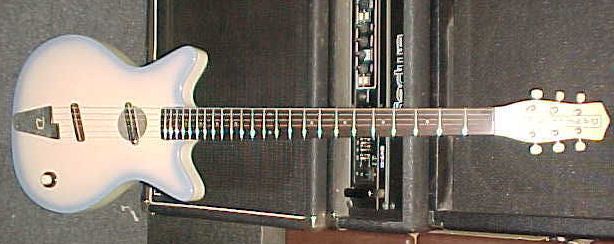
Danelectro Convertible baritone/6-string bass

/

guitarz.blogspot.com:

Here's what the seller is describing as the "1st ever Danelectro Convertable Baritone/6 string bass" although, (a) it's actually spelt "Convertible", and (b) how do they know it's the first when anyone with access to the same parts could create the same Frankenstein job?

This hybrid has been put together using 1990s made in Korea EVETS Corporation Dano parts, most of which are pretty interchangable. (For years I had a 56 'U2 that I had assembled from the neck and body of separate guitars. The colours didn't match but I liked it.)

I can't imagine the intonation on that simple floating bridge is brilliant. Those Convertible bridges are just a piece of rosewood with three inserts for height adjustment and a piece of fretwire set into the top!

Anyway, with a Buy It Now price of $875, I think this is another case of optimistic eBayer!

G L Wilson

© 2011, Guitarz - The Original Guitar Blog - now in its 10th year!

Some hybrid guitar designs are just not meant to be!

/

guitarz.blogspot.com:

My goodness, take a look at this... Flycaster... Telling V? Call it what you will, just because something is possible, doesn't mean that it should happen. As Guitarz reader Al in Crosby TX USA points out, even the eBay seller describes it as an abomination.

This Telecaster/Flying V hybrid comes from Indy Custom (The Indiana Guitar Company - not to be confused with Indie Guitars) and is one of a limited edition of 100 - even that sounds like pure optimism to me!

G L Wilson

© 2011, Guitarz - The Original Guitar Blog - now in its 10th year!

Burns/Hayman prototype hybrid guitar

/

guitarz.blogspot.com:

Am I the only one who thinks that modern electro acoustics and and hybrid guitars look just too sterile? I really never did like this business of hiding away all the gubbins. "Oh, you can't have any visible pickups or control knobs, that'll spoil the illusion of this being an acoustic guitar." Huh! As if those horrible little slider controls they stick on the rim of an electro acoustic are any kind of replacement!

I've always liked acoustics that have obviously been electrified with pickups and control knobs on show for all to see. They can have a rather Heath Robinson appeal sometimes (Oh, if only Heath Robinson had designed a guitar!), but to me they seem all the more honest, as if to say, "Yes, this is an acoustic but it's hardly unplugged!"

Think John Lennon with his Gibson J-160E, Nirvana's Kurt Cobain playing supposedly "unplugged" with a Martin D-18E, or John Martyn with a Martin guitar with pickups obviously gaffer-taped to the guitar creating loops on an Echoplex machine (as if an acoustic could do that without all the electrickery!).

So... the above pictured one-off Burns/Hayman prototype is a guitar that I find mightily appealing. It's an acoustic/electric hybrid guitar that proudly displays its electric components for all to see. I like the electric style compensated bridge set into an acoustic style "moustache" - that's a nice touch. Actually, I doubt that acoustically this guitar is very loud at all - looking at the picture of the back of the guitar (I'll put some more photos in the comments) it does appear to have a very shallow body. It's like they took the Burns Steer guitar, and made it a little bit more acoustic-y.

I don't really have much info on this guitar other than what the eBay seller tells us (hey, it is a rarity), so let's quote from the listing:
Rare Virginian hybrid guitar designed by Barry Gibson and Keith West of Burns London Ltd. featuring:
  • Burns Rezo-Matik pick-ups
  • Solid Spruce Top
  • Rosewood back and sides
  • Burns badged Gotoh tuners
  • Burns Tortoiseshell bridge section
A real collectors piece for Burns/Hayman fans 1 only made as this model was never put into production. The guitar was made over 12 years ago in the U.K. and has been sitting in the Burns warehouse since then, untouched.
I'm actually surprised it's as recent as that; it looks older. Anyway, it has a starting price of £249 on it and a But It Now price of £850.

G L Wilson

Guitarz - The Original Guitar Blog - now in its 10th year!

Ibanez Artstar AE-200

/


This Ibanez Artstar AE-200 is quite an intriguing guitar, about which I couldn't find much information - feel free to contribute if you know more... The acoustic/electric hybrid guitars are not exceptional nowadays but this one is from 1988! It has a piezo pickup under the bridge and a mini-humbucker in neck position, and you can balance the pickups from full bucky for a jazz tone to just acoustic with the piezo. I have no confirmation for this but the slits under the strings next to the bridge seem to be sound holes - strangely located then because we are more used to semi-hollow guitars with a central beam prolonging the neck... Definitely would like to know more - it's very interesting... 

Bertram

Guitarz - The Original Guitar Blog - now in its 10th year!