Posts RSS RSS

Welcome to our site

You can replace this text by going to "Layout" and then "Page Elements" section. Edit " About "
Showing posts with label bass VI. Show all posts

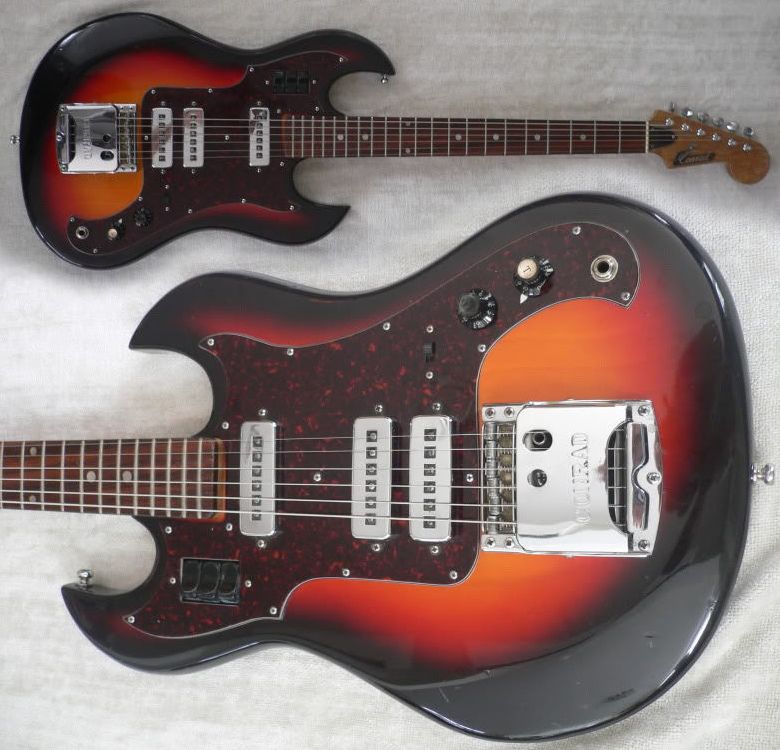
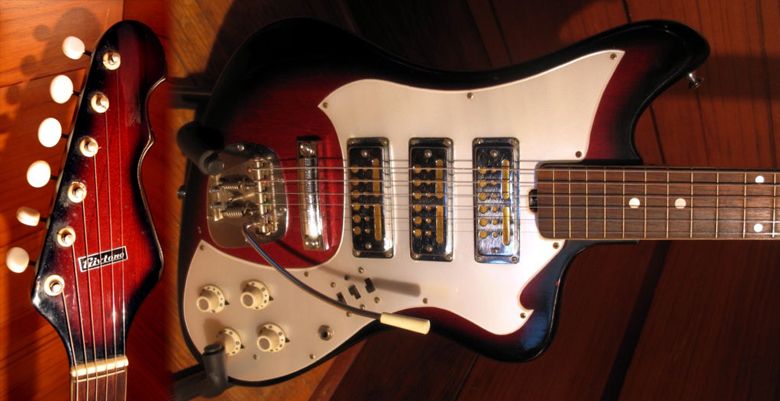
1960s vintage Japanese Givtone "baritone" guitar

/

guitarz.blogspot.com:

Here we have a vintage Japanese Givtone "baritone" guitar with three of the now legendary gold foil pickups beloved of the likes of Ry Cooder.

The Givtone name is almost certainly a department store/catalogue brandname. The seller rather lazily refers to this guitar as probably being a Teisco as if they were the only producers of Japanese electric guitars in that period. I'd say it looks more like a Zen-on/Zenon or Morales, maybe even Kawai or Guyatone, although I concede that the neck does look Teisco-like with its very narrow fretwire (maybe just a fashion of the era), but other Teisco trademarks such as offset block fingerboard inlays and striped metal pickguard are absent.

As, to it being a baritone, I feel this is unlikely. The seller states that:
Guitars like this, with a 26.5" scale, are usually tuned to Low "B" in between a guitar and bass but it'll hold up if you want to go lower or even higher.
Well, as I've said before, my understanding is that "baritone" tunings somewhere between a guitar and bass are a relatively modern concept. On a vintage guitar such as this, they'd more likely be tuned down a whole octave a la Bass VI. However, for a Bass VI, I would have expected a slightly longer scale length, maybe 28" or preferably 30". I have to wonder if this was simply a long scale guitar intended for regular tuning?

By the way, the earliest reference I can find to baritone guitars being used is in the Wikipedia entry for the Fender Bass VI, which says:
In the late 1960s some artists used heavy guitar strings with resp. length and tuned the Bass VI to a baritone guitar from 'B to b' or 'A to a'. With this 'down and dirty' sound the Fender VI enriched 'Indo-Rock' bands with their unique Rock & Roll sound. One of those players was Reggy Tielman from the 'Tielman Brothers'.
Note that whilst these guys were using baritone tunings, the instrument they were using was built as a Bass VI.

Just to confuse things, the Wikipedia entry for "baritone guitar", states that:
The Danelectro Company was the first to introduce the electric baritone guitar in the late 1950s, and the instrument began to appear in surf music, as well as background music for many movie soundtracks, especially spaghetti westerns.
The confusion comes in here because the modern name "baritone guitar" is being applied retrospectively to the Bass VI, the term being incorrectly used here so as to distinguish the original six-string bass from the modern variant typically with a low B string and high C string, 34" scale and proper bass string spacing.

But maybe you know different and there was an earlier precedent for dedicated baritone guitars being made in the 1960s. Because of the mixed terminology being used it is very difficult to find out the absolute truth of the matter.

G L Wilson

© 2011, Guitarz - The Original Guitar Blog - now in its 10th year!

Fender Bass VI, sunburst finish, circa 1962-63

/

guitarz.blogspot.com:

Those of you who fell in love with the candy apple red Fender Bass VI in our previous post here on Guitarz but didn't fancy the eBay Buy It Now price of $15,995, might want to consider this sunburst version of similar vintage and condition. This Bass VI was listed on eBay UK today with a starting price of £0.01 and with the bidding currently at £500 as I type this. I don't expect that it'll cheaply but I'd wager it'll go for a lot less than the asking price on the candy apple red example.

G L Wilson

© 2011, Guitarz - The Original Guitar Blog - now in its 10th year!

Fender Bass VI, candy apple red, 1963 vintage

/

guitarz.blogspot.com:

Here's an original Fender Bass VI in glorious condition - like a natural relic - but the candy apple red finish must be as vibrant as when the guitar was new in 1963. The Bass VI first went into production just two years before, in 1961, although it wasn't the first six-string bass; Danelectro got there first in 1956. The body design is somewhere between a Stratocaster and a Jazzmaster. The Jaguar, with which the Bass VI shares similar electonics, wasn't introduced until 1962.

With a 30" scale, it was designed to be tuned as per a regular six-string guitar but tuned down an entire octave so that it covered the bass range. The result was a hybrid guitar/bass - a bass in guitar format. It even came with a tremolo arm.

The four switches on this example are three pickup on/off selectors plus a "strangle" switch for bass cut.

This particular example is currently being offered for sale with a whopping Buy It Now price of $15,995.

G L Wilson

© 2011, Guitarz - The Original Guitar Blog - now in its 10th year!

Danelectro Convertible baritone/6-string bass

/

guitarz.blogspot.com:

Here's what the seller is describing as the "1st ever Danelectro Convertable Baritone/6 string bass" although, (a) it's actually spelt "Convertible", and (b) how do they know it's the first when anyone with access to the same parts could create the same Frankenstein job?

This hybrid has been put together using 1990s made in Korea EVETS Corporation Dano parts, most of which are pretty interchangable. (For years I had a 56 'U2 that I had assembled from the neck and body of separate guitars. The colours didn't match but I liked it.)

I can't imagine the intonation on that simple floating bridge is brilliant. Those Convertible bridges are just a piece of rosewood with three inserts for height adjustment and a piece of fretwire set into the top!

Anyway, with a Buy It Now price of $875, I think this is another case of optimistic eBayer!

G L Wilson

© 2011, Guitarz - The Original Guitar Blog - now in its 10th year!
You can never have too many necks

/

guitarz.blogspot.com:


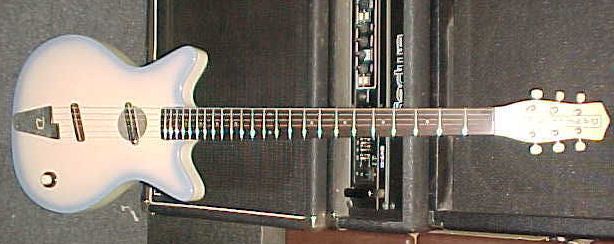
I bet you thought was going to be about one of those Rick Nielson multi-neck Cheap Shot guitars eh? I should coco! This is something I haven't come across too often before. Fender is a company I don't readily associate with doubleneck guitars. In fact I don't think I've knowingly seen any before - not that I've been looking, I have to add. The only Fenderish doubleneck I've happened across recently is the handsome, though not actually from Fender per se, creation from the skilful hands of young Bertram (with a little help from one of his woodworking associates). We have a fondness for the Fender Bass VI here in Guitarzland so it's an even bigger delight to find one Siametically co-joined to another of our favourites - the Fender Jazzmaster.

It's on the Austrian eBay site and I don't speak German. Maybe Bertram can help out with some of the details. As far as I can make out, it's a newish - 2010 - model, one-off, masterbuilt by Dennis Galuska (who's probably famous - sorry Den, not terrible au fait with the world of Lutherie) for the Frankfurt Musicmesse 2010 (that's a bit unfortunate isn't it, Musicmesse? Not really encouraging, eh? Probably means fair, exhibition or show or something similar. Maybe we should let them know. Might improve attendance a bit).

By the way, the body is lightweight ash with maple necks and rosewood fingerboards with Nitrocellulose lacquer - NOS (I thought that meant New Old Stock. Probably something else in German).

Amazingly enough (to me at least) it seems Yngwie Malmsteen also played a Fender double-neck 12/6 (probably very fast and very proficiently). That sounded a bit sarcastic didn't it? At least he's not Steve Vai. No, I didn't mean it. OK, YM isn't really my cup of tea, I'll admit, but until this week I'd have said the same about Steve Vai. Until... I Youtubed some of his performances and was a little surprised. Maybe it's a big act, I don't know, but he seems a nice guy, a great showman, a big ham, doesn't take himself too seriously (for a rock star) and plays with a ferocious passion. I'm not gonna rush out and buy his back catalogue but I don't mind anyone knowing I now have one of his tracks on my iPod - the Crazy Horses/Edgar Winter tinged-one-riff-all-the-way-through "Bad Horsie". It's only Rock N Roll etc... Stupid faces and all.

Anyway, Happy New Year to all. Taken my own sweet time to get back into second gear this year, sorry all.

David in Barcelona where the weather isn't too bad although it's a bit soon for the beach.

Guitarz - The Original Guitar Blog - now in its 10th year!
Burns Barracuda Baritone Guitar or VI string bass

/

guitarz.blogspot.com:


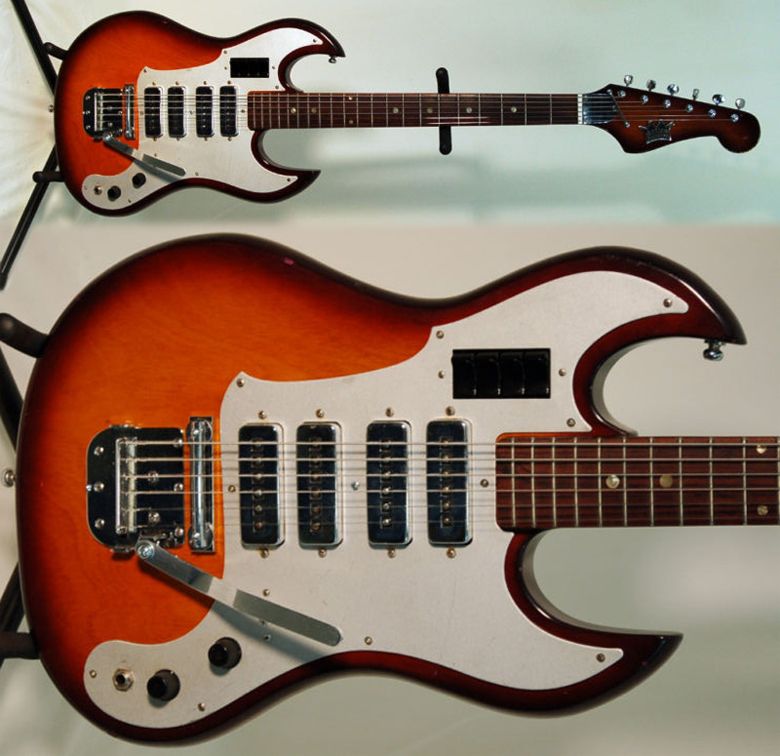
Well, talking of Burns, this is a coincidence. I was browsing eBay EspaƱa just this morning and came across a Burns Barracuda VI string bass or baritone guitar. I'd not heard of it before and I'm in two minds about it. There are a lot of features I like about it but I am a big fan of Burns's turned aluminium knobs and I'd love to see this kitted out with those. These knobs just look too cheap.

David in Barcelona

Guitarz - The Original Guitar Blog - now in its 9th year!

Conrad/Crown Bass VI (or baritone guitar if you prefer)

/

guitarz.blogspot.com:

One of the many things I've been learning from the years of compiling this blog is that there were a lot more companies producing Bass VI guitars in the 1960s than just Fender and Danelectro.

This particular Japanese-made example from 1965 bears the Crown brand insignia on the headstock, although the seller (lawman-mike - who certainly seems to know his stuff) tells us that it is a Conrad. It has a 27" scale length, four pickups with attendant rocker switches, a whammy bar (which looks to be all present and correct, and big pointy body horns that you might expect to see on a Burns.

He does, however, refer to it as a baritone guitar and says that: "They are tuned B to B instead of E to E". Well, that's all dependent on the strings you use. It almost certainly would have been strung E to E originally. (Unless you know differently.)

G L Wilson

Guitarz - The Original Guitar Blog - now in its 9th year!

Jet Harris plays Fender Bass VI

/


We've been often showing baritone guitars and short scale 6-string basses on this blog - really exciting instruments I must say (I have a Dan'o baritone for a few months now and I start to figure out what to get out of it!)

For people of my generation, the Fender Bass VI is mostly the unique sound of the Cure in 1981, but it's not bad to hear how it was used in the early 60s when it was released. Jet Harris was the bassist of the Shadows (the first one to use an electric bass in the UK - a Framus one, yes, a German guitar) then had a short and fulgurant solo carrier. He's playing here on his Bass VI the theme of the Man with the  Golden Arm - a brilliant and catchy song.  

bertram

Guitarz - The Original Guitar Blog - now in its 9th year!

Gibson EDS1250 doublenecked bass

/

guitarz.blogspot.com:
We've all seen Gibson doubleneck guitars before - indeed the Gibson must be the best known exponent of this particular type of instrument - but I, for one, have certainly never set eyes before on a Gibson doubleneck bass with four-string and six-string necks.

Made in 1970, this is allegedly one of only eight such instruments built. Note that the seller insists on referring to the 6-string neck as a "baritone", but it was much more likely conceived as a 6-string bass especially given the date.

G L Wilson

Guitarz - The Original Guitar Blog - now in its 9th year!

Conrad Bison baritone guitar (allegedly - I'm not convinced)

/

guitarz.blogspot.com:
Here's another vintaqe Japanese-made oddity for your. It's a Conrad Bison, and according to the seller it is a baritone model having a longer scale (although it's not too obvious in the photos - I'm not 100% convinced about this).

If it IS indeed a longer scale guitar, possibly it should more accurately be labelled a Bass-VI. As many of you will know, Fender, Danelectro and various other companies jumping on the bandwaggon produced these six-string basses in the 1960s. They were basically 6-string guitars with longer scale-lengths and tuned like a guitar, E to e, but down an octave. String spacing was as a guitar and they were often equipped with tremolo arms.

In more recent years people have taken to calling these "baritone guitars" so as to distinguish them from the more modern vision of the 6-string bass with low B-string and high C-string. But this, for me at least, causes another problem because it then confuses the Bass-VI with the modern baritone guitar which uses a tuning somewhere between a guitar and a bass (tunings vary), whereas the original Bass-VI guitars went down as low as a 4-string bass but added two higher strings.

Sure, some players took the Bass-VI and tuned it in ways more akin to our modern baritone guitar, but that is not how these instruments were envisioned.

Anyway, don't you think the shape of this Conrad with its offset pointed horns reminds you of the "Unknown" 12-string we looked at recently? (Which was, we decided, most likely an Arai/Aria Diamond or similar). From what I can find out, Conrad was indeed a related brandname for these same instruments, probably used by a certain store as its in-house brand.

G L Wilson

Guitarz - The Original Guitar Blog - now in its 9th year!

Hohner Hollywood Bass VI / Baritone guitar

/

guitarz.blogspot.com:
This post is for Biliby who emailed me waxing lyrical about a Jazzmaster/Strat hybrid guitar he'd found called the Hohner JT-60 - see pics of that one here.

The above-pictured guitar, however, is a custom shop version designed to function as a Bass VI. However, the guitar scale makes the strings a little floppy at the regular bass tuning and so it's more realistic to use it tuned to G. Not quite as low as a bass (c'mon, only three notes out), but lower than most baritone guitars. This was actually my own guitar, but I sold it several years ago when I was having my great guitar clear out. It was quite sad; I needed money to pay the bills, and ended up selling virtually my whole guitar collection. However, I soon built up another collection.

The guitar was manufactured in the Far East, but finished and set-up in Wales in the UK. I believe the guitar is a Trevor Wilkinson design (hey, he gets everywhere) and features Wilkinson pickups and Wilkinson tremolo. The tremolo on the bass was fantastic - twang-tastic, even! I used this guitar on a few recordings in both bass and baritone roles. The string spacing also allowed EBow usage which sounded great. It was a very nice guitar, but not one that got played a whole lot.

G L Wilson

Guitarz - The Original Guitar Blog - now in its 9th year!

Teisco Del Ray TB-64 Bass VI guitar

/

Here's a Japanese Teisco Del Ray guitar from the 1960s, featuring a 4 + 2 headstock (way before Musicman thought of it) and a handle in the body (way before Ibanez thought of putting the monkey grip in the Jem range of guitars). It just goes to show, there aren't that many original ideas out there. Someone has almost always thought of it first a long time ago.

Actually, looking at the close-up pictures of this one on the eBay listing I'd say that this example is actually a six-string bass that someone who doesn't know any better has strung up with regular guitar strings. Check out the huge machine heads and the size of the slots in the nut. The scale length also looks longer than that of a regular guitar (for instance, look at the huge amount of space between each of the three pickups). I'd wager good money that this is a bass VI.

Additional: A quick check at the ID Parade over on the Teisco Twangers website tells me that this is TB-64 from 1965, and that it is indeed a bass. Pity the trem is missing on this example.