/
guitarz.blogspot.com:
This
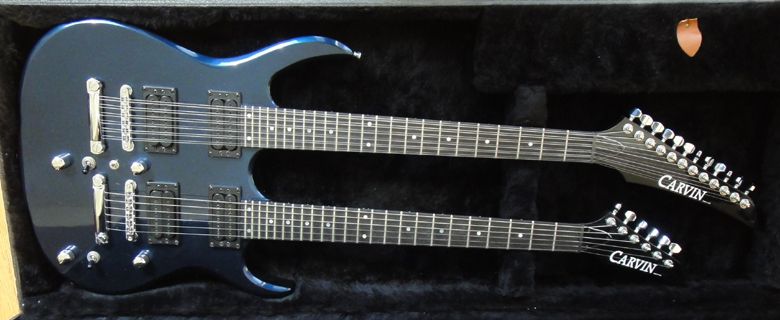
Carvin doubleneck 12+6 guitar was, until very recently, the property of
Guitarz reader Derek; he sold it on
eBay just this last week. He comments:
This is a early 90s Carvin doubleneck. It is, as far as I know, the only 6/12 that has the tuners on the 12 string neck inline. It makes for a very weird looking headstock... it looks more like a shovel.
It appears to be the same as the guitar on this catalog page from 1990.
The 12 inline was a option, the 6+6 was standard. The microswitch is the neck selector.
It's very heavy. The neck feels like a cross between an Ibanez RG and a Jackson; it's very thin, flat and wide. It is very much in keeping with the Superstrat/shred guitar design (other than the lack of a Kahler or Floyd). It's well made just like any other Carvin I've run across, but offers little in the way of new ideas. It looks and feels very late 80s if that makes sense.
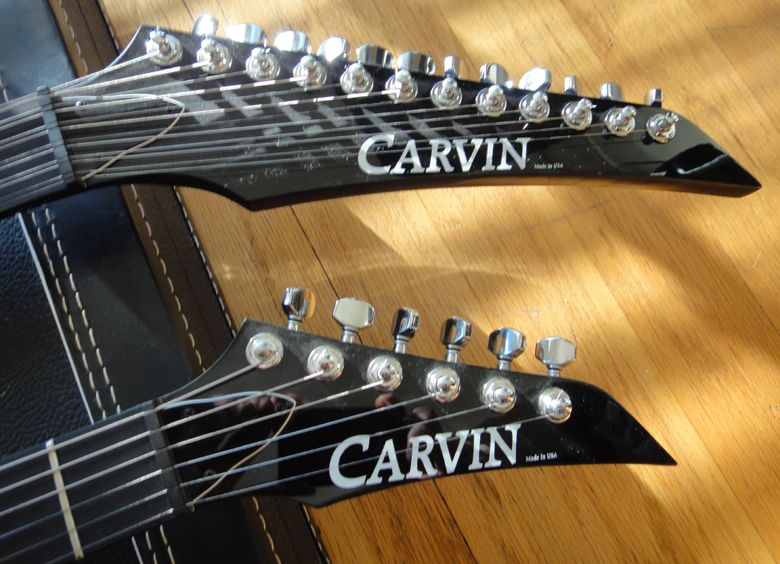
Thanks for showing us that beast, Derek. I can imagine I'd get into all sorts of tuning difficulties with a 12-string headstock like that. I often seem to go for the wrong tuner even on a regular 6-string 3+3 headstock. Still, in an on-stage situation, I guess that's what guitar techs are for.
G L Wilson© 2012, Guitarz - The Original Guitar Blog - now in its 10th year!
3:16 AM |
Labels:
12-string,
Carvin,
doubleneck,
superstrat,
Your Guitars
/
Still not a superstrat fan but this
Framus Camarillo Custom really caught my eye! It's probably because I have a fetish with black color, but this transparent satin black finish is just gorgeous, and fits perfectly the curves of an archtop superstrat, with the help of black hardware (also like how the knobs are emerging from the top)...
The
Camarillo is a model of the revived
Framus company (that started again in 1995 after 20 years in limbo), only available from their custom shop.
4:00 PM |
Labels:
elegant guitars,
Framus,
German guitars,
superstrat
/
OK, it's the 11th November 2011, that is 11/11/11, and as such today has been designated Nigel Tufnel Day. To celebrate this day of Maximum Elevenness, we here at Guitarz - for this day only - will be posting an unprecedented ELEVEN blog posts! So, keep tuned throughout the day for eleven weird and wonderful guitars!
Here's a guitar that I'm sure Nigel Tufnel would enjoy rocking out on. For many a Kramer collector the
Kramer Nightswan is considered the Holy Grail. Quite why, it's hard for a non-Kramer collector to tell, but I'm told that these guitars are amazing players. On first impressions it's just another Superstrat, but you'll notice that the two humbuckers have a treble bias being positioned in the middle and at the bridge. The lower cutaway is also extended so that access to the top frets on the 24-fret neck is unhindered. Also in its favour is that it is a genuine Made in the USA guitar, and hasn't just been thrown together in the Far East.
It is what it is. A no-nonsense guitar built to widdle.
This particular example is located in France and is currently listed on eBay with a Buy It Now price of €1690.
G L Wilson© 2011, Guitarz - The Original Guitar Blog - now in its 10th year!
9:11 AM |
Labels:
80s guitars,
Kramer,
superstrat
/
Usually when one thinks of GDR electric guitars, what comes to mind are superb and very German hollow-body jazz guitars, or these later through-the-looking-glass designs, both familiar and askew, sometimes radically and wildly beautiful (have you seen the sublime
Marma in the
Guitarz 2012 calendar? what, you don't have it yet?), sometimes rough and uninspired, but all well rooted in the Continental European guitar flourishing of the 1960s that happened mostly in Italy and Germany...
Well that's what I thought so far - until I discovered this
Lead Star guitar by
Musima, the perfect 1980s Japanese-style superstrat with the long pointy horns, the bridge humbucker and the fancy finish - though it doesn't have a
Floyd Rose trem but a classic strat one, probably a patent issue, if not a budget one...
It's one of the latest
Musima electric guitar models before the post-reunification progressive collapse of the famous company. Online information starts to be a little more solid, there is now a good page on
Schlaggitarren.de - in German but the Google instant translation isn't too bad!
12:15 PM |
Labels:
German guitars,
Musima/Migma,
superstrat,
vintage guitars,
wacky finishes
/
guitarz.blogspot.comA little bit of simplicity after all the previous marvels, this
Gilmour Choi Hee Sun Signature guitar is what one could call a
supertele - it has the basic design of a telecaster but the uncovered humbuckers , simplified controls and
Floyd Rose tremolo of a superstrat - plus the reversed headstock that I quite like (I always thought that
Fender should give the choice of reverse/non-reverse headstocks on all their models - for the access to the tuners and the look, I prefer reverse).
Gilmour Guitars is a small Korean company, Korea is obviously not only subcontracting for western companies but I don't know Korean original models (correct me if I'm wrong) - unlike what happened in Japan in the 1960s (another brand from Korea making no original models but incredible engraved metal work is
Moollon). Choi Hee Sun is supposed to be one of the best rock guitar players in South-Korea.
Bertram© 2011, Guitarz - The Original Guitar Blog - now in its 10th year!
4:00 PM |
Labels:
Korean guitars,
small company,
superstrat,
Telecaster
/
I don't know if I like or not this
Gibson M-III, a quite unique guitar in my opinion. This guitar released in the early 1990s was
Gibson's late move to get its share of the then flourishing market of the superstrats - too late, Grunge played on vintage budget guitars was about to refresh rock music and close the era of hair metal (that was about to turn into thin hair metal - this joke is not mine but it makes me laugh a lot, if I was 15 and hiding my pimpled face behind long dyed greasy hair, I could even write LOL) - and initiated the current vintage cult.
The M-III was then short-lived - Gibson like the other companies won't wait for decades anymore for a new model to catch - but its design is quite cool, modern and elegantly aggressive - it even has a Rickenbacker vibe, that can never be bad. It has 3 pickups, HSH, and the humbuckers are splitable, so with its 5 positions blade switch it makes 9 pickup combinations, the 10th one being a killswitch.
The zebra humbuckers have a function, they make clear that this guitar can be a strat style 3 singlecoils instrument, as much as a more Gibsonesque HB one. The '
tigershell' pickguard is also nice, but is probably the source of very ugly pickguards proposed on
Gibson failure models of the last 10 years... When the
M-III was cancelled, its electronics went to the
Les Paul Lite M-III with its super light balsa body, and its design was used to create the
Epiphone EM series.
11:16 PM |
Labels:
80s guitars,
Gibson,
superstrat
/
guitarz.blogspot.com:
Recently here on
Guitarz we've been discussing and looking at Gibson guitars with Fender influences (see
here and
here).
Pictured here we see a
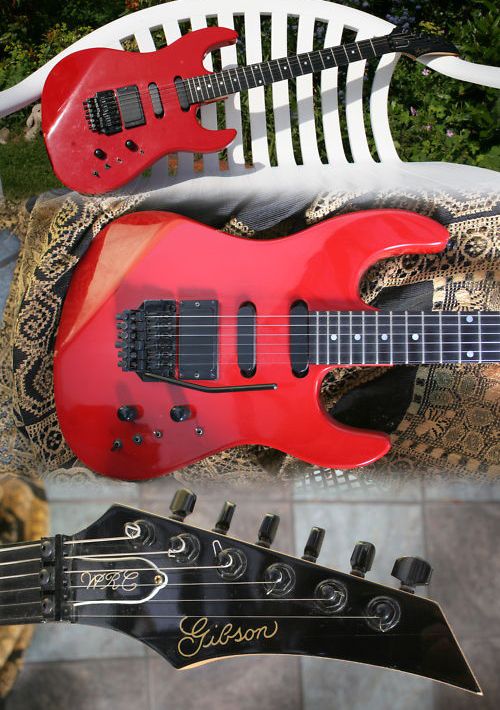
Gibson WRC, and there's absolutely no denying its Strattiness. Despite carrying the Gibson name, these were actually built by Wayne Charvel (his initials are W.R.C.) in 1987-1988. It's ironic in a way when you consider that Charvel is now part of the Fender empire. It's like some things come full circle.
In tried and tested Superstrat tradtion, the WRC is equipped with a Floyd Rose double locking trem. It has three pickups in SSH formation with a coil tap for the humbucker and individual toggles for each pickup allowing for a wider range of pickup combinations than the usual 5-position switch. In keeping with Fender-derived guitars it has a bolt-on neck, which is of the pointy headed variety as was the fashion when this guitar was made.
This guitar is currently being auctioned on eBay UK with a starting price of £795.
G L Wilson© 2011, Guitarz - The Original Guitar Blog - now in its 10th year!
12:11 PM |
Labels:
80s guitars,
Charvel,
Gibson,
superstrat
/
Can't say that I find the design of this early 1990s
Godin Artisan ST extremely sexy but it has something typically
Godin - a brand I quite like - in its way of keeping discreet while still proposing something slightly bizarre, but always relevant.
Here the very long upper horn where you attach your strap is quite ergonomic, allowing a better balance, when the lower horn logically almost disappears, since it is usually mere cosmetic. The result is probably disturbing 60 years after Stratocaster set the standard for electric guitars, but it is sensible and gives this guitar a nice personality, is spite and of its boring finish.
You'll notice the double dual blade humbucker in bridge position and the competition trem - all that making this guitar a shredding machine - though I still don't really get the concept of shredding, but who cares?
Bertram
© 2011, Guitarz - The Original Guitar Blog - now in its 10th year! Stratocaster
12:59 AM |
Labels:
Canadian guitar,
godin,
superstrat
/
A few weeks ago I was writing about the guitars I usually overlook when I'm browsing for new stuff to show on the blog, here is one of them - an
Ibanez again, the
S670FM. It's hard to tell when classicism turns into banality, but once you go over its boring shape, you find a pretty nice guitar, with a thin round mahogany body (the
Ibanez S series was intended to provide light guitars made of mahogany) and nice flamed top - I usually loathe this but it's actually agreeable when it's not spoiled by a glossy transparent lack. Even the light sunburst is swell!
I like the routing for the jack output, and the sophisticated trem with fine tuning thingummies (sorry I'm too lazy today for precise technical details). If I was given one (yes, I'm the kind of guy who tries to win a guitar for free in these internet giveaways, because I promised to myself not to buy a guitar anymore if it cannot pay for itself, and I don't have a current project that allows that), I'd just add chrome humbucker covers (uncovered pickups are not my cup of tea) and probably enjoy it because I have nothing in this style, and I trust Ibanez for the sound...
BertramGuitarz - The Original Guitar Blog - now in its 10th year!
4:01 PM |
Labels:
Ibanez,
Japanese guitar,
superstrat
/
guitarz.blogspot.com:

I thought I'd keep the Fender theme going a bit if that's OK. I've been promising myself for years that I was going to buy a Fender. My shopping list is "pre CBS Strat" (which I came within a hairs breadth of attaining once - 59 body 60 neck, metallic green respray out of a can £100), Telecaster Esquire, Thinline with bound body, Jazzmaster with anodised gold scratchplate (which I came within an eBay's breadth of attaining last year £3000 and some change (1958, excellent-mint condition - almost unbelievable).
My sights have lowered significantly of late apart from the '94 aluminium body that I'd bid and paid for before the seller decided he couldn't send it to my unconfirmed address and backed down.
I've only ever sold one item through eBay so don't have much experience as a seller so maybe someone can help with me something. What is with this "unconfirmed address" thing? Sellers won't post to an unconfirmed address even though eBay says they are still protected. I'm not sure why eBay doesn't just drop the option as, in their FAQs, even they discourage sellers from stating it in their ads as it reduces the chances of selling. Also, surely it's us buyers who more at risk from "sellers" who don't deliver. After all, you receive our money before you ship so we are taking a much bigger chance.
Anyway, back to the guitar. I was checking out my local online classifieds (loquo.com) and found someone who was selling a 2005 Squier Standard Strat for €125 (£104). I went along, looked it over and bought it.
Maybe it was just my expectations but this seems to be anything but standard. I guess it's a copy of another, high-end, Fender. It's obvious this wasn't going to be a luthier's wet dream but it's not bad, by any means. The body is matt varnished, tinted mahogany (looking not too dissimilar to my Mum's coffee table), maple neck and rosewood fretboard (as I understand). Big old 70s headstock - nice. The fittings are Squier, enough said. The middle and neck pickups are very bassy and boomy and the tone controls don't seem make one iota of difference whatsoever to the tone. Anyone had the same experience? And, is there anything I can do to brighten them up without changing the pickups? The bridge humbucker is hard edged aggressive and has a bright, dry, shrieky tone. I love it.
I'm not a great trem user and this two point trem seems very delicate. It moves when I bend the strings! I'm going to add an extra spring or two and see if that helps. If not, I'll lock it in place with some blocks of wood. Any tips or comments on that appreciated.
I shall be using this experiment with so it may well begin to transform, Frankenstein-like over time. Ha! Ha! Ha! Ha! Ha! Ha! Ha! Pass the soldering iron Igor!
Stop Press: Just seen a Squier Obey Telecaster for €150, hmmm Franken-Tele-Strat-stein-thing! Where is that saw? Seriously. Anyone have experience of these Teles?
David in Transylvania
Guitarz - The Original Guitar Blog - now in its 10th year!
10:01 AM |
Labels:
Squier,
Stratocaster,
superstrat
/
If the 1960s have been the time of wild creativity for Japanese guitars and the 1970s radically the contrary - the law-suit era when Japanese companies released copies of the US guitars better than the originals, the 1980s seem to have been the time of solid no-nonsense guitars that would allow Japan to establish a strong base for the coming (and profitable) metal era.
It's the case for
this guitar of unknown brand - unknown because it's been strongly retrofitted. The removal of the lack finish reveals the neck-through construction of the strat-like ash body - everything else is replacement: the
GFS power rail humbuckers, the
SG-style pickguard, the kind of tele knob plate next to the strat jack input...
For some reason I like this modest guitar - nothing like the extravagances I usually favor, maybe because it reminds me somehow of my good old
Kawai Aquarius...
BertramGuitarz - The Original Guitar Blog - now in its 9th year!
5:42 PM |
Labels:
80s guitars,
Japanese guitar,
superstrat,
What's that guitar?
/
Can we show a guitar just because of its colour? Well I guess we can - to be honest I wouldn't have looked at this
Hohner ST Lead if not for its pink shocking so 1980s (the guitar is actually from the late 80s, early 90s).
When you google this guitar, you mostly find questions of people who want to know more about it - and sometimes that it's a good professional instrument with a graphite neck, and how difficult it is to find replacement parts for it, since Hohner almost completely backed off from the guitar field...
This one is a lefty, and we never show enough!
BertramGuitarz - The Original Guitar Blog - now in its 9th year!
12:23 PM |
Labels:
German guitars,
Hohner,
left-handed,
superstrat,
wacky finishes
/

(Almost) everyday I search the Internet about guitars, to learn more about them, to feed this blog, or to see what I will buy (or more likely not buy) to improve my guitar work (and my GAS). I look for special guitars, often vintage ones because we are living in strange times, when most guitar makers and lovers are stuck in the 1950s and consider that the first models built are for ever the best ones, then to find the innovation and creativity we lack nowadays, one has to go to the 1960s and 1970s (I know, I know I said this already but we have new readers all the time!)...
So I look for special innovative guitars in term of sound, technology and design, but also for classics to have a better understanding of the history of electric lutherie, but what I see the most on the web are guitars like this
Jackson Soloist the so-called superstrat aimed at metal shredding! And when I have to select a guitar to post here, I always overlook an endless stream of
ESP,
PRS and other
Jacksons to find the
Teisco or
Eko gem, the one-off built in a garage by an obscure genius or the tripping East-german bizarro that we'll enjoy together. Once in a while I try to show a superstrat to keep connected to the whole guitar universe but I don't have much to say about it like today (did you notice the tigerish finish? about as scary as a stuffed kitten - exactly what you need to play hair metal).
I know that metal is the most spread style of pop music, but there is something twisted in the guitar business, because of all the kids who buy a superstrat in the hope of becoming the next Kirk Hammett, only 1% will actually learn more or less how to play - since shredding is highly technical and difficult, and 1% of these 1% will do something good out of it. If they would play good old garage rock, they would enjoy themselves much more, reach a better result in a few months, and play much cooler guitars, wouldn't they?
2:11 AM |
Labels:
Jackson,
Rant,
superstrat,
wacky finishes
/
This is an
Aria Pro II Integra, quite special for a superstrat (I think that this is still a superstrat, however far it is from a stratocaster), with its prominent upper horn. The construction looks really serious, and the design is well balanced - neither fancy nor boring.
You might be surprised but I have a few friends who play jazz on this kind of guitars - not the kind of blues-based old school jazz you play on a semi-hollow with a beard and a smoking pipe between your teeth though - since they are excellent instruments, reactive and as fast as a virtuoso can expect. They usually use plenty of pedals and digital modeling amps, and save money to buy a Parker Fly - and think that my Breadwinner looks like a metal guitar...
Guitarz - The Original Guitar Blog - now in its 9th year!
10:50 AM |
Labels:
80s guitars,
Aria,
Japanese guitar,
pointy guitar,
superstrat
/
On the comments of the previous post we've been debating about what is a
superstrat. For me this
Caparison Dellinger is a perfect example: based on Leo Fender's 1954 double cutaway design, it has its horns elongated while the back on the guitar stays classic, and the headstock is pointy because a superstrat has to be pointy. The main pickup is the bridge humbucker, the trem is a Floyd Rose, there are only two knobs, and there are 24 frets on the neck.
You don't take risks with such a guitar, it's tasteful though a little bit boring, and you can play plenty of notes very fast with it I assume.
Guitarz - The Original Guitar Blog - now in its 9th year!
11:17 PM |
Labels:
Caparison,
Japanese guitar,
pointy guitar,
superstrat
/
I've stated here a few times that I don't like strats, and not shredding either, so of course superstrats are not particularly my cup of tea. However, this early 90s
Hohner Revelation RTX caught my eye, first because of its bizarre finish I guess, but also because its shape reaches a strange mix of elegance and extreme pointiness that you usually find in Japanese early 70s guitars such as the
Tokai Hummingbird...
Unfortunatly I couldn't find much information about the
Revelation,
Hohner is more known for its current
ergonomic and headless guitars and basses (and great harmonicas, I have a few of them), but beside the shape I like the H|S blade pickups, the 4 + 2 headstock, and the
Wilkinson trem bridge.
Guitarz - The Original Guitar Blog - now in its 9th year!
6:07 AM |
Labels:
German guitars,
Hohner,
pointy guitar,
superstrat
 RSS