Posts RSS RSS

Welcome to our site

You can replace this text by going to "Layout" and then "Page Elements" section. Edit " About "
Showing posts with label east-European guitar. Show all posts

Customised Jolana Disco Bass

/

guitarz.blogspot.com:

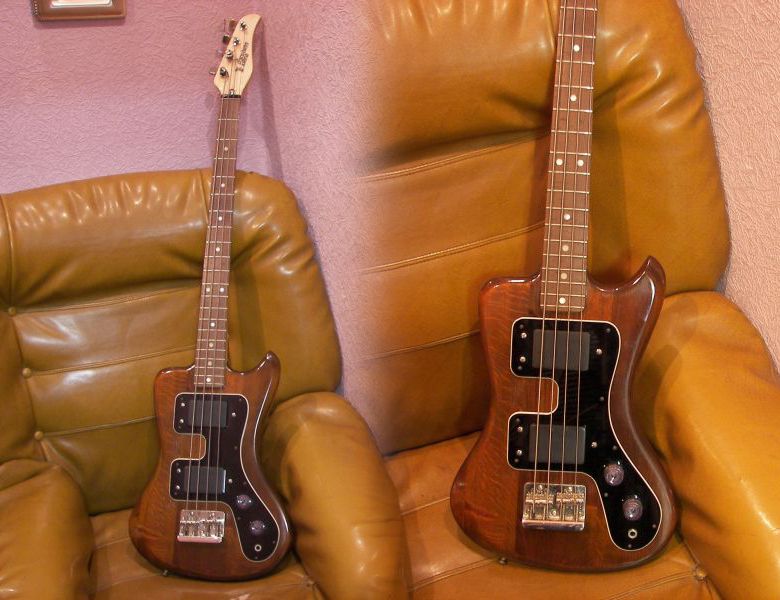
As a postscript to yesterday's blog post, here is another Jolana Disco Bass belonging to Guitarz reader Philipp Kostov. The bass's previous owner has re-shaped the body and stripped it back to a natural finish - surprisingly it looks like it's made from some pretty nice timber. These old "Behind the Iron Curtain" guitars are getting increasingly collectable as more people discover their existence (and, often, their affordability) but this customisation is likely to incur the wrath of the collectors. Personally - and I know I've written a lot about how people should leave vintage guitars alone and take out their urge to modify on cheap modern-day Chinese-made guitars - I quite like the new shape and finish on this particular Disco Bass. I guess the point is that if you really HAVE to customise something, just make sure you do a first class job.

See here for more of Philipp's guitar collection (including more Jolana guitars and basses).

G L Wilson

© 2012, Guitarz - The Original Guitar Blog - now in its 10th year!

Jolana Disco Bass - another 1980s Czechoslovakian wonder

/

guitarz.blogspot.com:

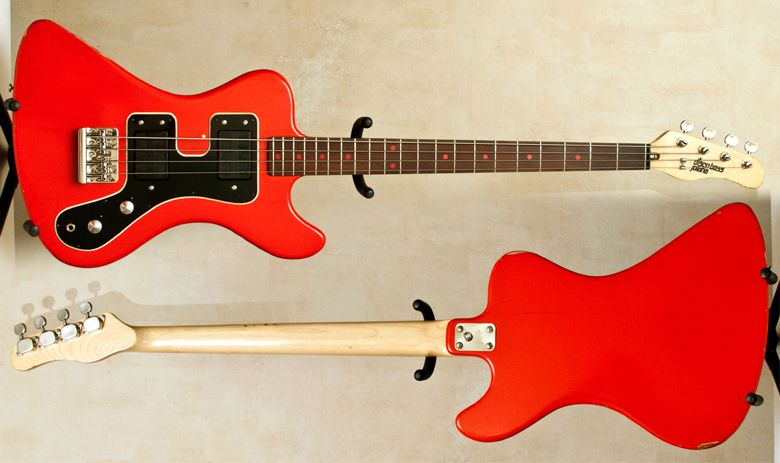
Seriously, if I had the means right now, I would buy this Jolana Disco Bass. The eBay listing has some particularly clear close-up photos and although it's quite apparent that this is a used instrument and shows signs of wear here and there, it is in exceedingly good condition.

Although quite obviously from the same stable, the Jolana Disco Bass has quite a different design to the Jolana Disco 6-string guitar; whilst the guitar looks to be a Burnsian interpretation of the SG, the bass has been styled after the Gibson RD Artist. They share the same giant-sized humbuckers although the bass has a pair of these against the guitar's single unit. Tuners and bridge are of the same design and even the pickguard follows the same design rules.

The controls are simple with no pickup selector, no tone controls, but just a volume for each pickup - which couldn't be further away from the instrument that the body shape is copying. I believe that the "1970s transistor-radio" style knobs on this example are not original, and that it would have originally have had the same chunky clear plastic knobs as used on the Disco guitar.

This particular Disco Bass is finished in a vibrant red; I really like how the colour is echoed by the dot inlays on the fingerboard.

Possibly, with a Buy It Now price of $400, this is a little over-priced, but having said that it is a particularly nice example.

G L Wilson

© 2012, Guitarz - The Original Guitar Blog - now in its 10th year!

1980s Soviet-era Czechoslovakian-made Jolana Proxima guitar

/

guitarz.blogspot.com:

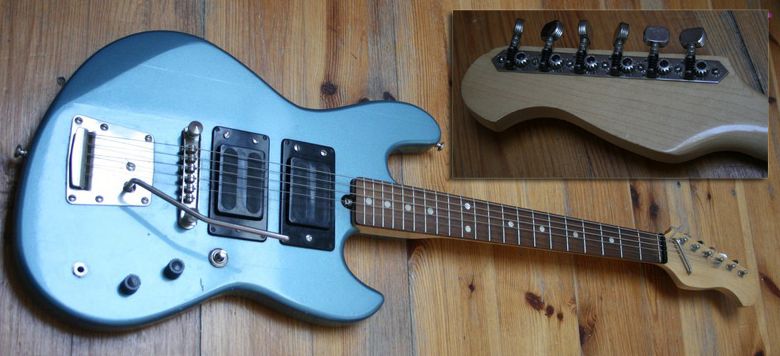
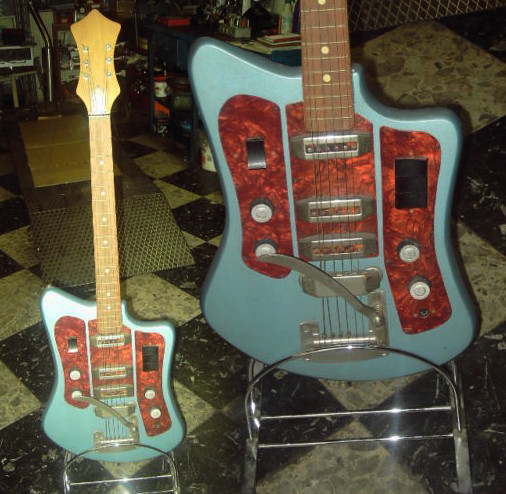
There's a lovely Jolana Proxima being offered for sale on eBay UK with bidding currently at £65 at the time of writing. I'd dearly like to join in the bidding myself, but do not have the funds (nor the space) available right at the moment. The Proxima, made in Czechosolvakia in the 1980s, is a close relative to the Jolana Galaxis guitar which had pickups and controls front-mounted on a pickguard, Strat-style.

The guitar appears to be in excellent condition, although strangely the Proxima logo is missing from the headstock. Pickups are a pair of huge humbuckers, identical to the single unit on my Jolana Disco. The chunky machine head buttons are another item these guitars have in common. The tremolo/vibrato is of the Jazzmaster persuasion, which I guess is in keeping with the Proxima's offset body design.

Thanks to Alex for bringing this guitar to my attention.

G L Wilson

© 2011, Guitarz - The Original Guitar Blog - now in its 10th year!

Vintage & Rare guitar of the week: Fibernare Erotic Regime from Hungary

/

guitarz.blogspot.com:

Regular readers of Guitarz will know that we are enthusiastic about East European guitars, particularly those from the Soviet era. It's not often that we look at contemporary instruments coming from Eastern Europe.

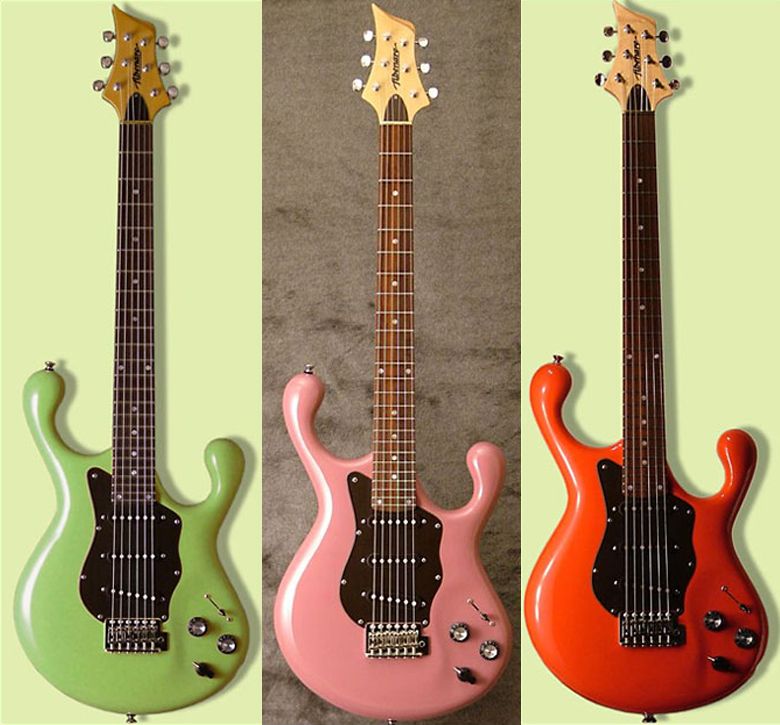
Fibernare Guitars are made in Hungary by the Benedek brothers. In the 1980s the three brothers Attila, Csaba and Árpád, disparaged by the price and availability of electric guitars in their country were encouraged by their father to build their own. Other guitarists took notice of their self-built instruments and very soon they were building guitars for others too. Eventually this led to the establishment of Fibenare Guitars Co. in 1998.

The Fibernare Erotic Regime is the Brothers' take on the traditional three singlecoil pickup guitar, and thankfully looks very unlike the most famous exponent of that species of guitar. The Regime is part of Fibernare's "Erotic" series; with those curves you can see where that name comes from. The sculpted fluid-like body design looks as if it could be molded from some kind of high density polymer, but is in fact carved alder. The neck is, appropriately Hungarian alder; it's a bolt on design with a sculpted heel to ease access to the highest of the 24 frets.

The Regime is super lightweight at only 6 lbs and has a cunning control layout allowing the player to morph seamlessly between the most glorious Strat and Tele tones with the greatest of ease. The controls consist of volume and tone pots, 5-way pickup selector, and 3-way rotary switch which allows for the following settings:

1) Front position on rotary: standard strat 5way selection; 2) Middle position on rotary: neck and bridge pickups wired together in the 1st and 5th positions, 2nd and 4th positions is all 3 pickups, 3rd position is middle pickup; 3) Rear position on rotary: neck pickup phase inverted (PI) and wired to the output so: 1st position PI neck pickup, 2nd and 3rd position PI neck with middle pickup, 4th position PI neck with middle and bridge pickups, 5th position PI neck with bridge pickup.

The Fibernare Erotic Regime is available via Vintage & Rare priced at €2150.

G L Wilson

© 2011, Guitarz - The Original Guitar Blog - now in its 10th year!

1960s Defil Malwa thinline

/

Like many instrument of this vintage Polish company, the Defil Malwa is a strange mix of elegance and crudeness: it has a subtle outline and Framus-like cats-eyes sound holes always look cool, but the gear and the finish feel rough - though the knobs and trapeze stoptail are without doubt replacements parts. These guitars have often bad reputation but I heard some demos on YouTube that are not that bad.

BTW, did you know that Defil stands for Dolnoslaska Fabryka Instrumentow Lutniczych (Instruments Factory of Lower Silesia)? And that Malwa refers to a plant genus that includes hollyhocks - those tall and beautiful flowers that grow all over Amsterdam in summer when girls are shortly dressed, air is perfumed with suave cannabis fragrance and life is light - and mallows - with which marshmallows are made?

Bertram

© 2011, Guitarz - The Original Guitar Blog - now in its 10th year!

1959 Jolana Neoton hollow body electric from Czechoslovakia

/

guitarz.blogspot.com:

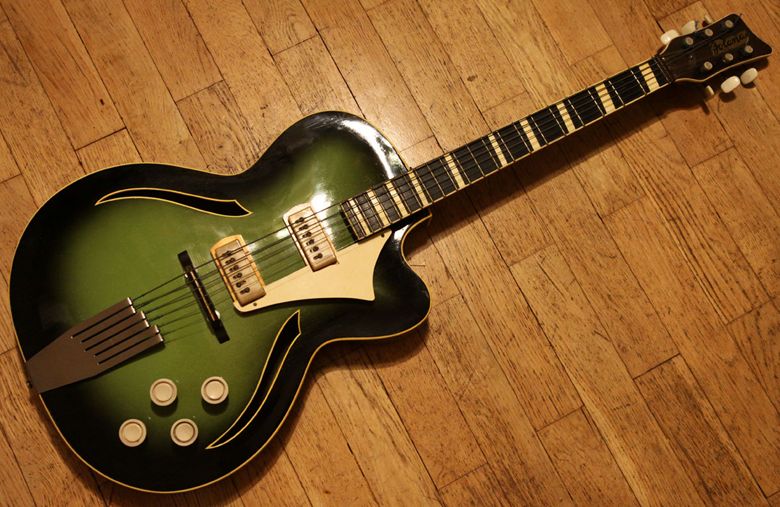
You know that here on Guitarz we are particular fans of guitars from behind the Iron Curtain, and here is another one, a Jolana Neoton electric hollowbody jazz-type guitar in greenburst finish. I have no way of telling how way it plays - or should I say how playable it might be after a proper set-up - but if I had the readies available I would buy this for looks alone because as an object it is a thing of beauty.

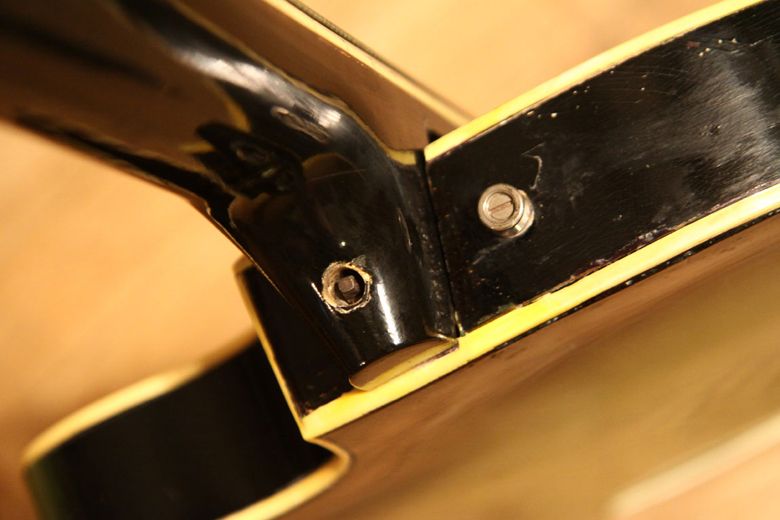
I must admit the neck adjustment fills me with dread. When I was a kid, my family used to have an old Russian acoustic with a neck set like this and it was ghastly.

Currrently listed on eBay with a starting price of £169 and with free shipping within the European Union.

G L Wilson

© 2011, Guitarz - The Original Guitar Blog - now in its 10th year!

1980s Soviet-era Czechoslovakian-made Jolana Disco: piece of unplayable junk OR single-pickup wonder?

/

guitarz.blogspot.com:

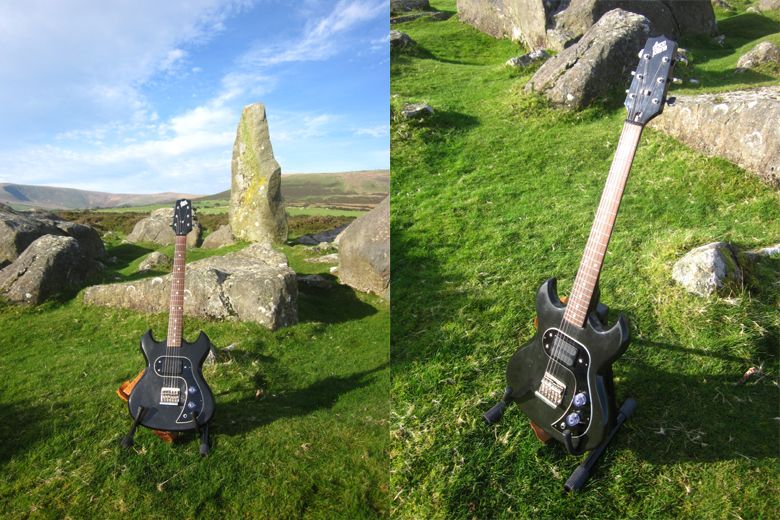
Regular readers of Guitarz will know that we have a particular affection for Soviet-era East European and Russian guitars. When I saw this Jolana Disco guitar from 1980s Czechoslovakia listed on eBay UK recently with a Buy It Now price of just £60, I knew I had to buy it; indeed I think I would have been failing in my duty as a Guitarz author if I hadn't.

The Jolana Disco is a very basic model guitar, that much is obvious just from looking at it. It's a no-nonsense, simple electric guitar. Single pickup, volume and tone controls, no trem or any other fancy gubbins. The design, whilst quite clearly derived from the Gibson SG, is squat, pointy and - dare I say - it's a little bit of an ugly duckling. In fact it reminds me of certain Burns guitars, and I mean that as a compliment.
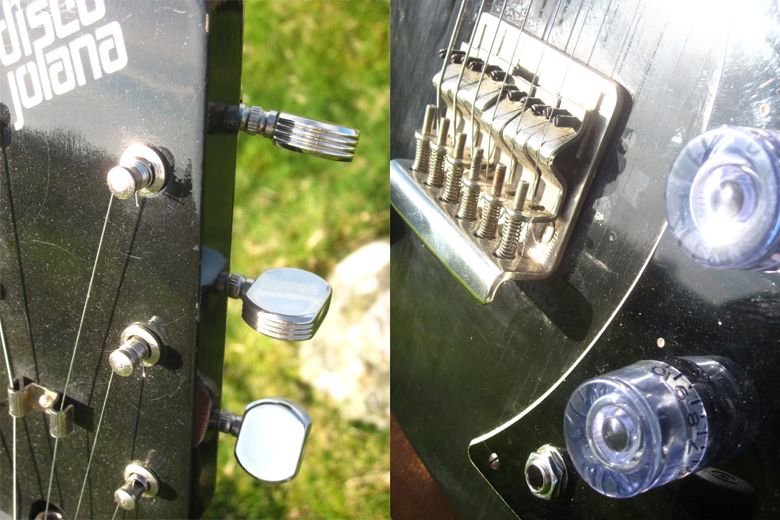
Because it was made in Soviet-era Eastern Europe we do not have here a guitar be-decked with all the same hardware - pickups, tuners, bridge, etc - as found on countless other brands. The Jolana features home-grown hardware which makes it all the more idiosyncratic. The tuners, for example, are huge and, in my estimation, quite attractive. They are hardly the best tuners in the world, but they seem to do the job. The bridge is highly engineered and shaped from pieces of sheet steel, and is fully adjustable; it looks a little unusual when we are so used to seeing the same old bridges everywhere, but it is fully functional and does the job.

The finish is black and THICK. I suspect that it may hide a body of cheap timber - I don't think it's plywood because you normally see the telltale ridges of ply where the finish has sunken in around the sides of the guitar.

The Jolana Disco has just a single pickup, and what a pickup it is! It's a HUGE humbucker and is positioned slap bang in the centre of the guitar's body. To my ears it sounds great and can provide everything from a crystal clear bell-like tone to downright raunchy overdrive. The positioning might throw a few people, and although I'm not usually a fan of tone controls on guitars, in this instance the tone control is essential in making sure you have the required amount of treble.

The volume and tone controls have over-sized chunky clear plastic knobs which I find quite ugly, and which do look rather cheap. The pickguard (or scratchplate) is quite minimalistic and is essentially an over-large pickup surround combined with a control plate.

I've read reviews of this guitar where the owner has commented with words to the effect that it is virtually unplayable. Well, either they had a particularly bad example, or else - as I suspect - they weren't trying hard enough to get on with the guitar and to allow it to shine.

I admit I found it awkward to play at first. The biggest hurdle to overcome is the high radius of the fingerboard. Boy, that fingerboard ain't half got a curve to it! If you prefer your fingerboards flat or virtually flat, you'd be in for a shock with this Jolana. Still it doesn't take too much perseverance to become accustomed to the fingerboard radius, and I feel the results are well worth it because this guitar is quite playable once you get over that initial shock.

The other thing that might freak you out is the position of the pickup, which as I have mentioned already is slap bang in the centre of the body. I hear so many people say, "Oh, I only ever use the bridge pickup," and that is something that never ceases to amaze me. I think this goes back to guitars that have those stupid "Rhythm/Treble" legends on their pickup selector switches (Yeah, Gibson and their imitators!). Put simply, the mental process goes like this: Lead guitar is cool, rhythm is boring. Who wants to be a rhythm guitarist? So this totally erroneous notion that the neck pickup is the rhythm pickup and the bridge pickup is the lead pickup, i.e. the COOL pickup, has been perpetuated. Well, it's complete bullshit. Most guitarists rate Jimi Hendrix, so I say to them check out video footage of Hendrix (the Hendrix at Woodstock DVD is a good one), check out the close ups and tell me what pickup he uses for most of his solos. Yup, you've guessed it, it's the neck pickup. And then tell me that that's NOT lead guitar playing.

So, for a single pickup guitar, I'd argue, the obvious position for a pickup is in the centre. It's neither too trebley nor too bassy. Sure, it's a compromise to some people, but as I've said you can bring the tone control into play. And really, I think that's all you need.

So yeah, I LIKE this little ugly duckling of a guitar. I admit the action could be improved upon, it has a slight tendency to neck heaviness (small body, large headstock) and it does have a few little rattles here and there, but to me these add to the character of the instrument. All in all, it's a highly playable no-nonsense guitar, and I would happily play it in a band situation.

G L Wilson

P.S. The photos in this blog post are my own work, so please do not copy or re-use without asking permission first!

© 2011, Guitarz - The Original Guitar Blog - now in its 10th year!

Unusual left-handed baritone guitar from Budapest

/

guitarz.blogspot.com:

Hello,

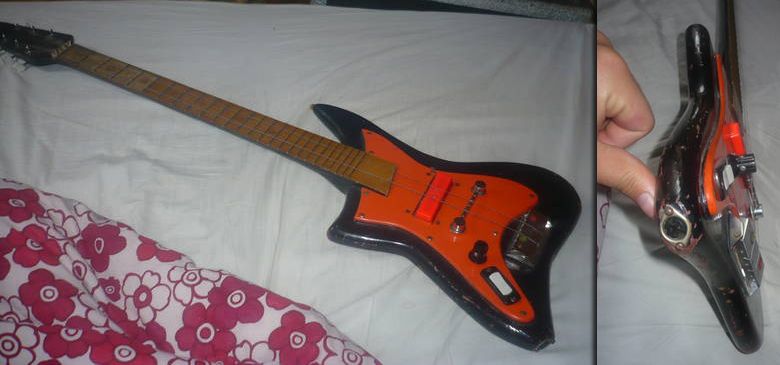
My name is Daevid, I live in France and I really like your guitar blog. I have pictures of a friend's baritone left-handed guitar from Budapest that you will be insterested in, I think. It's a small guitar with a strange XLR output.

Daevid
Hi Daevid, thanks for sending those pictures. It's certainly an oddity. I wonder if any of our readers might recognize this guitar and perhaps be able to tell us some more about it.

G L Wilson

© 2011, Guitarz - The Original Guitar Blog - now in its 10th year!

One-off über-psychedelic Migma doubleneck bass/guitar

/


Who can think of former East-Germany as a place and time of stern and dull design? Look at this  Migma doubleneck bass/guitar (it sports no brand but its look and finish cry Migma - there were some models shared with twin brand Musima but Migma was into wild post-accordion finishes) and praise whoever could have conceived and built this delightful monster.

Its fierce horns exceed their Burns model to reach an almost Wandre extravagance that allows the mother-of-toilet-seat-from-hell finish to escape Mitteleuropean kitsch to rocket to the crepuscular twirls of psychedelic heaven! I would love to listen to the music for which it was conceived... And I wish this guitar was mine!

This guitar is too crazy to be a series one - its seller on eBay.de (the excellent e-shop Vintage*Guitar*Collection) says that it's unique, so it must be a custom job... I don't know about Migma, but it seems that in Markneukirchen where most of the GDR music instrument companies were established, more or less everybody was a luthier, and people would easily have an atelier at home and make some extra instruments upgrading company models - their version of nowadays custom shops. 


Bertram

© 2011, Guitarz - The Original Guitar Blog - now in its 10th year!

Musima 8-string mandolin with german carve

/


This is not a GDR guitar but its baby sister, a beautiful vintage Musima mandolin. I'm not a specialist but I've never seen one like this, with its wide german carve and wooden pickguard. Remember that Musima was not just a guitar company but produced all kind of music instruments, and you can still find accordions, zithers and violins auctioned online.

Bertram

© 2011, Guitarz - The Original Guitar Blog - now in its 10th year!

Jolana Rubin - 1970s Soviet-era Czechoslovakian semi-hollowbody bass

/

guitarz.blogspot.com:

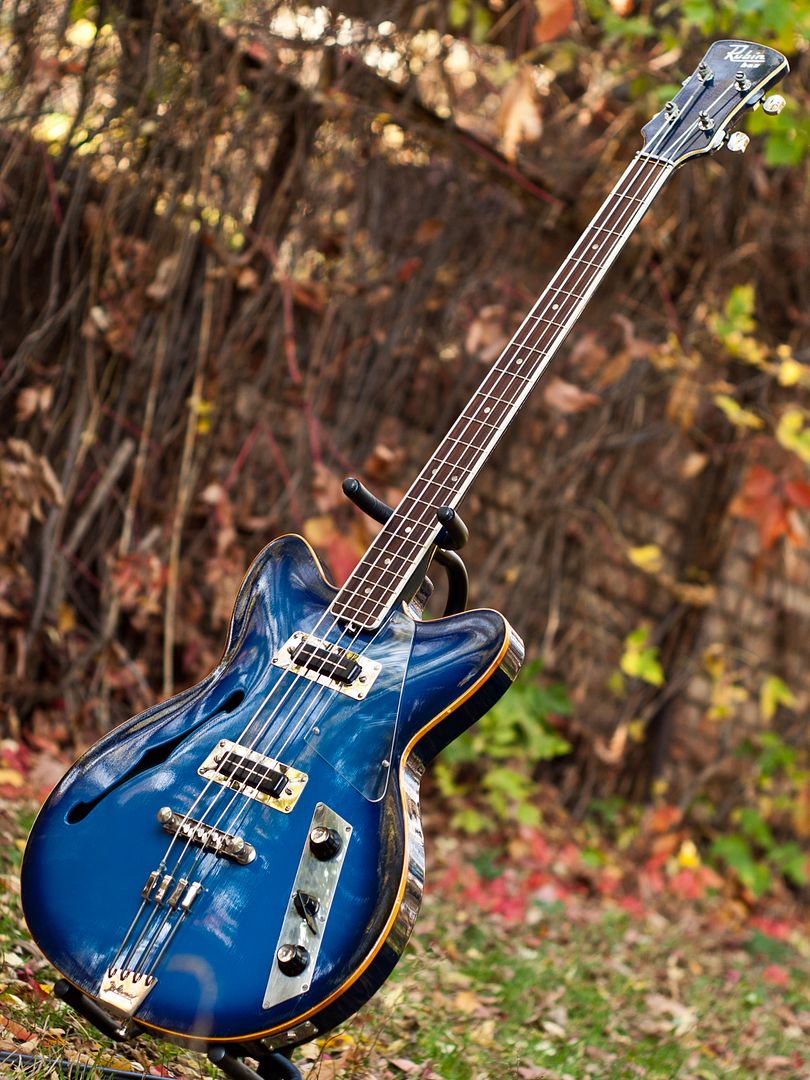
This Soviet-era Czechoslovakian semi-hollowbody Jolana Rubin short-scale bass really does look quite glorious. I've no idea what it sounds like or how it plays, but I want it.

I am reminded of the Orfeus Hebros bass from Bulgaria that we looked at in November 2009; it's similar, but if anything this Jolana is nicer. Note the single f-hole, the clear pickguard and trapezium-shaped metal control panel, not to mention the glossy blue burst finish.

This instrument is currently listed on eBay and with a day still to go before the auction finishes, bidding is at $350 (at the time of writing). These old Soviet-era Eastern European and Russian instruments are becoming ever more increasingly popular, and - as you may have noticed - we here at Guitarz have been fans for quite some time already.

G L Wilson

© 2011, Guitarz - The Original Guitar Blog - now in its 10th year!

Osbama Tango acoustic guitar

/


The Osbama brand stands for Oswald Bachmann Markneukirchen - Markneukirchen being this town in Saxony (next to the Czech border) famous for its music industry since the late 17th century. Situated in GDR after the WWII, it is where many of these electric guitars we enjoy so much have been conceived and built, and many East-German brands you are familiar with included its first syllable in their names - Musima, Migma, Marma...  

The Osbama Tango was a very successful model at the time, combining traditional music quality and art-deco design - the lightning sound holes are particularly bold and elegant. Like often, its lines are more dynamic and elegant that it equivalent from West-Germany, with which it still shares the inevitable German carve and blonde finish.

An interesting fact - that might explain why it is sometimes so difficult to gather information - is that these guitars were usually not branded to ease their distribution in the black market. Both in the east and the west, post-war Germany was avid of entertainment, and musicians were often retributed with black market goods from occupation armies, including instruments, and a good Markneukirchen guitar was appreciated in the west, though it was better if it was untraceable...

Bertram

© 2011, Guitarz - The Original Guitar Blog - now in its 10th year!
Car
Tango Osbama

Jolana Iris bass - faux thinline Tele bass from 1970s Czechoslovakia

/

guitarz.blogspot.com:

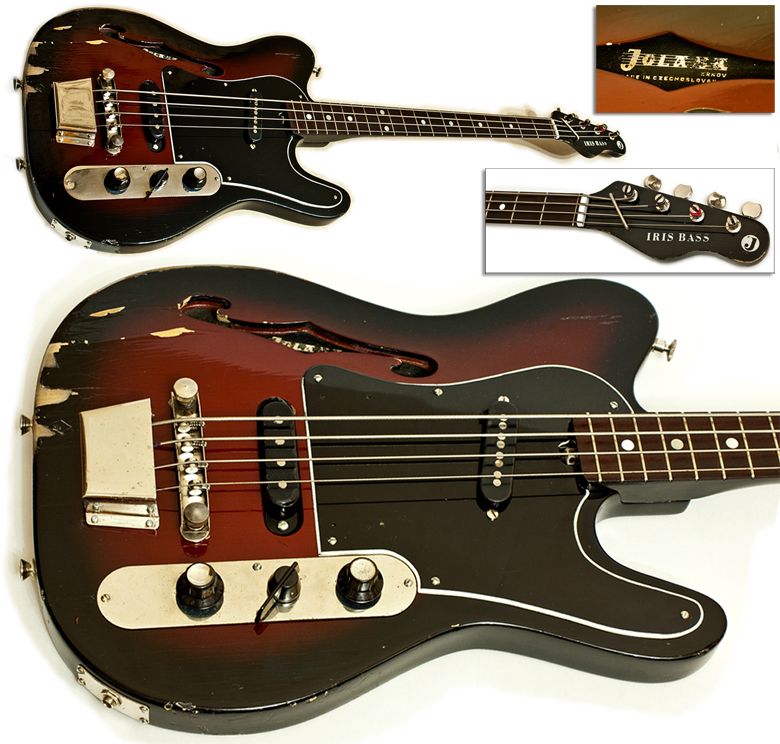
Here's another Czechoslovakian-made Jolana, the Jolana Iris bass, a short-scale bass styled roughly after the Fender Telecaster Thinline (of which there never was a bass version). However, this is not a true thinline as the photos reveal; at the angles shown you can see that the "chamber" beneath the f-hole is barely larger than the shape of the hole itself. It's all about aesthetics and the hole gives a good place to locate the Jolana logo.

This example looks to have been well used and isn't in as good condition as the Jolana Iris guitar we looked at before. Still, it'll appeal to those who like "relics".

G L Wilson

© 2011, Guitarz - The Original Guitar Blog - now in its 10th year!

1970s Czechoslovakian Jolana Star IX guitar a.k.a. the Screwdriver

/

guitarz.blogspot.com:

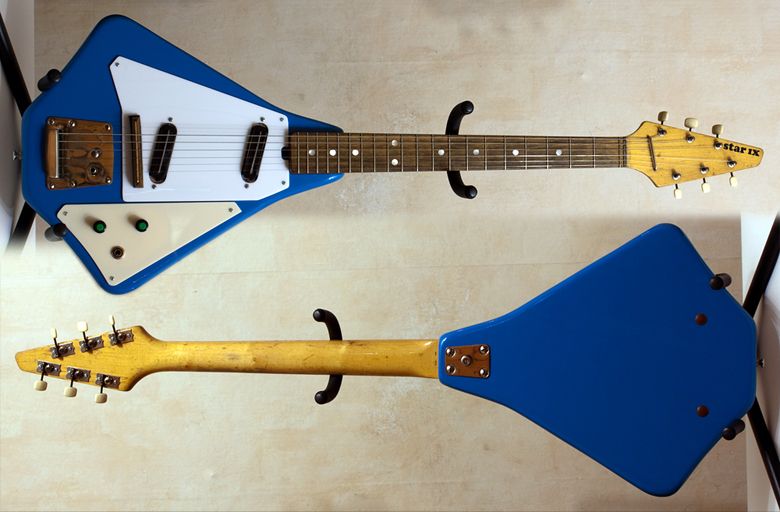
According to the seller of this guitar, it is known as the Screwdriver because of its shape. Made in Czechoslovakia in the 1970s, this Jolana Star IX with its "screwdriver" shape doesn't very much resemble the Jolana Star X that we looked at here on Guitarz back in August 2009. The Jolana Basso IX that we looked at in December 2009, however, does share the same shape. It's nice to see what the control plate on this design should look like (the Basso IX we featured had a home-made replacement), but I doubt the knobs are original. Alas, the original pickups are missing their covers, and the trem arm would appear to be similarly absent.

This guitar is currently being auctioned on eBay with a starting price of $200.

For more about Jolana guitars, see Cheesy Guitars!

G L Wilson

© 2011, Guitarz - The Original Guitar Blog - now in its 10th year!

Vintage PerlGold Jazz Guitar

/


Here is a nice Pergold semi-hollow body guitar, with 3 single coil pickups, the typically East-german tail in its long-harm trem version, a strange perloid pickguard and 4 knobs following the external curve of the body. You will notice something I've seen on several of these guitars, the lower part [I think you mean "higher" - GLW] of the fingerboard is unfretted, where it is anyway inaccessible...

Pergold was a high-end guitar brand from DDR - for what I understood, information about it is scarce...

Bertram

© 2011, Guitarz - The Original Guitar Blog - now in its 10th year!

Orfeus Thinline review

/

guitarz.blogspot.com:

Recently here on Guitarz, Bertram showed us an Orfeus thinline guitar. Pictured above we see another similar Orfeus guitar, owned by Martin Cater, who has kindly supplied the following review:

I own a couple of other Communist-era guitars and, in common with those models, the tone of this Bulgarian-made Orfeus is best described as having not so much twang as clank! Information on Orfeus guitars is scant, but comparing this one with images I’ve seen of others, I would hazard a guess that it dates from the late 60s or early 70s.

It’s undoubtledly a crude instrument, though not without a certain character. The body is semi-hollow, not unlike the Rickenbacker 330 which probably inspired the design (if you can call a thing like this inspired), and there’s additional wood in the centre which falls short of being a centre block as there’s a narrow gap through the middle. The top is about 5mm thick and as can be seen from the photos, it’s quite an attractive piece of wood. The finish is the kind of matt varnish you might expect to find on a piece of furniture or maybe an acoustic guitar. The top and back are natural wood, whilst the sides are a contrasting dark brown matt stain. It’s impossible to be sure if either of these finishes is original. What appears to be binding is nothing more than a white painted strip around the edges of the top and back and the soundhole.

The neck is thick and fat, with a squareish profile that’s reminiscent of old Italian acoustics, and no separate fingerboard – the frets are just hammered straight into the neck. Action is on the high side, but not unplayable. The unusual string retainer seems to be typical of Orfeus models, as is the zero fret.

All the equipment appears to be original and is consistent with photos of other Orfeus instruments that I’ve seen. Typically, the name is spelled differently on the headstock and on the pickups, which seems to suggest models made for export. One of the strangest aspects of the guitar is the bridge, with saddles which appear to be made of perspex. This seems to be a standard type used on other Orfeus models. The three large control knobs comprise volume for each pickup and a third control which is probably a master volume but doesn’t have any effect. The 5-pin din output is typical, but luckily the guitar was supplied with the correct lead.

There’s a fair amount of volume when played acoustically, and plugged in, the tone is very much that of a cheap amplified acoustic: thin and middly with barely any sustain. Single notes have an almost sitar-like quality on the top three strings, especially when the volume is rolled off on the neck pickup. Both pickups combined give a pleasantly mid range Johnny Marr-style tone which sounds surprisingly good on strummed chords. Output is quite loud compared with other cheap vintage instruments, and whilst it doesn’t take kindly to distortion, what you do get when you crank it up is a primitive boxy growl that sounds for all the world like Dave Davies’ shredded speaker tone on You Really Got Me. This is essentially a Bulgarian chord machine!

The nearest thing to this that I’ve played is a Harmony Rebel – also Rickenbacker-inspired, and with a similarly crude finish and clanky tone.

Martin Cater

© 2011, Guitarz - The Original Guitar Blog - now in its 10th year!

Orfeus thinline

/


The only thing you can be sure about Bulgarian communist-era Orfeus guitars is that they often look like no other guitars... That's the case with this one, about which I unfortunately know nothing... 

Like many of these east-european guitars, it looks like it was designed by someone who heard a description of an American model (here could be a Rickenbacker) and tried to recreate it in his own way - like when in the Middle-Age people having heard of a rhinoceros envisioned it as an unicorn... For example Orfeus had a model called Джипсон - Djipson - a Bulgarian interpretation of Gibson...

BTW, a Jazzmaster trem looks good on thinline, isn't it?


© 2011, Guitarz - The Original Guitar Blog - now in its 10th year!

Badly refinished Jolana Superstar

/

The late 1970s Czechoslovakia made Jolana Superstar is supposed to have been inspired by the Peavey T60 but to me it looks more like a Yamaha SG - that would mean that after all, while Japanese companies were busy copying American guitars, their own models were copied too!

One can't help noticing the ultra-wide humbuckers, the massive bridge and the oddly placed switches; it's a pity that this one is such in bad condition because I saw some in a better state that are quite appealing guitars...

Bertram


Guitarz - The Original Guitar Blog - now in its 10th year!

Defil Jowita 12-string

/


A vintage semi-hollow body Polish Defil Jowita 12-string with flat top, cat's eyes soundholes, undefined pickups - some reviews I read say it sounds bizarre but not bad... 

I like the very modernist feel of this kind of design - simple, sharp, elegant -, it has something optimistic from a time you could still believe in human and guitar progress.

Bertram


Guitarz - The Original Guitar Blog - now in its 9th year!

Formanta Borisov from Belorussian Soviet Socialist Republic

/

formanta borisov


Another Soviet guitar - literately - this 1980s Formanta with its rough switches (for built in effects) is one of my favorite eastern guitars. I missed one on eBay a few months ago and I still sigh with melancholy just recalling this...

This guitar had many interesting finishes, I like this combination of metallic blue, perloid brown and mate aluminium - I saw it in different sunbursts, mauve and even a sparkle pink one that didn't look silly at all!

Bertram

Guitarz - The Original Guitar Blog - now in its 9th year!