/
guitarz.blogspot.com:
We've already looked on in horror and dismay when confronted with modifications made to vintage and classic guitars. Time and again, we've said, if you're going to mess around with something choose something cheap and Chinese-made that nobody is going to lament the demise of if it all goes horribly wrong (as it so often does).
Thankfully we have no worries in this instance for here we see what was a vaguely Les Paul-style very
basic bolt-on neck Epiphone Special Plus which surely has been enhanced by the modifications performed on it. This is a cheap guitar that has been vastly improved through modification. This is the type of self customization that we like to see on
Guitarz.
The eBay seller describes the work carried out on the guitar:
The body was cut in half. The inside was routed to leave roughly 1/2" sides, a 1/4" top and back, and a 4" solid core running from the neck pocket to the end of the stop tail. A sound hole and control access holes were cut in the top. The body was re-glued and then routed for a middle pickup. The finish on the neck is still the factory polyurethane, but the body was stripped and refinished in nitrocellulose. The body finish is thin and a little bit coarse in some areas. An aluminum pickguard was added, along with aluminum truss rod, control cavity and jack plates. The stock pickups were pulled and replaced with a set of three handmade humbucker sized blade single coils built around exposed alnico 5 firebird magnets. One master volume knob, one master tone knob and three individual on/off switches for each of the pickups.
Currently listed on eBay with the auction due to finish later today. Bidding has been keen already, although I doubt it'll sell for big money. Bidding is at $127.50 at the time of writing.
G L Wilson© 2011, Guitarz - The Original Guitar Blog - now in its 10th year!
3:40 AM |
Labels:
customised,
Epiphone,
Les Paul,
modifications
/
guitarz.blogspot.com:
This
1964 Epiphone Embassy bass in cherry finish was owned by the late John Entwistle of The Who, and is one of the instruments featured in his book "Bass Culture". The bass is said to be in excellent original condition; it features Thunderbird pickups, and is still in the same condition as when John set it up with Rotosound strings.
You'll notice the design similarities with the
Epiphone Newport bass we looked at recently, although with the bridge-biased Thunderbird pickups on the Embassy you could expect a more "rocky" sound.
Having said that, it's highly likely that this bass will be bought as a collector's piece or as an investment, given its provenance. It is currently being offered for sale, via
Vintage & Rare, priced at €8000.
G L Wilson© 2011, Guitarz - The Original Guitar Blog - now in its 10th year!
8:23 AM |
Labels:
bass,
cool guitars,
Epiphone,
John Entwistle,
Vintage and Rare,
vintage guitars
/
guitarz.blogspot.com:
Please forgive the brevity of today's blog post, but I am experiencing computer problems and have limited time on a borrowed PC.
Here we see an
Epiphone Newport bass from 1966 - that is, back in the days when the Epiphone name meant something quite cool and when they weren't just the budget guitar arm of Gibson with their name slapped on a stream of Korean and Chinese-made Les Paul and SG copies.
It's a gorgeous bass and obviously a sibling to the Wilshire guitar series. Judging from the position of the single pickup at the neck, the sound probably wouldn't suit modern playing styles, although personally it's a sound I love. Each to their own.
G L Wilson© 2011, Guitarz - The Original Guitar Blog - now in its 10th year!
2:37 AM |
Labels:
bass,
Epiphone,
vintage guitars
/
Yes Ma'am, this
Epiphone Zephyr Emperor Regent is all this - Zephyr, Emperor and Regent, on top of being an
Epiphone - I mean a 1953
Epiphone when the brand was
Gibson's most serious concurrent, and actually leading the market of archtop hollow body electric guitars with this very model (at a time when there wasn't other kinds of electric guitars).
A few years later
Epiphone started to wane - it had never really recovered from its founder's passing away in 1943 - and was sold to
Gibson in 1957, and became what it is nowadays, this bizarre mix of budget and historical instruments maker...
Anyway, Zephyr stands for electric, Emperor for the characteristic big archtop hollow body that made
Epiphone rule the market back in the day, and Regent for cutaway. This model shows also the first serious pickup selector in history, the six switches allowing to reach quickly several combinations of the three pickups, at the exception strangely of the three together...
A sexy grandma, isn't it?
BertramPS. You'll find a fine review here.© 2011, Guitarz - The Original Guitar Blog - now in its 10th year!
3:05 AM |
Labels:
cool guitars,
Epiphone,
hollow body,
vintage guitars
/
guitarz.blogspot.com
It's strange, I have the feeling that I already saw this kind of guitar on the web but for now I cannot find any information about this 1962
Epiphone Riviera with its large
Jolana-style pickguard and its strangely placed effects - tremolo, reverb and tone expressor as you can see on the close-up below... Is it a one-off mod, a forgotten limited edition or is it so stuffy in Berlin today that I'm not able to use Google anymore? Anybody who can tell me more is welcome!
Edit: it' actually the 'Professional' model - a short lived series, some having also a trem bar like on this demo video, on which you can see that the knobs and switches are not so awkwardly placed has it would appear at first sight to a tight-ass 21st century guitar lover! Thanks to our sharp readers... Bertram© 2011, Guitarz - The Original Guitar Blog - now in its 10th year!Jolana
10:30 PM |
Labels:
effects,
Epiphone,
semi-hollow body,
vintage guitars,
What's that guitar?
/
guitarz.blogspot.com:
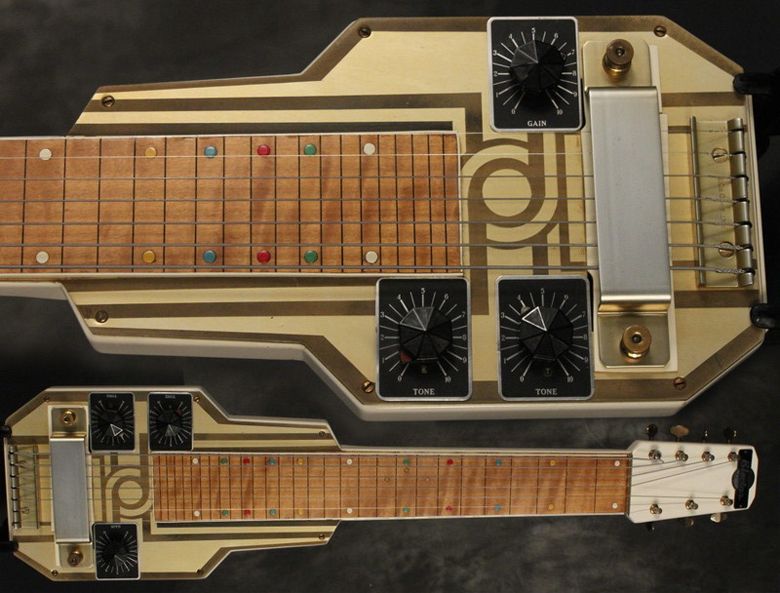
Here's an early Epiphone from way before the company had any links with Gibson. We've seen guitars before with an Art Deco design to them; none seem to pull it off more successfully than lap steel guitars such as this Epiphone Electar 7-string lap steel, which the seller claims is from the late 1930s. This would partly be because being a lap steel instrument it's not subject to the same ergonomic constraints as a guitar played "Spanish" style, if I may borrow that antiquated term. Also, if it's from the 1930s then it's the correct period for this style of design so it's the real thing and not just a latter-day homage. I particularly like the ocatagonal control knobs which look as if they might be made from bakelite, although I can't imagine why there would be two tone controls for just a single pickup.
G L Wilson
© 2011, Guitarz - The Original Guitar Blog - now in its 10th year!
2:52 AM |
Labels:
cool guitars,
Epiphone,
lap steel,
vintage guitars
/
guitarz.blogspot.com:
I lose count of the number of times I've seen eBay sellers trying to shift what they insist on calling a "RARE Gibson Epiphone STRAT". They always emphasize the RARE and the fact that it is a Strat but Gibson-made (which it isn't, it was made in Korea). The words "rare" and "mint" have little currency on eBay these days as they are bandied about with wild abandon and without any basis in truth or the seller having done a little basic research.
This post originates at http://guitarz.blogspot.com - beware of those damned scraper blogs!The Epiphone "Strats" and "Teles" were quite a common sight in music shops in the late 1980s. They offered a fairly decent S or T-type guitar for the price in those days (they were budget-line instruments). Personally I always felt that the Explorer-like banana headstock looked slightly incongruous on those body shapes, but I guess Epiphone wanted to reference their parent company somewhere in the design.
This post originates at http://guitarz.blogspot.com - beware of those damned scraper blogs!Now this
Epiphone copy of a B.C. Rich Bich (shown above) is a new one on me, but I'm guessing it would have come from the same period. It's probably
rarer than the Fender-derived designs but I doubt it's particularly rare or of any great value. It's an interesting one, and certainly should be of consistent workmanship for an Epi of that period.
This post originates at http://guitarz.blogspot.com - beware of those damned scraper blogs!But as ever, if you know differently then please leave a comment!
G L Wilson© 2011, Guitarz - The Original Guitar Blog - now in its 10th year!
3:11 AM |
Labels:
80s guitars,
BC Rich,
Epiphone,
Weird guitars
/
I'm also a 12-string guitars lover and this
Epiphone Riviera is an extremely lovable one! This is not the first
ES-335 12-string we've seen here - there was a
Gibson, a Kapa, an
Ovation... - but this one in dark natural finish is quite something.
It's been produced in Gibson's factory in Kalamazoo in 1967, at the same time Gibson was selling a similar model, but actually at a cheaper price!
BertramGuitarz - The Original Guitar Blog - now in its 10th year!
3:20 PM |
Labels:
12-string,
Epiphone,
ES-335,
semi-hollow body,
vintage guitars
/
This 2005 limited edition 'guitar-of-the-month'
Epiphone USA map is a reissue of an early 1980s even more limited model.
I wonder if this one was made in People's Republic of China, like all the fake GDR memorabilia they sell here in Berlin...
BertramGuitarz - The Original Guitar Blog - now in its 10th year!
2:52 AM |
Labels:
Epiphone,
reissue,
Weird guitars
/

There are those who consider
Epiphone no more than a budget company selling cheap
Gibson copies, and those who are thankful for the affordable quality instruments they provide, but you can also focus on their original models, of course the ones released before they where bought by
Gibson in 1957, but also some that were released later (up to nowadays) like the 1966
Epiphone Olympic SB 722 you can see here.
It's part of the Kalamazoo (
Gibson's original factory in Michigan) built solid bodies line produced between 1958 and 1969 - this one sharing its asymmetrical body shape with the
Crestwood and the
Wilshire, also the batwing 6-in-line headstock. This
Olympic SB 722 has a single single-coil pick-up in bridge position and the optional trem. I personally don't like its design but it seems to be well sought after - this has been
Epiphone's most successful model ever...
BertramGuitarz - The Original Guitar Blog - now in its 10th year!
3:19 AM |
Labels:
Epiphone,
vintage guitars
/
guitarz.blogspot.com:
Rob J writes:
Dear Guitarz Blog,
On
Tuesday you posted about a hollowbody guitar with 3 p90 pickups and asked 'did you ever see a hollow body guitar with 3 p90s?', well there is one sitting in my front room!
I bought this guitar a year ago from a local guitar shop for £300. Google has revealed to me that it is an Epiphone Riviera P93, a thinline semi-hollowbody guitar with 3 p90 pickups, a threeway selector, 3 volume pots, a master tone pot and a bigsby tailpiece with a tune-o-matic bridge. The selector switch selects the neck and middle pickup in the top position, all three pickups in the middle position and the middle and bridge pickup in the bottom position. It was released sometime around 2007-8 so it is definitely a modern guitar!
just thought you might be interested in this guitar after Tuesday's post.
Keep up the good work,
your loyal reader,
Rob J
Oh dear, it looks like I'm going to have to watch Bertram coming out with wild things such as "
did you ever see a hollow body guitar with 3 P90s?"
I just KNEW someone was going to challenge that - it was an open invitation! And as was already pointed out in the comments, there's also the Gibson ES-5, as played by T Bone Walker.
Thanks for showing us your guitar, Rob. It's a beauty!
G L WilsonGuitarz - The Original Guitar Blog - now in its 10th year!
9:03 AM |
Labels:
Epiphone,
semi-hollow body,
Your Guitars
/
guitarz.blogspot.com:
Stephen writes:
Hi, I've been following your blog for a year and bit now, it's brilliant. It led me to wonder about one of my own guitars - I've had it about two years now, and never really wondered about it, but the more I try and find out about it, the less I seem to know. It started off as (according to The Gutar Dater Project website) a Korean made 1996 Epiphone Les Paul Limited Edition, nice sort of bluey green marine burst that is semi transparent so you can see the wood texture (nice gentle quilted look).
The guy who had it before me upgraded a lot of stuff, ie Speigel locking tuners, chrome telecaster style knobs, chrome pick up switch, a couple of punchy new coil tapped humbuckers (JBs I think) and generally upgraded stuff to make it better sounding, rugged, and all with a chrome theme. I was looking for a beefy guitar that hopefully wouldn't develop problems, so I figured if it had been throughly up graded it would do the trick.
Nothing too unusal there, but here's the thing, and I don't know why I've never really wondered about it before - sitting between the humbuckers is a single coil pick up, and it's sunk about half an inch into the body so as to be in keeping with the levels of the humbuckers. It looks like the sort of chrome lipstick pick up you'd get on the neck position of a telecaster. I wondered if someone might have routed out a slot for it and installed it as a guitar project, but when you look on the inside of the hole that the single coil sits in, it's perfectly machine cut and the same bluey green colour is on the inside walls of the hole. If it was a project, surely routing a slot for a pick up would expose the wood of the body of the guitar and there would be none of the blue stain?
The guitar was due a restringing, so while I had the old strings off this evening, I popped the single coil out, and the blue colour of the wood stain definitely goes all the way to the bottom of the slot. I popped out the bridge humbucker too just to compare the slots and any colouration in that one, and they're both bluey green all the way down, including the bottom.
The colouring in the hole suggests to me that the slot for the single coil may have been cut before the guitar was stained the greeny blue colour, which suggests it may have been done at the factory where it was made. The guy I bought the guitar off said it was like that when he got it, and he'd had it while.
Do you know of Epiphone ever releasing a Les Paul with a tele style single coil sitting between the humbuckers? Have you come across anything similar in your blogging? By the way, the single coil sounds very nice, it has a dynamic, articulate chime that the humbuckers can't achieve.
Thanks for showing us your guitar, Stephen. No, it's not a pickup arrangement I've seen on a Les Paul before. Perhaps some of our readers might know some more about it. I have to agree with the conclusion that you yourself have to come to, that the middle-pickup routing was done at the factory.
Now, I've read comments on guitar forums and in emails and a lot of people out there seem to think that we here at
Guitarz have set ourself up as self-proclaimed experts. We're not, and have never claimed to be. We - like many of you - are simply guitar enthusiasts and are learning things about our favourite instrument all the time. We're happy to do our best to answer any questions and if we don't know the answers we can try to find out or else ask our readership to assist.
One thing that I've often wondered about is, on a 3-pickup Les Paul, which of the controls control which pickups and is the pickup selector switch a 5-way or is it a regular 3-way with the middle pickup being dialed in separately elsewhere? I took this opportunity to ask Stephen about the controls on his LP, to which he replied:
I'm not 100 percent sure that it all does work, but here's what it does what at the moment - the switch is a standard three way - of the two volume knobs, the volume knob nearest the bridge currently acts as master volume, and the tone control near the bridge currently acts as a master tone - the two tone knobs are push / pull coil tap type jobs for the humbuckers and both work - the volume knob furthest from the bridge doesn't do anything (although it looks like it's wired up) - all the pickups work, I had a look and they're all wired in, but I don't know enough about that side of things to be able to follow what they do.
The bridge humbucker sounds like a bridge humbucker, the neck humbucker sounds like a neck humbucker, and they can both be tapped for a single coilish sound. the centre position engages all three pickups, but the single coil seems to push to the front, with a nice sort of snappiness and articulation that the humbuckers can't manage, tapped or full.
If I was better with electronics I might be able to deduce more, but one thing I do know is that it sounds great, and I can get a ton of sounds out of it.
Thanks again, Stephen!
G L WilsonGuitarz - The Original Guitar Blog - now in its 10th year!
4:43 AM |
Labels:
Epiphone,
Les Paul,
pickups,
What's that guitar?,
Your Guitars
/
guitarz.blogspot.com:
I can't help it. I just find myself becoming a tad snobbish when it comes to Epiphone guitars. Well, that is to say,
modern Epiphone guitars. I think I resent that they've become to Gibson what Squier is to Fender. They used to have plenty of their own classic designs but now they are playing second fiddle to Gibson. Somehow that irritates me.
But I do love some of Epiphone's older designs from the days when they didn't slavishly copy Gibson. I've aleady mentioned the
Scroll guitar and
Double Scroll bass. Epiphone Newport basses have been around since 1961 with a few cosmetic changes over the years and here we see a
Japanese-made left-handed Epiphone Newport bass from the late 1970s/early 1980s in superb condition. The finish shows off what looks to be a mahogany body perfectly - but apparently it's maple. And if you look at the back you'll see that it's of through-neck construction (maple and rosewood), but is nicely understated unlike all those 1980s basses with contrasting timbers.
I'm not 100% sure about this, but I'd say this was a medium-scale length bass. It doesn't look to be a full long-scale and the bridge is set at the very end of the body unlike on most short-scales. If anyone can confirm this, please leave us a comment.
G L WilsonGuitarz - The Original Guitar Blog - now in its 9th year!
11:47 AM |
Labels:
80s guitars,
bass,
cool guitars,
Epiphone,
left-handed,
vintage guitars
/
This
Antoria 2358R is not only a pure beauty, it is also a complicated story.
The original model is an
Epiphone signature guitar designed in 1963 for jazz musician
Al Caiola (who sided the greatest such as
Frank Sinatra or
Buddy Holly). In 1970,
Ibanez issued a quite accurate copy - that's what they were doing at the time, before they started to get sued by Gibson - but the
FujiGen Gakki factory that worked for
Ibanez also made the same guitar for the UK brand
Antoria.
This guitar is remarkable for being a thin full hollow-body
E-335 without F-holes - this being being aimed at reducing feedback - similar to the
B.B. King Lucille signature model
Gibson released in 1983. I like the
FujiGen Gakki model better for its curved control plate being further back an smaller than on the
Epiphone, but the big round scratchplate is a little bit bizzare.
bertram
Guitarz - The Original Guitar Blog - now in its 9th year!
3:11 AM |
Labels:
Antoria,
Epiphone,
FujiGen Gakki,
Ibanez,
Japanese guitar,
vintage guitars
/

Unlike the previous
Explorer variations I showed here before, the
Epiphone Prophecy Futura doesn't try to hysterise its model but on the contrary, by reducing its body results in a very strange and radical guitar indeed... The narrow wasp center is disturbingly unusual (much more than a
BC Rich guitar with plenty of pointy bits in every direction) even if the relation to the familiar
Explorer is obvious.
Thought it's as angular as a regular
Explorer, it is more ergonomic - even the longer lower horn is relevant, allowing to hold the guitar on the lap with a high neck. It looks like every superfluous wood was eliminated, making it much lighter than an
Explorer. This guitar is more than a show-off and was meant to be useful in any situation. I still need to see it in someone's hands to see how this strange shape feels in relation to a human body (the best would be of course to play it but I've never seen it in any guitar shop I ever visited).
A few days ago I was writing here that
Epiphone issues mush more new models (real new models) than
Gibson, that's what I meant, and there're many like this, plus the regular
Gibson budget models.
5:00 AM |
Labels:
Epiphone,
Explorer
/
guitarz.blogspot.com:
 Nine Inch Nails have created an eBay account especially to sell off their old stage gear - guitars, keyboards, amplifiers, drums, staging, anvil cases, cables, rack/outboard gear, guitar effects, pedal boards, etc. Some items are in working condition and some items, such as this Epiphone Les Paul Gothic, are trashed.
Who in their right mind would pay over $400 for a broken Epiphone Les Paul? Oh... Nine Inch Nails fans. Without the NIN connection, it's worth just a fraction of that. Looking through their past sales there are broken Gibson and Epiphone Les Pauls that have sold for thousands. Crazy!
It's sad really. People are bidding on this (admittedly, not very exciting) guitar, not so they can repair it and make it playable again, but as a NIN souvenir.
I can feel a rant coming on. Isn't trashing your instruments on stage a bit of hoary old cliché now? I find it incredible that bands insist on resorting to such tired worn-out "shock tactics". Even Pete Townshend seems embarrassed by it these days.
I can understand bands want to put on an incredible show, to create a spectacle, but come on... use your imaginations!!! Let's see something NEW and different and exciting. Hell, you could even amaze and excite us with some incredible musicianship! Ever thought of that?
Trashing instruments is up there alongside on-stage nudity and self-abuse as the tired old clichés designed to shock which any self-respecting artists should avoid. Is that really the best they can do?
G L Wilson
ADDITIONAL: If you don't agree with me, fine. You are welcome to air your views in the comments so long as you do so in an CIVILISED manner. Personal insults and bad language are unacceptable and will not be tolerated. If you want to make childishly inane and abusive comments then please go back to YouTube.
NB: There are a lot of blogs STEALING content and bandwidth. If you read this anywhere else but on guitarz.blogspot.com then you are reading a blog that STEALS content. Please support original bloggers!
7:20 AM |
Labels:
Bands,
Cliche,
Epiphone,
Les Paul,
Mindless guitar abuse,
Rant
/

Let's make another exception to the implicit moral obligation we have here to not promote new models from big companies (what most so-called guitar blogs make a living from) - unless, like it is the case here, it's a real soft spot for a really cool one.
I don't know if I'm getting old but since I feel less and less receptive to pure excitement and macho display of musical skills, I enjoy playing bass more and more, so I'm looking at bass guitars more accurately. For the first time I have a real
coup de coeur for one, the newly released
Epiphone Triumph II. With its hollow body, F-holes and hidden pickups, it might seem devoid of any rock potential, but that's maybe what is so cool in it, its way to be one of its own, open to any music style for any musician, without forcing into anything.
Again a very good example of how you can upgrade a classical design with a little distortion - here the wide 'gipsy style' cutaway and the wooden bridge -, and keep a pure line. Then you can remember that Epiphone is not only providing democratic Gibson guitars to non-billionaire musicians (I imagine that most Gibsons are bought by fetishist old timers too old to play in a rock band ever again) but sometimes manages to keep to their glorious past by proposing nice and original hollow-bodies.
Ah, and this bass is said to be powered by 'revolutionary NanoFleax™ and NanoMag™ pickups' but I don't have the slightest idea of what this means!

OK, I made my little
Gibson bashing but they make of course the best guitars and
Epiphone is part of it. There was another bass called
Triumph made by
Gibson in the 70s that is also quite amazing. A few weeks ago GL wisely pointed how the
Jolana Diamond bass was a much better
Les Paul bass that
Gibson ever released, but the
Triumph is a brilliant LP style bass, even though it doesn't bare the name. It looks almost too good to play on it, doesn't it?

And finally this is the ultra-classic Epiphone Triumph archtop acoustic guitar designed in the 30s, when Epiphone was the direct concurrent of Gibson - who solved the issue by buying Epiphone. So I don't know if the II in Triumph II makes it a inheritor of the Epiphone Triumph guitar or the Gibson Triumph bass but it both case that is quite a legacy!
NB: There are a lot of blogs STEALING content and bandwidth. If you read this anywhere else but on guitarz.blogspot.com then you are reading a blog that STEALS content. Please support original bloggers!
2:05 AM |
Labels:
bass,
cool guitars,
Epiphone,
Gibson,
hollow body,
Product news,
vintage guitars
/

When
this guitar first caught my eye, I didn't realise that it's a complete fake, one of these 'relic'ed' new guitars (this one is from 2006) that I usually hate (even more when it's done on industrial scale like
Fender's). But, well, it's still an interesting modification, so I'll do as if I don't make an unwilling advertisement for an acquisitive guitar torturer.
So I like the disrespectful empty pickup cavity and unfilled pot, switch and tune-o-matic holes; also putting an early vintage Bigsby on a new guitar is a good (aesthetical) move. The logo on the pickguard comes from some car also called
Firebird (for our American readers, we urban European people can leave an entire life without putting any interest into cars). Of course, the fact that the
Firebird is one of my favorite guitars (even more in the hands of
PJ Harvey as I
already stated on this blog) helped catching my attention - I wouldn't have noticed this mod on a strat.
BTW it's a strange thing to me that when I make a guitar (yes that's what I do!) I put a lot of work in making it look all machine made smooth and flip out at the idea of any little mark that would reveal my clumsy craft (oh these hours of sanding with bleeding fingers!), but I enjoy on old factory guitars the marks of an appropriation process...
But sanding off a guitar finish to make it look older is in any case definitely inept.
6:59 PM |
Labels:
Epiphone,
Firebird,
wacky finishes
/

Similar process than on the
Peavey Mystic, but applied to a SG instead of to a strat, this is a quite rare
Epiphone G-400 Xtreme model that I never heard of until 10 minutes ago!
Though I like the idea, I feel that these back horns don't really work here - but it's actually hard to tell because the 'industriel steel scratch plate'™ ;) spoils it completely... I would like to see this guitar with a classic 'worn' finish and see how it feels... Am I too old to appreciate a guitar targeted at teenager gothic wanabees?
12:39 AM |
Labels:
Epiphone,
pointy guitar,
SG,
Weird guitars
/

We've already looked at the Epiphone Scroll Guitar on this blog (there's one for sale on eBay right now - if I hadn't just lost my job I'd snap it up straight away) and here's its bass counterpart also from the 1970s, the Epiphone Double Scroll bass, featuring - as the name suggests - scrolls on both horns. She sure is a beauty!
4:03 PM |
Labels:
bass,
cool guitars,
Epiphone,
vintage guitars,
Weird guitars
 RSS