This is my main guitar, Javier, who I modified heavily. He is an SX Liquid from rondomusic.com. I outfitted him with a Retrotron mini humbucker and a lipstick tail pickup from guitarfetish.com, painted him pistachio green, stuck a buncha stuff on him, and now he is as you see! I love this guitar. I keep him tuned to DGCGBB, and his third bridge effects come through really nice when the volume's rolled off. Hope you like'm!
Harri
Thanks for showing us that, Harri. I confess that I have been curious about pickups behind the bridge and the effects you can get with 3rd bridge guitars. I know that Sonic Youth have made much use of them. For anyone who is interested in 3rd bridge instruments, check out the fascinating website of Hans Reichel who made and played guitars not only with pickups behind the bridge but also with another fretboard beyond the bridge. (Sadly, Hans passed away last November, which alas I failed to report on the blog at the time.)
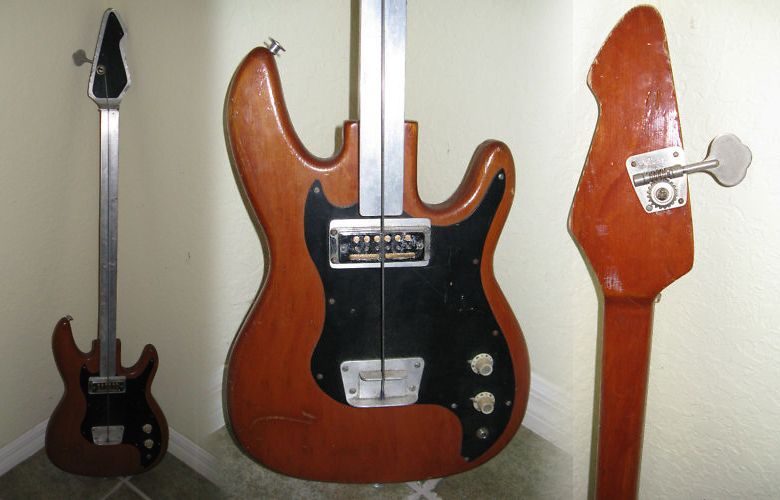
According to the eBay seller, this is "Fender Jaguar inspired" and "a homemade 1 string bass guitar with Fender parts". Well, I can't see any Fender Jaguar influence, nor any genuine or even approximated Fender parts. The pickup looks like it came off an old Teisco or other contemporaneous Japanese 6-string guitar and the headstock shape looks as if its been modelled on a Peavey. Maybe the donor neck is from a Peavey bass? The fretless fingerboard (it's not a "fretboard", as the seller calls it, if it doesn't have any frets!) is made from a piece of aluminium.
Thanks to Jeremiah for bringing this auction to my attention. He comments that, with a starting bid of $9.99, at least the price is fair.
I'm going to be really lazy today (hey, it IS the holidays) and copy extensively from the eBay listing for this Tele/Rickenbacker hybrid:
This is a guitar which was constructed using:
Fender MIM neck Serial Number MZ4013361 (hard rock maple) Non-Fender Tele style Mahogany body Rickenbacker horseshoe pickup from a Rickenbacker (old spelling is Rickenbacher) Model 100 lap steel Lipstick pickup (4.9K) GFS from Guitar Fetish Brass nut
Other misc parts from Guitar Fetish, staggered tuners and string tree, 3 way switch, tele jack cup, Tele dome knobs, cloth wiring.
This guitar was born in a Hamtramck second hand store where I found the Rickenbacker lap steel. At the time I could not even tell what brand it was because there were no tags, markings, or serial numbers on it. Also the body had been crudely modified, some wood cut away, strap buttons put on so it could be played slung around your neck more like a regular guitar. The store owner told me it had been owned by a friend of hers that had passed away. who was from the coal mining fields of Tennessee. He had also painted numbers on the metal fretboard. That genesis gave me the idea of putting this pickup on a telecaster style body.
Since the Rickenbacker is an old pickup with usage marks, I bought a Fender neck which showed a little natural wear. I then yellowed the face of the neck over the logo to make the neck looka little further aged. It is a very subtle effect. (I used gunstock oil infused with a little walnut dye.)
I picked up a mahogany body and modified it so the Rickenbacker pickup fit on it. At first I used a Gibson style wraparound bridge behind the rickbacker pickup. But it seems like some of that lap steel singing quality was missing. So I filled those holes, cut a little more wood and used the bridge integrated into the pickup. I also more tightly attached the neck to the body by using threaded steel neck inserts instead of the standard wood screws. You can search on ebay to see what inserts are are like.
The end result is that this thing sings like a woman! I took the guitar to my sister's house in Michigan's UP and played with her old-timey, bluegrass band. With the bluegrass band, I had to use the lipstick pickup because the Rickenbacker was too powerful, too bluesy. We were just playing an instrumental, but after the end of one song, someone asked "Who is singing?" No one was singing. It was the TeleRick. I was playing on the next song, and I thought I heard a woman singing vowels, I looked up from the fretboard and no, my sister (the only female musician present) was not singing. It WAS the guitar.
I had configured the guitar with a brass nut at first. It sounded great. I then switched to a solid plastic nut, and the open notes sounded more muffled than the notes held with the slide did. So, I put the brass nut back on. Also, when you play I think the brass affects the tone even more than just the open notes. I mean, the string does vibrate from the slide back to the nut unless you dampen it. The lipstick pickup loves the brass nut. I think the singing woman tone is a combination of the brass nut, lipstick pickup, mahogany body, threaded steel inserts, and the very solid Rickenbacker bridge. As I mentioned, the bluegrass people were not into the powerful Rickenbacker sound.
I put a 3 way switch on the guitar so you get the raw lipstick pickup, lipstick and Rickenbacker combined, and Rickbenbacker by itself. The tone and volume knobs only affect the Rickenbacker pickup. I did it this way for a couple reasons. If you wanted you could physically move the Rickenbacker pickup from the tele body to the Rickenbacker body, by only by snipping two wires. If I had integrated the tone and volume with the lipstick pickup, then more wires would have to be cut. Tonewise, the guitar rocks this way. The lipstick is a kind of a hollowed out singing acoustic sort of sound, you can play 4 strings together and they blend like a gospel choir. The Rickenbacker pickup has twice the output of the lipstick and is more raucous so you would only want to play 2 notes together (unless you are going for the heavy distortion). So you can do this multiple string sliding with the lipstick, and then flip the switch and go into a real heavier tone on the Rickenbacker pickup. You can tone down the Rickenbacker pickup with its controls to more closely match the lipstick if you want. The one pickup sounds like a logical extension of the other.
This guitar sounds so good, it could be the basis for a whole new unique style of playing. You can get lost flipping back and forth between them for hours..
The string height (action) is such that you can play the classic boogie woogie on the low strings from open to the 7th fret, and if you are sliding at the 5th fret, you can press down the strings behind the slide to get the missing notes in the scale, but when you are at the 12th fret you will be all slide all the time. Now, the action could be lowered a little. The bottom of the brass nut could be filed, maybe the neck truss rod could be used, but the Rickenbacker bridge is a little higher than the tele bridge, so the action will always favor the slide player. But that is not a loss on this guitar, because this is a slide players guitar.
In my heart of hearts, I believe that is a guitar born for slide and it will need a slide guitarist to properly appreciate it. That is why I am putting it on a month long listing. This special guitar requires a special person...
Likely this guitar is as amazing as the seller claims, but it's sure not going to win any beauty contests. Personally I think the placement of the volume and tone controls is a mistake - and I appreciate this was dicatated by the plate used from the Rickenbacker lapsteel. Nevertheless, I think he should have put the controls in the usual position for a Tele, and maybe plugged the holes in the lapsteel plate - else not used the plate at all if it is detachable from the pickup. I'm not just talking aesthetics here, those controls would get in the way where they are.
Currently listed on eBay with a Buy It Now price of $1,000.
The Rockin' Chair was invented on a coffee break at a newspaper in Värmland, Sweden, back in 1984 by the journalist Kjell Palmers and noted by his college Stefan Markebo. Many years later Stefan thought it would be a good idea to really build this handy instrument.
The guitar chair is played through the nice Volkswagen amp and the bass chair is played in a cheap little Hellborg amp.
Some of us would respond that such scarcity could be considered to be something in its favour.
The strange carved object on this guitar, at closer inspection, reveals itself to be a rattlesnake, but unfortunately from further away it does resemble something that comes out of the rear end of a dog. I'm sorry, the last thing I want to do on this blog is to get all scatalogical and severely lower the tone, but with a guitar like this it is very hard to avoid saying something along those lines.
The carving doesn't work for me, because if that is supposed to be a snake, then what is it meant to be sitting on? A severely sawn-up Telecaster?
Nice try - someone probably put a great deal of effort into this creation - but design-wise it just does not work.
Currently being offered for sale on eBay UK with a Buy It Now price of a staggering £999. (Cough, splutter, choke...)
Thanks (if that is the word I'm looking for) to Alan Newton for bringing this guitar to my attention.
Below is a translation, some info is repeated and the first line is a classic, but you get the idea:
This is a unique instrument! It is also the only one of its kind!
It is constructed as a guitar with all the possibilities of an electric organ. The instrument contains the circuit board of an electric organ, which is controlled from the strings and fretboard. Basically the organs "lower/under manual" (not sure what he means here) is replaced with a fretboard and strings.
When a chord is played on the fretboard and strings, a preset rhythm, background and bass line starts. The strings work as they would on a conventional guitar.
An organ keyboard is built into the instrument, with different harmonies.
The construction is a easy to handle electric guitar, with all the possibilities for rhythm, backgrounds and bass lines of an electric organ.
The builder was a musician and telephone electrician, who for years had been thinking about how to build a guitar with backgrounds, just like an electric organ. In the end he built this prototype. Technical drawing is available.
I'm curious as to why this so-called "handmade model guitar" is described as a "model" when it uses bona fide guitar parts, albeit those from a basic cheap Encore Strat copy. My guess is that it doesn't actually play. It may have been intended to be a playable instrument, but perhaps the maker didn't realise about one of a number of things, such as correct bridge placement or how to wire it up properly. Or maybe it was intended just as a prop all along. Those volume and tone conrols could be glued on for all I know.
Currently listed on eBay UK with a starting price of £20, which might be OK if you want a few cheap parts although the shipping cost is a bit on the high side.
Seeing Bertram's post featuring the black and white ES335-alike guitar reminded me of the black and white Fender Telecaster used by Deke Leonard of legendary Welsh band Man.
You'll notice that Deke's Tele is painted in a bullseye pattern; this was years, decades even, before Eddie Ojeda from Twisted Sister or Zakk Wylde thought of doing the same. I've seen more recent photos and YouTube footage of Deke playing a Gibson SG decorated with a similar bullseye.
You'll also notice in the photo here that there's a large rectagonal hole cut behind the bridge of the Tele. There is also a hole cut above this, but this is partly obscured by Deke's arm in the photo. The story I've heard is that apparently he was bored one day and started cutting holes in his Telecaster and got carried away. He has joked that the idea was to fill the gaps with a couple of miniature aquariums and keep fish inside.
Check out this video from 1975 of Man performing live on the BBC's The Old Grey Whistle Test which includes some nice close-up shots of Deke's Tele:
For more photos of Deke and the Bullseye Tele see this blog post at Brit Rock By The Bay.
Deke is currently working on a book, The Twang Dynasty, which is to be a discussion of his favourite guitarists, and ought to be one to look out for as I imagine it would appeal to many of the readers of this blog.
I shall quote from the eBay listing for this so-called "stratocaster les paul handmade guitar from a peavey" (please note all spelling and punctuation mistakes, inability to use capital letters, etc, are courtesy of the eBay seller in question):
the ease of a strat without looking a prat,......every strat i have ever had has made me feel like a bit of a prat when i am playing it , like im hank marvin or something ..now what have jimmy page and slash got in common , well appart from being uber cool they play the coolest guitar the les paul.
last week my mum rang me from the charity shop she works at saying that some bloke had broght in a guitar and did i want it , well as im a guitar maker of course i wanted it so my mum bought it for 10 quid and i arranged a courier, when it arrived i was shocked to see a really nice flight case. when i opened it inside it was like a time capsule from the 80's inside was a peavey preditor from the late 80's when they were still hand made in america, a boss ds1 japanese pedal all boxed and as new and a ibanez stereo chorus jap pedal boxed in mint condition as well as a analoge korg tuner 3 good leads and a strap.
the guitar was a bit beat up on the body so i stripped the parts for other projects and then i had a brain wave.....why not try to make a les paul shape out of the strat body so i got out the jigsaw and here we are....as i said the body was a bit gnarly so i decided to try a glitter finish to buff out the knocks so i put on 3 layers of silver glitter and 5 layers of varnish sanding between each to get a really good finish, did my custom headstock with 5 tuning pegs on 1 side and 1 on the other that goes on all my guitars and did a glitter finish and my trademark lightning bolt in red glitter, cut and shaped the scratchplate and voilla , oh the knobs are just some that i stuck on but when you get it it will have standard strat knobs in black that are winging their way here as i type. the action is set low and the intonation is good and it looks a million bucks as im sure you will agree. the glitter finish is just on the front and sides , the back is sprayed silver and a bit gnarly. also i sort of rushed this so the shape it isnt as perfect as i would like (the back is smaller than the front bevause i angled it by 2mm to scallop it to fit the body better) but still pretty wicked . it sounds great through my session amp but i have not really played this because i am a leftie and normally i make one off guitars to order but i think this could be a good seller and as there are zillions of strat shaped guitars going cheap so i might make a few more of these so i cant say its a one off. so if you are looking for something a bit different that will turn heads, play and sound great and is cheap then this guitar could be for you.
Hopefully Guitarz readers can see this for the atrocity it truly is.
Thanks to Jason Summer who spotted this eBay listing.
...speaking of Teisco guitars, this custom tenor guitar not only has parts from an el cheapo 1970s-era Japanese Teisco (often branded as Kay in the UK) but the body shape seems to be based on the same, although with an extended "bottom".
Despite the interestingly-shaped headstock implying that the wooden parts were all custom made, it looks as if it was originally intended as a 6-string guitar because the neck has obviously been whittled down to the width of a 4-string - witness the change in width where the neck sits in the neck pocket of the body.
I think I said it all in the title. More or less. I'd give this DIY doubleneck guitar and bass customization top marks for resourcefulness and inventiveness but zero marks for elegance and design. And I can't imagine that bass neck is going to sound too great with an ultra-shortscale length which is less than the Squier Strat neck that its been grafted next to.
Thanks to Greg Cadman for alerting me to this monstrosity via our Facebook page.
OK, this is slightly off-topic because, of course, the double bass is NOT a guitar but rather a member of the viol family; however most would agree it IS a parent of the modern bass guitar and so is worthy of including here on Guitarz. Anyway, this isn't any old double bass. It's the creation of sound designer and composer Diego Stocco. As he explains:
I had an idea in mind for an instrument I wanted to build. My curiosity was to hear the sound of violin, viola and cello strings amplified through the body of a double bass. I came up with a quadruple-neck experimental "something" that I thought to call Experibass.
To play it I used cello and double bass bows, a little device I built with fishing line and hose clamps, a paintbrush, a fork, spoons, a kick drum pedal and a drum stick. I hope you'll like it!
While the music produced is mostly percussive, there's no denying the drama within it.
The previous blog post reminded me of this - another Gibson guitar with a part of the body sliced off and reversed. The photo shows Bob Mothersbaugh in the video for Devo's "Whip It" with a very peculiar-looking Les Paul.
With all the technology being dangled in your face when you hit it big, did you ever use a guitar synthesizer?
Back in 1979, I used a device made by 360 Systems. It was a big box that sat next to your amp and required a special pickup. The 360 Systems people recommended I use a Les Paul, and at the time I was horrified—I thought Les Pauls represented arena rock, long hair, and Puka shells. But I got a Les Paul and took a jigsaw to it with the intention of making it look like a skull. I cut the little horn off at the cutaway and flipped it over backwards and thought it looked a lot better. The 360 was a horrible synth and really didn’t sound good. I only used it for one tour.
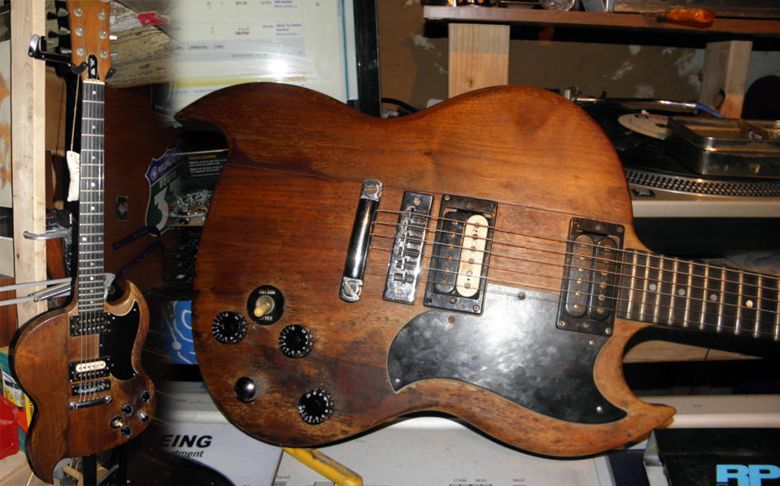
Here's a Gibson "The SG" from 1979 which at some point suffered some body damage so that the bass side of the body split away. The owner has stuck it back together again but reversed the top section for a certainly quite distinctly different look. You almost wonder why Gibson didn't think of it themselves, considering some of their recent design tweaks.
Gibson's "The SG" was a partner to "The Paul"; both were walnut-bodied budget-conscious versions of Gibson's two best-loved solidbody designs and were produced between 1978-1982.
Thanks to Colin Brown who suggested we look at this guitar via our Facebook page.
A few days ago here on Guitarz we looked at a Kay acoustic guitar with built-in amp, speaker and effects. Well, here's something similar submitted by Jonny M. Garcia via our Facebook page but this time it's not a factory-fitted speaker, it's a Do It Yourself conversion by the owner who is now selling the guitar on Craig's List. This is what he says about it:
I modified an almost new AmericanLegacy acoustic guitar by mounting a speaker and amp (with overdrive) directly into the guitar! I quickened the action and now this bad ass mother sounds, plays and feels like a strat! A guitar body is really a speaker box and the speaker here picks up on resonant frequencies that feeds back on itself like Eddie Van Halen! It is truly a live wire! It uses 2- 9 volt batteries, and has a 3 band EQ onboard as well. The pickup is a transducer. The frets are in perfect shape. It comes with a hard case. Look closely at the pic to see the red "on" light next to the volume and overdrive controls. Take it to an acoustic jam anywhere and you can play rock leads on an acoustic that really sound like rock leads! I made one for myself nearly 30 years ago and it has been awesome and reliable, and people are amazed! I am a furniture artisan so my workmanship is good. Believe it or not, this is the second one I've made in all that time- this one's for sale!
I don't know where to start! "Plays and feels like a Strat"? "Eddie Van Halen"? "Overdrive control"? I do have to ask, WHY? If you want something that plays and feels like a Strat, why not use a Strat? As for using an acoustic to play rock leads, again I do not see the point. Just because something is possible, it doesn't necessarily follow that it should be done.
Also, I can't help thinking that cutting a hole in an acoutic's top and inserting a speaker is not going to do the natural acoustic sound of the guitar any favours at all. And what about the internal bracing? I can't believe he cut a hole without cutting through some of that.
Guitarz reader Patrick Foss sent me these pictures of what looks like a Telecaster that has been assimilated and upgraded by the Borg from Star Trek. It's an Axxx Hotrod complete with both a B-Bender and a G-Bender, so should be able to manage comfortably with some decidedly non-futuristic country music, and is the product of veteran motorcycle builder Donnie Tate and infamous guitar guru Tim Wallis of Timara String Benders.
It looks like some poor old 1960s Japanese semi was a donor for this bedpan guitar project. I'm going to resist the all too obvious lavatorial comments (if you really feel the need, please use the comments!) and will only add that with a starting price of $319.99 you have to wonder who it is going to appeal to.
As I've said before, if we're going to show Fender Stratocasters on this blog they need to be pretty damn special - either that or particularly disgusting or amusing. This Pixelator Strat, I'm sure you'll agree, falls into the "special" category.
The brainchild of Duran Duran's keys player Nick Rhodes, this Mexican-made Fender Stratocaster has been customised by Sims Custom Shop with 100s of LEDs beneath a plexiglass top, which when controlled from a laptop (also included in the sale) allows video-streaming straight to the guitar's top, as seen in the YouTube clip below.
Currently being offered for sale on eBay with a Buy It Now price of £5,000.
 RSS