 RSS
RSSguitarz.blogspot.com:
It's the start of a brand new week, so here's a video to put a smile on your face and help cure those Monday morning blues:
Frank from the Lampeter Fire Station Guitar Club, which I've been attending recently, sent me this link. His comment was that it was "something to work on". Whoah, you mean that's this week's homework?
G L Wilson
© 2012, Guitarz - The Original Guitar Blog - now in its 10th year!
Showing posts with label acoustic. Show all posts
Showing posts with label acoustic. Show all posts
Tommy Emmanuel - 12 bar blues in the key of E
/

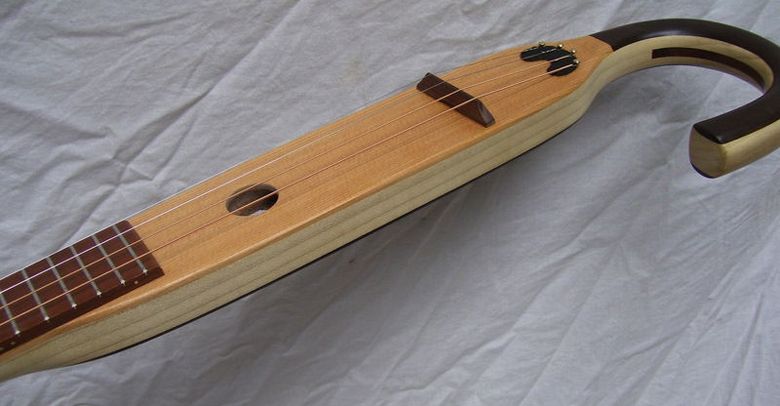
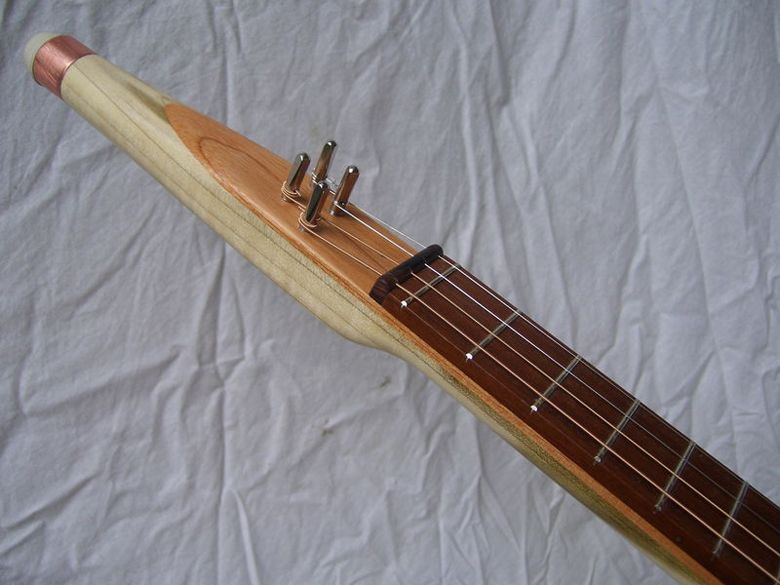
Walking cane tenor guitar/mandola - for those who like music on the move, now here's an instrument you can take hiking
/
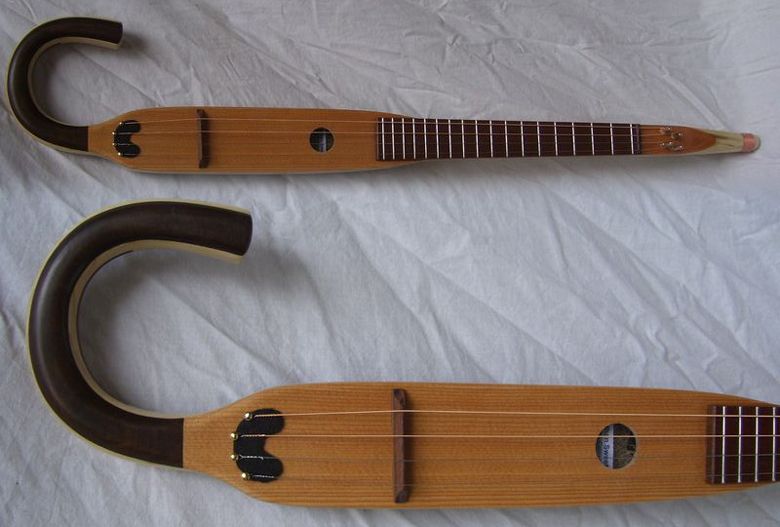
A truly unique instrument, functions as a cane and a Tenor Guitar or 4 string Mandola at the same time. Tuned C-G-D-A, 19 inch scale, so it is a little long for a mandola, and on the short end of a tenor guitar scale, but in the cane design it is very ergonomic. The cane crook acts like a armrest, and it is very comfortable to play. Very light yet strong enough for support, the sound is not as full as a full-bodied instrument yet very sweet and clear. This is a fully acoustic Tenor Guitar, not a solid stick. It has a Spruce soundboard, Mahogany headstock lamination, Rosewood back and crook laminations. The body is hollow. The crook-cane handle is cross laminated for directional grain strength.
G L Wilson
© 2012, Guitarz - The Original Guitar Blog - now in its 10th year!
Silvestri 7-string guitar from the 1890s
/
But 7-string guitars were around long before this. Both Russian and Brazilian music had developed 7-string guitars as part of their culture. The Russian 7-string dates to beginning of the 19th century and utilised an open G tuning (DGBDGbd). It was said to have been invented by Russian guitarist and composer Andrei Sychra who wrote a method for the 7-sting guitar and a whole wealth of compositions for the instrument.
In Brazil the 7-string guitar was introduced in the early 20th century as an accompaniment instrument in choro and samba music. It is traditionally tuned as a standard 6-string with the addition of a low C string, although some guitarists took this down to a (more logical perhaps) low B.
In 18th century Europe, the baroque guitar evolved from an instrument with 5 courses to one with 6 courses - initially the courses were paired strings but later the consensus of popularity favoured single strings as is common today - so it was perfectly natural that someone would take this a stage further and add a 7th course (or string). Those advocating the 7-string guitar included French guitarist Napoleon Coste (1805–1883) who composed specifically for the instrument, and the Italian guitarist Mario Maccaferri (born 1900) who used additional unfretted bass strings (known as diapasons or bourdons) on his guitars.
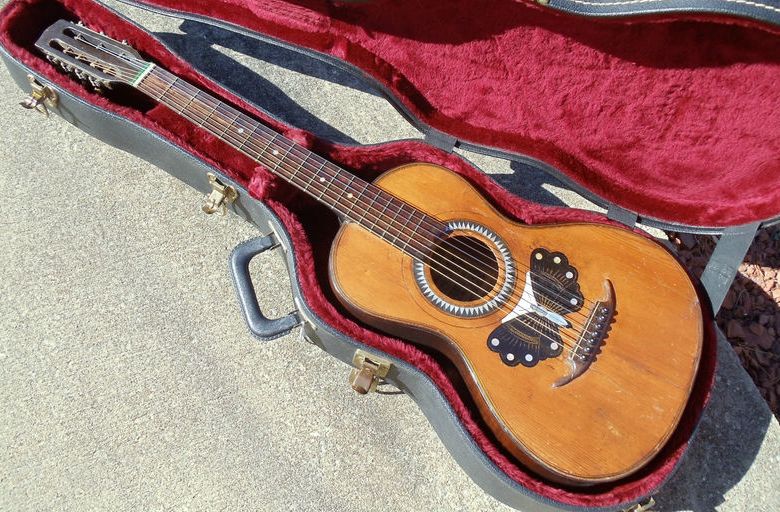
The above pictured guitar is an Italian 7-string by Ermelinda Silvestri and dates to the mid 1890s. In keeping with most of Silvestri's instruments it bears the butterfly inlay which was a trademark of sorts. The seventh string seems to be very close to the edge of the fingerboard, which suggests that it wasn't intended to be fretted and would have been a diapason (or bourdon if you prefer).
This repaired but still playable antique 7-string guitar is currently listed on eBay with a Buy It Now price of $1,450.
G L Wilson
© 2012, Guitarz - The Original Guitar Blog - now in its 10th year!
The "Elvis Toaster" Harmony guitar
/
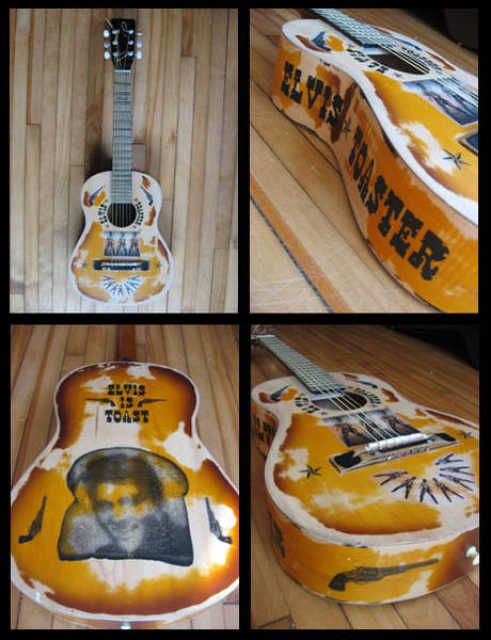
Guitarz reader Richard saw this guitar in the UsedOttawa.com classified ads:
Vintage, small scale Harmony acoustic guitar, stripped down and fancied up with Elvis images. One of a kind strummer for the Elvis completist. Comes with new bone nut and saddle for added twang, Andy Warhol print on front, and the infamous burnt toast image on back.It's definitely one to file under "Wacky finishes". With a price tag of $330 I think it's also one to file under "Optimistic sellers"!
G L Wilson
© 2011, Guitarz - The Original Guitar Blog - now in its 10th year!
1968 Kawai roundback acoustic - Japanese Ovation Glen Campbell copy
/
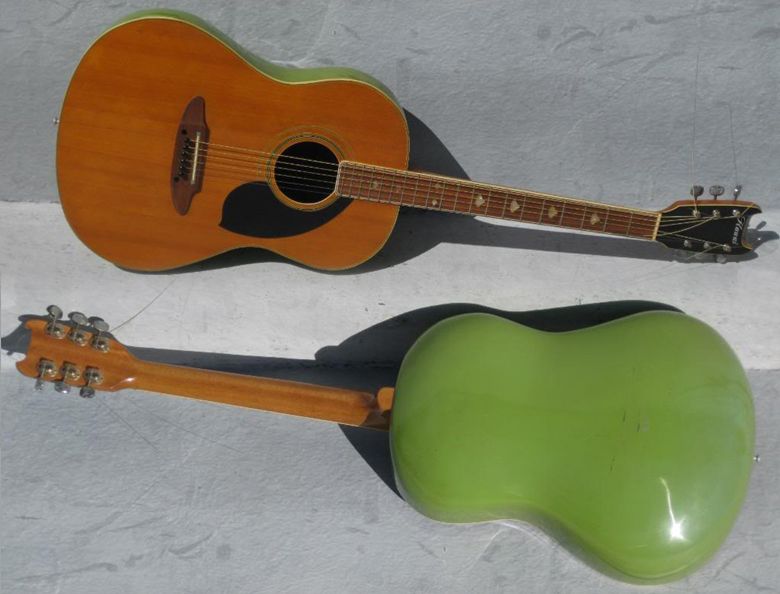
The downright weirdness of this guitar may be lost on most of you, but for those collectors of 1960s Japanese vintage, bizarre and lawsuit guitars, this thing is so bad it's good. What we have is a 1968 Kawai knockoff prototype of what was at the time one of the strangest and most novel pieces of guitar technology out there: the Ovation smooth-bowl Glen Campbell model. You gotta give it to the Japanese, they didn't waste anytime. But not only did they copy what is now perhaps the rarest and most sought after Ovation, they one-upped them as well in the strangeness category. First off, the smooth FRP resin bowl is LIME GREEN! On top of that, the neck is triple-bound, the headstock is pointy and devilish and capped with three-ply laminate and an awesome Kawai emblem, and the fingerboard is inlayed with upside down Teisco Spectrum 5 inlays (makes perfect sense as the Kawai factory was turning out those Teiscos at the time). And if that isn't cool enough, the tuning keys have CLEAR enclosures. Talk about space age tech.Currently listed on eBay with a $400 starting price and a Buy It Now of $600.
Thanks to Jaimie Muehlhausen for bringing this one to my attention.
G L Wilson
© 2011, Guitarz - The Original Guitar Blog - now in its 10th year!
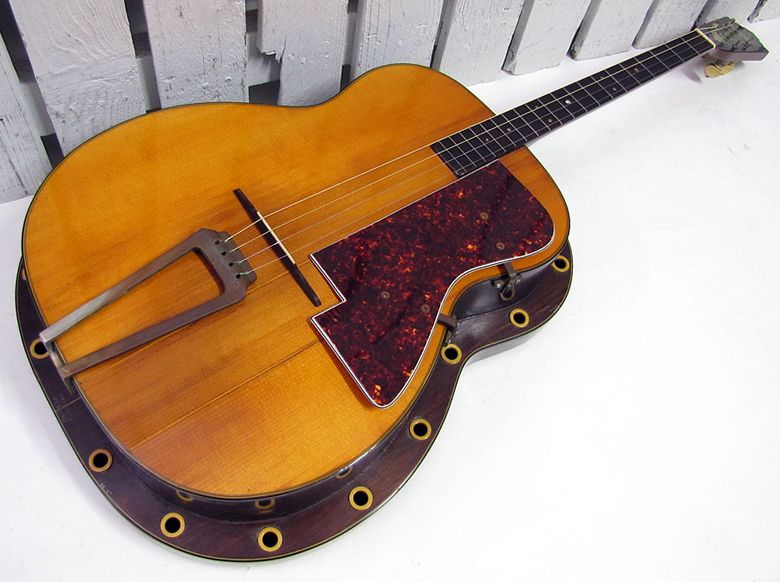
1930s Paramount L-Style Tenor guitar with "double" body - made by Martin
/
G L Wilson
© 2011, Guitarz - The Original Guitar Blog - now in its 10th year!
1950s Selco "Skiffle Junior" plastic toy guitar or ukulele - Mickey Mouse in disguise!
/
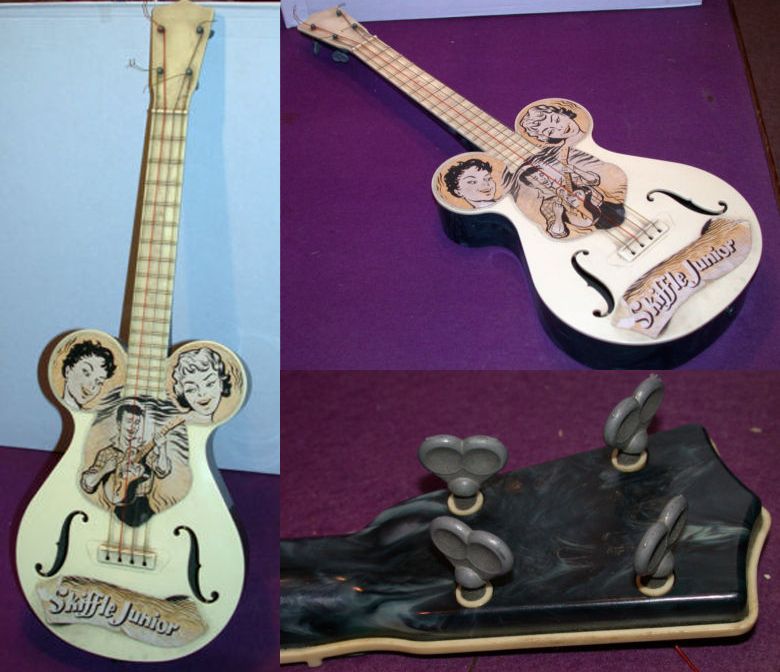
The Skiffle Junior dates from 1956. Perhaps they were just going along with the current trends. To begin with Disney was popular, then the Skiffle craze came in and so they altered the design. A few years later they would issue the more famous Selco Beatles plastic guitar.
Currently listed on eBay UK with a starting price of £45.
G L Wilson
© 2011, Guitarz - The Original Guitar Blog - now in its 10th year!
1930s Winton Hawaiian Moon parlour guitar made by Kay
/
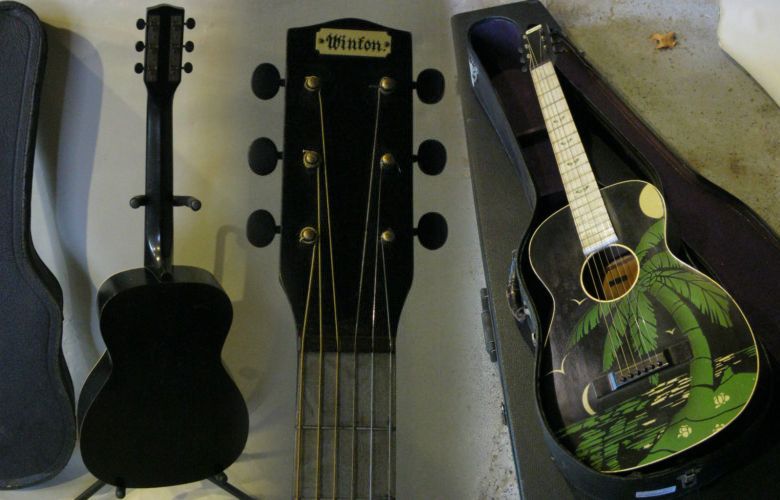
Currently listed on eBay with a realistic Buy It Now price of $349.99.
G L Wilson
© 2011, Guitarz - The Original Guitar Blog - now in its 10th year!
Jon Kammerer Glitter Rose parabolic electro-acoustic guitar made in the USA
/
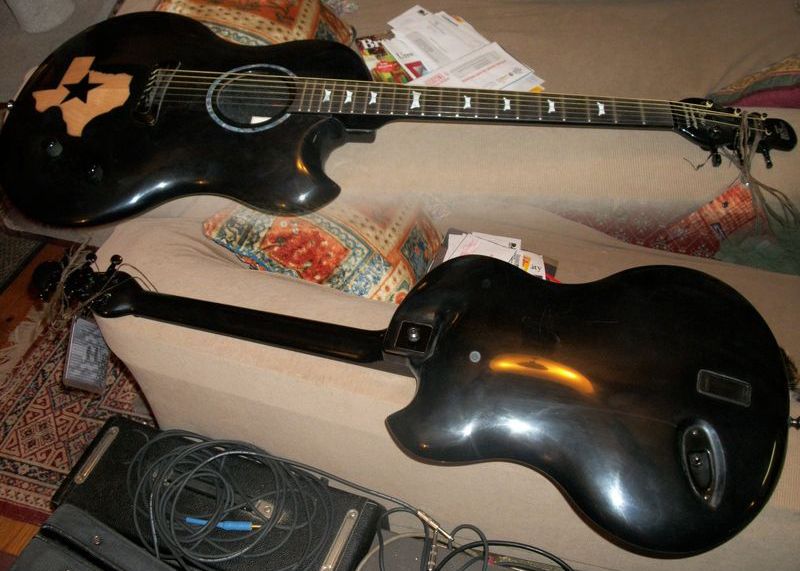
Currently being auctioned on eBay with bidding at $267 at the time of writing this blog post and just over 18 hours to go.
G L Wilson
© 2011, Guitarz - The Original Guitar Blog - now in its 10th year!
1930s Kay Wood Amplifying guitar - weird acoustic with wooden resonator
/
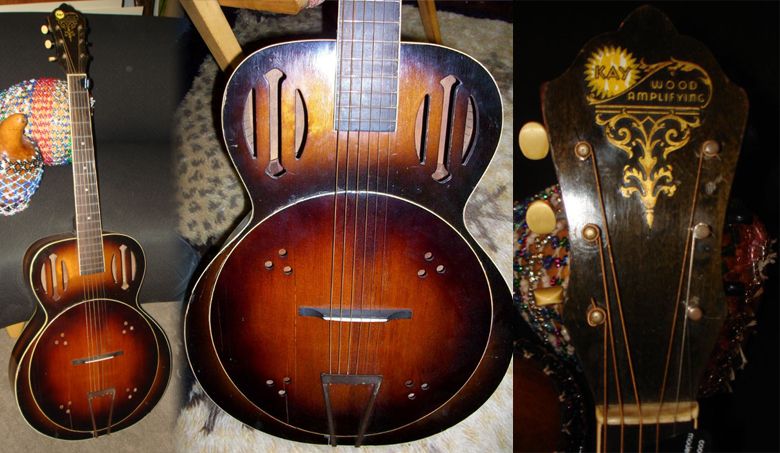
This Kay Wood Amplifying guitar (that's what it says on the headstock) would appear to be some little known species of resonator guitar. Of course, most resonator guitars use one or more spun metal cones to project the sound forward, but this Kay instead has a wooden resonating chamber with a trough that feeds the sound upwards to the dual grille holes. The chamber is covered by a wooden coverplate which helps give it the appearance of a resonator. How well it actually works in practice, I am afraid I cannot tell you.
Currently listed on eBay with a starting price of $995 and no bids at the time of writing. Bear in mind that similar instruments have been listed for over $3,000.
G L Wilson
© 2011, Guitarz - The Original Guitar Blog - now in its 10th year!
Mohan Veena Indian Slide Guitar - hybrid between jazz guitar and sitar
/
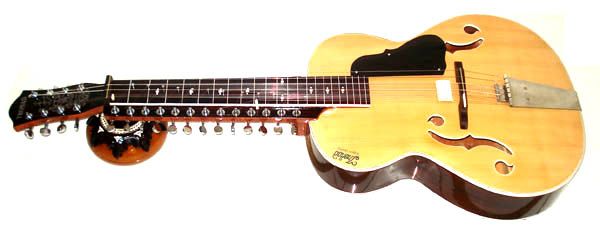
We first looked at Indian slide guitars here on Guitarz back in 2008. The Indian slide guitar is a hyrbid instrument, a musical chimera if you will, where quite literally East meets West and could be considered a cross between jazz guitar, slide guitar and sitar.
This Pro-grade Mohan Veena w Tumba Indian Acoustic Slide Lap Guitar claims to be the first such instrument to be offered for sale via eBay. It appears to have four main playing strings, four drones, and 13 sympathetic strings with machine heads along the length of the neck.


Hear it in the hands of Harry Manx:
Currently listed on eBay with a starting price of $799.99 (plus shipping).
G L Wilson
© 2011, Guitarz - The Original Guitar Blog - now in its 10th year!
1920s Oscar Schmidt Stella doubleneck harp guitar
/
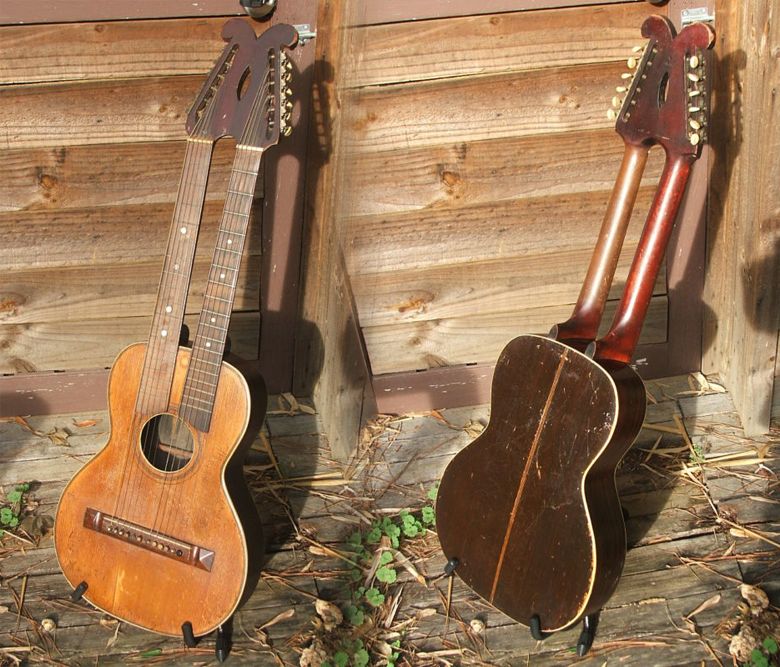
It's also interesting to note that an instrument such as a harp guitar, which nowadays would be regarded as a highly specialised form of guitar, was in the early years of the 20th Century considered popular enough to warrant the existence of a budget line model.
Harp guitars come in many shapes and forms as even the briefest of glances through the fascinating www.harpguitars.net website will show you. This Stella example appears to be a double-necked guitar, but the contra-bass strings on the upper neck - which you'll notice has been left fretless - are only intended to be played as open strings. In fact, the necks are mounted too closely together to allow conventional playing on the upper neck, and this is another visual clue that the left hand is not required on the upper neck.
This guitar is currently listed on eBay with a Buy It Now price of $3,499.
G L Wilson
© 2011, Guitarz - The Original Guitar Blog - now in its 10th year!
Vintage & Rare guitar of the week: Dommenget Maththias Jabs Acoustic Explorer
/
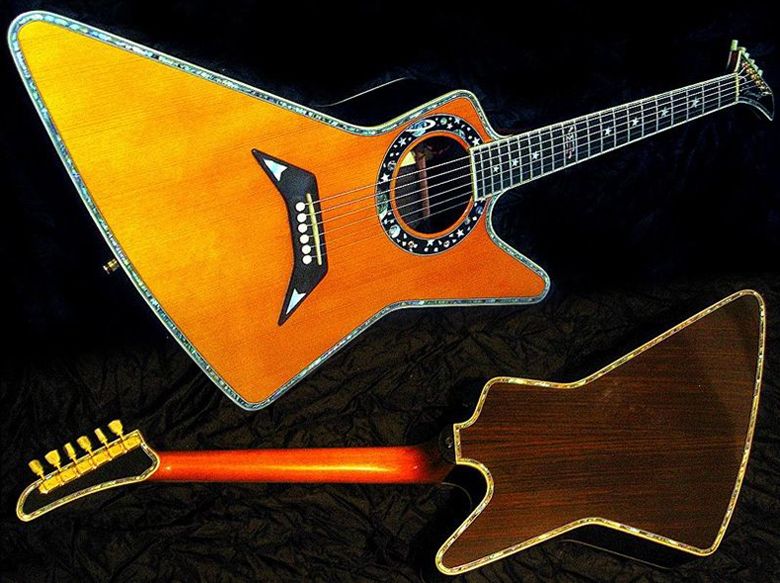
The guitar features a solid spruce top with back and sides of solid rosewood. Body binding on front and back is abalone and mother of pearl, and the intricate soundhole binding features stars and planets. The neck is Spanish cedar with ebony fretboard inlayed with star position markers. The headstock is the traditional Explorer shape and is fitted with Kluson tulip tuners. The scale length is a Fender-like 25.5" rather than the Gibson scale length of 24.75" that you might expect considering the design.
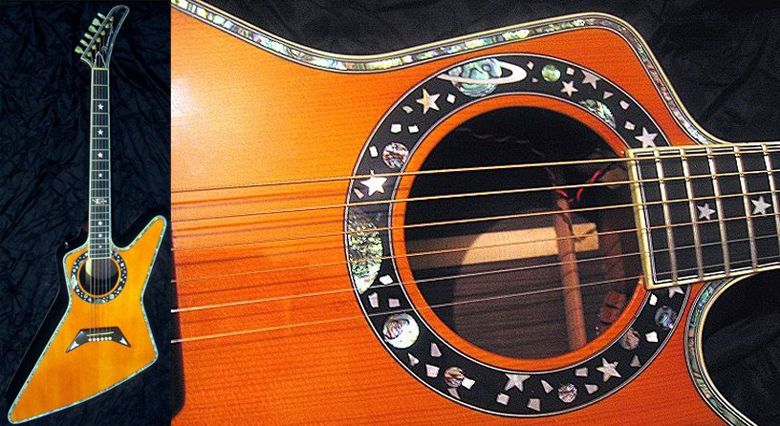
This guitar is being sold via Vintage & Rare priced at €7990.
Dommenget Guitars are based in Balje, Germany, and are best known for their various guitars built for German rock act The Scorpions. These have included acoustic Flying V guitars for Rudolf Schenker in 6-string, 12-string and doubleneck 12+6 models.
See also: Dommenget Guitars
G L Wilson
© 2011, Guitarz - The Original Guitar Blog - now in its 10th year!
What guitar is Zaniboni playing in this video clip?
/
Check out the guitar in this video.Zaniboni is a French singer. I love her guitar - so small and well-designed. A cute little acoustic. Plus she's a great singer and guitarist. I have no idea what she's singing! Thanks for the help!Tone Deaf Radio!

G L Wilson
© 2011, Guitarz - The Original Guitar Blog - now in its 10th year!
Antique vintage tenor guitar banjo uke banjitar - handmade and possibly unique?
/

I'm not sure what instrument the maker thought they were building here, but for our purposes I think it's safe to call it a cross between a tenor guitar, a tenor banjo and a baritone ukulele. The headstock style is very banjo-like, as is the general shape, but the all-wooden construction and soundhole are more guitar- and/or ukulele-like. The scale length is 21 1/2" which is more akin to a tenor guitar or banjo than it is to a baritone uke, but I guess it's up to the player to decide how to tune it and play it. I do like the hexangonal shape at the back of the body. If you've ever tried playing a banjo you'll know that a round body is not the best shape for playing when seated; I'm sure a hexagon-shaped instrument isn't going to slip as easily.
It does need some minor repair work doing to it, but with a starting price of $0.99 on eBay it could provide a nice little project for someone which is unlikely to break the bank.
G L Wilson
© 2011, Guitarz - The Original Guitar Blog - now in its 10th year!
BC Rich NJ Series Made In Japan electro-acoustic jazz guitar
/
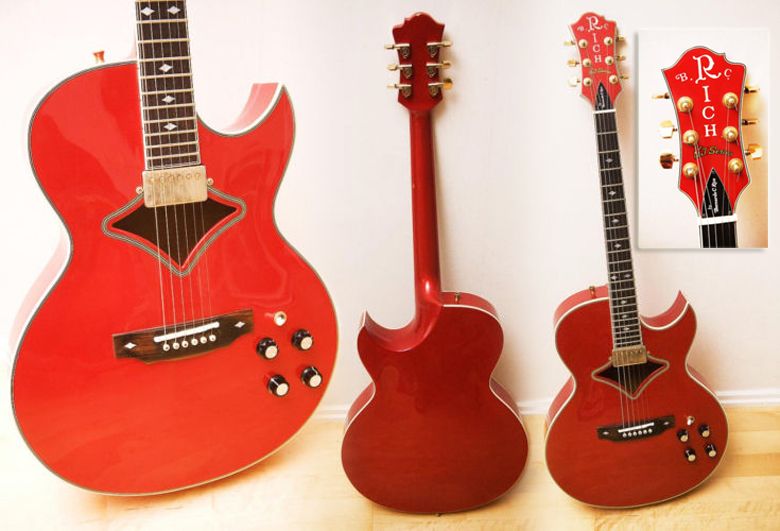
This B.C. Rich NJ Series electro-acoustic jazzer, reminiscent in some ways of Gibson's Howard Roberts model, is a Japanese-made example which the seller claims was made by the Daion company. (Check here for other Daion guitars that we have looked at previously here on Guitarz). Daion guitars were manufactured from the lates 1970s through to 1984 by the Japanese company Yamaki, so I guess that it was this same company who built these B.C. Rich models rather than Daion specifically.
The guitar features a humbucker pickup at the neck plus a piezo in the bridge, controlled via volume and tone pots for each and a 3-way pickup selector switch all boldy mounted on top of the guitar. The soundhole is a suitably angular shape considering the brand, as is the sharp Florentine cutaway. The heel of the neck is comfort contoured so as to facilitate playing at the top of the neck.
This guitar is currently being offered for same on eBay UK (although the item is actually located in Sweden) with a starting price of £599.99 and a Buy It Now price of £999.99.
G L Wilson
© 2011, Guitarz - The Original Guitar Blog - now in its 10th year!
So-called Art Deco resonator guitar with over-the-top finish and baked bean can detail
/
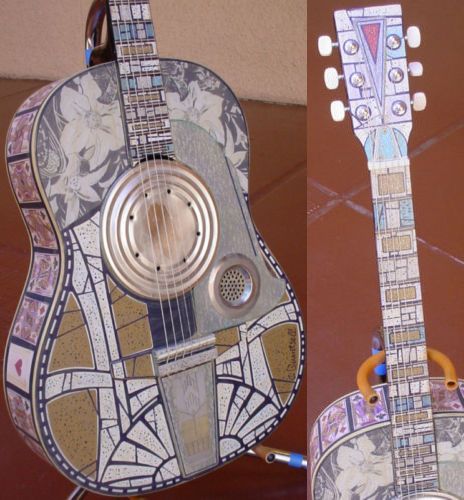
There's no denying that the artwork on this old acoustic guitar (a so-called "Customised Resonator Guitar" even) has been beautifully executed. It is supposedly Art Deco inspired, although I think it is rather too busy to fit in faithfully with that genre. The playing cards around the sides of the guitar are really one step too far and lend it a tacky Las Vegas look rather than one of sophistication which I believe was the desired effect.
What really spoils it is the base from a catering-size tin of baked beans that has been inset where the soundhole once inoffensively appeared. I usually try not to sink to lowest common denominators when describing guitars like this, but in this instance all I can think to say is that it looks crap. Pairing this with a second soundhole insert, quite obviously a strainer intended to sit over the plughole in the kitchen sink, does nothing to help matters. Yes, by all means use these elements on cigar box guitars; they seem to make some sense there and indeed are part of the charm of such instruments. But on an instrument that is trying to look sophisticated, such elements could not be more out of place.
Furthermore, shoving the bottom of a baked bean tin into the top of your guitar will not magically transform it into a resonator. The spun aluminium cone of a resonator guitar is a fine piece of precision engineering. Its function cannot be replicated with the bottom of a bean tin with a few holes punched in it. All that is going to do is to create a few more spurious vibrations and cause the guitar to rattle.
You might consider this a nice example of a piece of folk art and that the Buy It Now price of £270 would be money well spent, but personally I'd give it a miss. If it does actually sound any good, it'll be by accident rather than design. Note that in the YouTube video showing the guitar, the video finishes just before the guitar is about to get played. That alone speaks volumes!
© 2011, Guitarz - The Original Guitar Blog - now in its 10th year!
Vintage & Rare guitar of the week: Prohaszka Silver Sparkle flat-top acoustic
/

This Prohaszka silver-sparkle fronted flat-top acoustic guitar is currently being offered for sale via Vintage & Rare and is priced at £2600.00 (approx. €3101.00). The guitar has an original design that should find favour with electric players whilst still retaining the full acoustic body depth. I particularly like the "split" f-hole and the cut-out 6-in-a-line headstock which is quite elegant.
It's an instrument that you can imagine being played in the hands of the singer of a glitzy rock band. However, it might be considered sacrilege to subject a fine luthier-built instrument like this to the rock 'n' roll lifestyle where perhaps some cheaper generic electro-acoustic guitars would be better suited to the role. (Having said that, it doesn't look as if the Prohaszka Sparkle is actually fitted with any electronics, despite the design. I believe it is purely an acoustic guitar.)
G L Wilson
© 2011, Guitarz - The Original Guitar Blog - now in its 10th year!
Pre-war, French-made "Pineapple" guitar
/
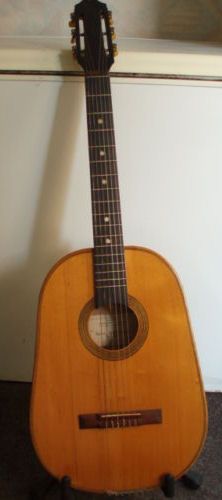
I'm afraid I have virtually zero information to give you about this French pineapple guitar other than it looks to be a nylon strng instrument (although it originally had a trapeze tailpiece which would imply folk guitar rather than classical guitar) and is supposedly pre-war French (2nd World War, I believe).
Its shape echoes that of the pineapple ukulele. I've not seen a pineapple-shaped guitar before, although we have previously looked at an egg-shaped acoustic guitar.
This guitar does require some attention and as such is being auctioned on eBay UK as a project with a starting price of £50.
G L Wilson
Additional: We believe it is a Hawaiian guitar - see the comments below this post.
© 2011, Guitarz - The Original Guitar Blog - now in its 10th year!
Osbama Tango acoustic guitar
/

The Osbama brand stands for Oswald Bachmann Markneukirchen - Markneukirchen being this town in Saxony (next to the Czech border) famous for its music industry since the late 17th century. Situated in GDR after the WWII, it is where many of these electric guitars we enjoy so much have been conceived and built, and many East-German brands you are familiar with included its first syllable in their names - Musima, Migma, Marma...
The Osbama Tango was a very successful model at the time, combining traditional music quality and art-deco design - the lightning sound holes are particularly bold and elegant. Like often, its lines are more dynamic and elegant that it equivalent from West-Germany, with which it still shares the inevitable German carve and blonde finish.
An interesting fact - that might explain why it is sometimes so difficult to gather information - is that these guitars were usually not branded to ease their distribution in the black market. Both in the east and the west, post-war Germany was avid of entertainment, and musicians were often retributed with black market goods from occupation armies, including instruments, and a good Markneukirchen guitar was appreciated in the west, though it was better if it was untraceable...
Bertram An interesting fact - that might explain why it is sometimes so difficult to gather information - is that these guitars were usually not branded to ease their distribution in the black market. Both in the east and the west, post-war Germany was avid of entertainment, and musicians were often retributed with black market goods from occupation armies, including instruments, and a good Markneukirchen guitar was appreciated in the west, though it was better if it was untraceable...
© 2011, Guitarz - The Original Guitar Blog - now in its 10th year!
Subscribe to:
Posts (Atom)