Based in Melbourne, the Maton Musical Instrument Company was founded in 1946 by Bill May and is Australia's longest running and most successful guitar manufacturer. They pioneered the use of many Australian wood species in guitar construction.
The guitar we see pictured above is a Maton Gold Line 750. It is of set-neck construction with a slab body featuring a German carve appropriately - given the model name - picked out in gold. Apparently only 210 examples of this model were built between 1962-1963, before the design evolved into the better-known Maton Fyrbyrd.
This guitar is in superb condition and is currently being offered for sale on eBay with a Buy It Now price of $5000 (US Dollars).
For more on Maton and other guitars from down under, see Australia's own always excellent guitarnerd blog.
G L Wilson
© 2011, Guitarz - The Original Guitar Blog - now in its 10th year!
Maton Gold Line 750 - vintage Australian guitar from 1962
/
5:46 AM | Labels: Australian guitar, cool guitars, Maton, vintage guitars
Gibson WRC - a superstrat from Gibson with assistance from Wayne Charvel
/
guitarz.blogspot.com:
Recently here on Guitarz we've been discussing and looking at Gibson guitars with Fender influences (see here and here).
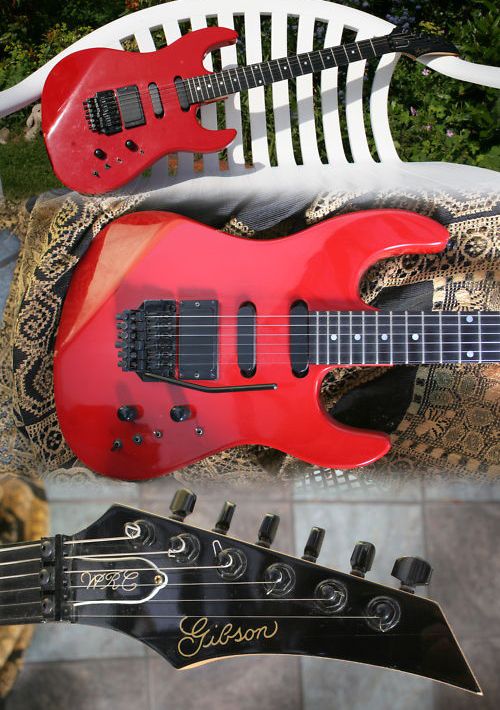
Pictured here we see a Gibson WRC, and there's absolutely no denying its Strattiness. Despite carrying the Gibson name, these were actually built by Wayne Charvel (his initials are W.R.C.) in 1987-1988. It's ironic in a way when you consider that Charvel is now part of the Fender empire. It's like some things come full circle.
In tried and tested Superstrat tradtion, the WRC is equipped with a Floyd Rose double locking trem. It has three pickups in SSH formation with a coil tap for the humbucker and individual toggles for each pickup allowing for a wider range of pickup combinations than the usual 5-position switch. In keeping with Fender-derived guitars it has a bolt-on neck, which is of the pointy headed variety as was the fashion when this guitar was made.
This guitar is currently being auctioned on eBay UK with a starting price of £795.
G L Wilson
© 2011, Guitarz - The Original Guitar Blog - now in its 10th year!
12:11 PM | Labels: 80s guitars, Charvel, Gibson, superstrat
1960s vintage Japanese Givtone "baritone" guitar
/
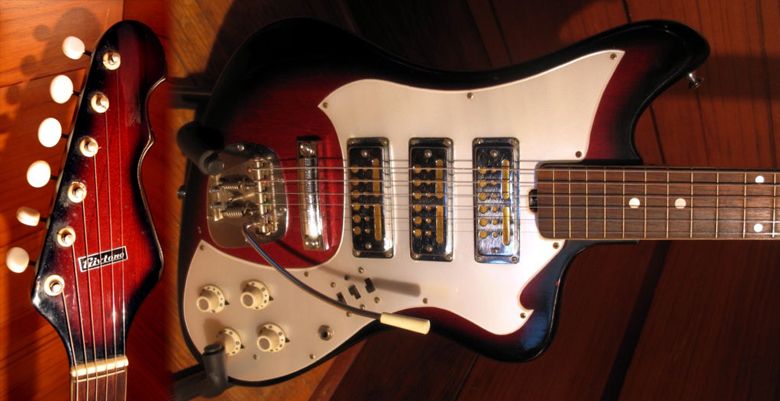
Here we have a vintage Japanese Givtone "baritone" guitar with three of the now legendary gold foil pickups beloved of the likes of Ry Cooder.
The Givtone name is almost certainly a department store/catalogue brandname. The seller rather lazily refers to this guitar as probably being a Teisco as if they were the only producers of Japanese electric guitars in that period. I'd say it looks more like a Zen-on/Zenon or Morales, maybe even Kawai or Guyatone, although I concede that the neck does look Teisco-like with its very narrow fretwire (maybe just a fashion of the era), but other Teisco trademarks such as offset block fingerboard inlays and striped metal pickguard are absent.
As, to it being a baritone, I feel this is unlikely. The seller states that:
By the way, the earliest reference I can find to baritone guitars being used is in the Wikipedia entry for the Fender Bass VI, which says:
Just to confuse things, the Wikipedia entry for "baritone guitar", states that:
But maybe you know different and there was an earlier precedent for dedicated baritone guitars being made in the 1960s. Because of the mixed terminology being used it is very difficult to find out the absolute truth of the matter.
G L Wilson
© 2011, Guitarz - The Original Guitar Blog - now in its 10th year!
The Givtone name is almost certainly a department store/catalogue brandname. The seller rather lazily refers to this guitar as probably being a Teisco as if they were the only producers of Japanese electric guitars in that period. I'd say it looks more like a Zen-on/Zenon or Morales, maybe even Kawai or Guyatone, although I concede that the neck does look Teisco-like with its very narrow fretwire (maybe just a fashion of the era), but other Teisco trademarks such as offset block fingerboard inlays and striped metal pickguard are absent.
As, to it being a baritone, I feel this is unlikely. The seller states that:
Guitars like this, with a 26.5" scale, are usually tuned to Low "B" in between a guitar and bass but it'll hold up if you want to go lower or even higher.Well, as I've said before, my understanding is that "baritone" tunings somewhere between a guitar and bass are a relatively modern concept. On a vintage guitar such as this, they'd more likely be tuned down a whole octave a la Bass VI. However, for a Bass VI, I would have expected a slightly longer scale length, maybe 28" or preferably 30". I have to wonder if this was simply a long scale guitar intended for regular tuning?
By the way, the earliest reference I can find to baritone guitars being used is in the Wikipedia entry for the Fender Bass VI, which says:
In the late 1960s some artists used heavy guitar strings with resp. length and tuned the Bass VI to a baritone guitar from 'B to b' or 'A to a'. With this 'down and dirty' sound the Fender VI enriched 'Indo-Rock' bands with their unique Rock & Roll sound. One of those players was Reggy Tielman from the 'Tielman Brothers'.Note that whilst these guys were using baritone tunings, the instrument they were using was built as a Bass VI.
Just to confuse things, the Wikipedia entry for "baritone guitar", states that:
The Danelectro Company was the first to introduce the electric baritone guitar in the late 1950s, and the instrument began to appear in surf music, as well as background music for many movie soundtracks, especially spaghetti westerns.The confusion comes in here because the modern name "baritone guitar" is being applied retrospectively to the Bass VI, the term being incorrectly used here so as to distinguish the original six-string bass from the modern variant typically with a low B string and high C string, 34" scale and proper bass string spacing.
But maybe you know different and there was an earlier precedent for dedicated baritone guitars being made in the 1960s. Because of the mixed terminology being used it is very difficult to find out the absolute truth of the matter.
G L Wilson
© 2011, Guitarz - The Original Guitar Blog - now in its 10th year!
4:08 AM | Labels: baritone guitar, bass VI, cool guitars, Givtone, Japanese guitar, vintage guitars
Soviet-era USSR B&G Formanta fuzz guitar
/
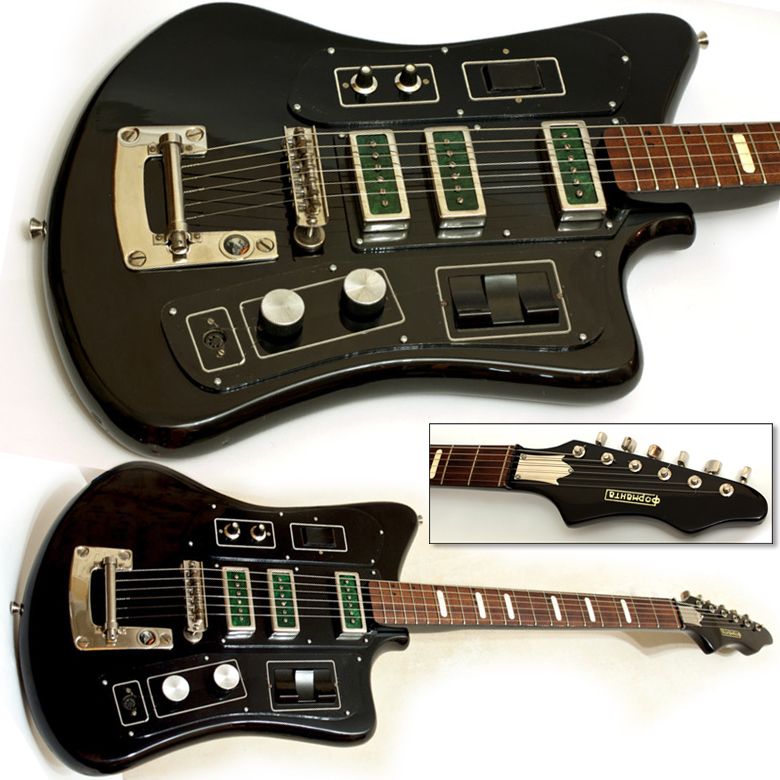
Just take one look at this B&G Formanta fuzz guitar and you know it's from Soviet-era Russia. Those switches and knobs all look as if they belong on some military hardware. However, the shape reminds me of the Vox Marauder.
This guitar is currently being offered for sale on eBay with a Buy It Now price of $400. The seller tells us that it was made in the 1980s in the USSR by Belarusian Musical Instruments Factory at Borisov city, and that it has a built-in fuzz effect powered by a 9 volt battery. Apparently the headstock shape is rare for this model and has a reversed signature.
G L Wilson
© 2011, Guitarz - The Original Guitar Blog - now in its 10th year!
3:46 PM | Labels: 80s guitars, cool guitars, effects, Russian guitars, Weird guitars
1970s Czechoslovakian Jolana Star IX guitar a.k.a. the Screwdriver
/
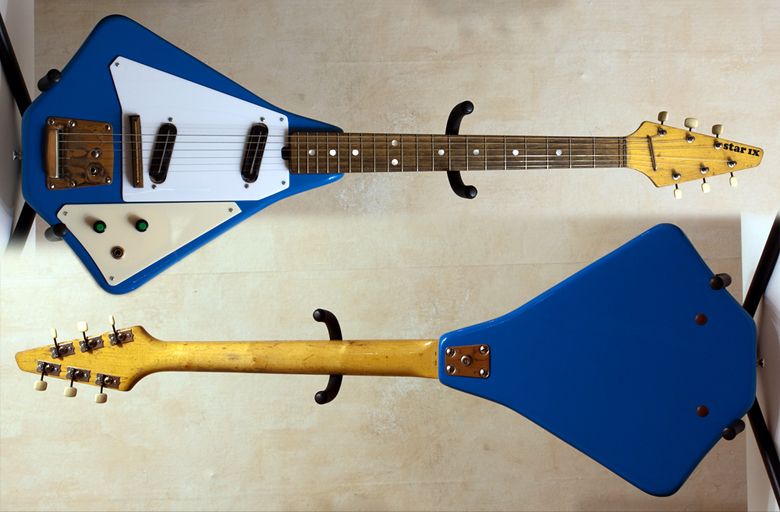
According to the seller of this guitar, it is known as the Screwdriver because of its shape. Made in Czechoslovakia in the 1970s, this Jolana Star IX with its "screwdriver" shape doesn't very much resemble the Jolana Star X that we looked at here on Guitarz back in August 2009. The Jolana Basso IX that we looked at in December 2009, however, does share the same shape. It's nice to see what the control plate on this design should look like (the Basso IX we featured had a home-made replacement), but I doubt the knobs are original. Alas, the original pickups are missing their covers, and the trem arm would appear to be similarly absent.
This guitar is currently being auctioned on eBay with a starting price of $200.
For more about Jolana guitars, see Cheesy Guitars!
G L Wilson
© 2011, Guitarz - The Original Guitar Blog - now in its 10th year!
This guitar is currently being auctioned on eBay with a starting price of $200.
For more about Jolana guitars, see Cheesy Guitars!
G L Wilson
© 2011, Guitarz - The Original Guitar Blog - now in its 10th year!
8:25 AM | Labels: Czechoslovakian guitar, east-European guitar, Jolana, Weird guitars
Univox Hi-Flier from 1976 - Japanese-made Mosrite copy
/
Guitarz reader Colin Brown brought this guitar to my attention via our Facebook page, commenting:
This example is currently being offered for sale on eBay with a starting bid of $300.
G L Wilson
© 2011, Guitarz - The Original Guitar Blog - now in its 10th year!
I thought this was kind of neat, with a maple fingerboard, wraparound bridge, and humbuckers... I've only seen the ones with the jazzy trem, rosewood fingerboard, and single coils.The guitar in question is a Univox Hi-Flier, which is essentially a 1970s Japanese-made copy of the Mosrite Ventures model. Nirvana's Kurt Cobain helped popularise these old Univox Mosrite copies, injecting them with the cool factor.
This example is currently being offered for sale on eBay with a starting bid of $300.
G L Wilson
© 2011, Guitarz - The Original Guitar Blog - now in its 10th year!
2:56 PM | Labels: cool guitars, Japanese guitar, Mosrite, Univox, vintage guitars
A pair of 1950s Kay Jazz Special basses
/
guitarz.blogspot.com:
Here we have a pair of Kay Jazz Special basses from the 1950s. With their hollowbody design they are a close relation to the Kay Thin Twin Bass we looked at here on Guitarz last month, the main differences being the doublecutaway body shape, pickguard, and the over-sized headstock with Art Deco styled "Kelvinator" badge (so-called because of its similarity to a Kelvinator refrigerator logo).
This pair are currently being offered for sale on eBay with a But It Now price of $12,995.
G L Wilson
© 2011, Guitarz - The Original Guitar Blog - now in its 10th year!
6:27 AM | Labels: bass, cool guitars, Kay, semi-hollow body, vintage guitars
Subscribe to:
Posts (Atom)