Posts RSS RSS

Welcome to our site

You can replace this text by going to "Layout" and then "Page Elements" section. Edit " About "

The "It's supposed to be a snake but it looks like something much more unpleasant" Telecaster

/

guitarz.blogspot.com:

"THIS IS THE ONLY ONE IN THE WORLD!" screams the eBay listing for this very ugly hand-carved guitar.

Some of us would respond that such scarcity could be considered to be something in its favour.

The strange carved object on this guitar, at closer inspection, reveals itself to be a rattlesnake, but unfortunately from further away it does resemble something that comes out of the rear end of a dog. I'm sorry, the last thing I want to do on this blog is to get all scatalogical and severely lower the tone, but with a guitar like this it is very hard to avoid saying something along those lines.

The carving doesn't work for me, because if that is supposed to be a snake, then what is it meant to be sitting on? A severely sawn-up Telecaster?

Nice try - someone probably put a great deal of effort into this creation - but design-wise it just does not work.

Currently being offered for sale on eBay UK with a Buy It Now price of a staggering £999. (Cough, splutter, choke...)

Thanks (if that is the word I'm looking for) to Alan Newton for bringing this guitar to my attention.

G L Wilson

© 2011, Guitarz - The Original Guitar Blog - now in its 10th year!

Vintage & Rare Guitar of the Week: John Entwistle's Epiphone Embassy Bass

/

guitarz.blogspot.com:

This 1964 Epiphone Embassy bass in cherry finish was owned by the late John Entwistle of The Who, and is one of the instruments featured in his book "Bass Culture". The bass is said to be in excellent original condition; it features Thunderbird pickups, and is still in the same condition as when John set it up with Rotosound strings.

You'll notice the design similarities with the Epiphone Newport bass we looked at recently, although with the bridge-biased Thunderbird pickups on the Embassy you could expect a more "rocky" sound.

Having said that, it's highly likely that this bass will be bought as a collector's piece or as an investment, given its provenance. It is currently being offered for sale, via Vintage & Rare, priced at €8000.

G L Wilson

© 2011, Guitarz - The Original Guitar Blog - now in its 10th year!

1980s Soviet-era Czechoslovakian-made Jolana Disco: piece of unplayable junk OR single-pickup wonder?

/

guitarz.blogspot.com:

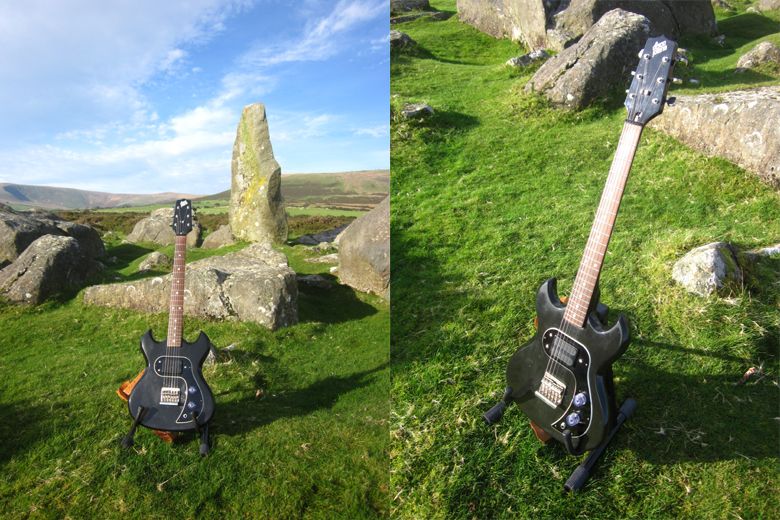
Regular readers of Guitarz will know that we have a particular affection for Soviet-era East European and Russian guitars. When I saw this Jolana Disco guitar from 1980s Czechoslovakia listed on eBay UK recently with a Buy It Now price of just £60, I knew I had to buy it; indeed I think I would have been failing in my duty as a Guitarz author if I hadn't.

The Jolana Disco is a very basic model guitar, that much is obvious just from looking at it. It's a no-nonsense, simple electric guitar. Single pickup, volume and tone controls, no trem or any other fancy gubbins. The design, whilst quite clearly derived from the Gibson SG, is squat, pointy and - dare I say - it's a little bit of an ugly duckling. In fact it reminds me of certain Burns guitars, and I mean that as a compliment.
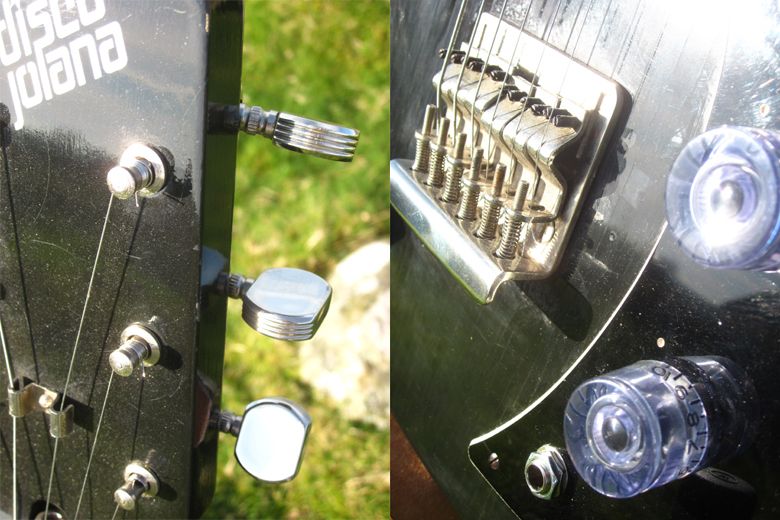
Because it was made in Soviet-era Eastern Europe we do not have here a guitar be-decked with all the same hardware - pickups, tuners, bridge, etc - as found on countless other brands. The Jolana features home-grown hardware which makes it all the more idiosyncratic. The tuners, for example, are huge and, in my estimation, quite attractive. They are hardly the best tuners in the world, but they seem to do the job. The bridge is highly engineered and shaped from pieces of sheet steel, and is fully adjustable; it looks a little unusual when we are so used to seeing the same old bridges everywhere, but it is fully functional and does the job.

The finish is black and THICK. I suspect that it may hide a body of cheap timber - I don't think it's plywood because you normally see the telltale ridges of ply where the finish has sunken in around the sides of the guitar.

The Jolana Disco has just a single pickup, and what a pickup it is! It's a HUGE humbucker and is positioned slap bang in the centre of the guitar's body. To my ears it sounds great and can provide everything from a crystal clear bell-like tone to downright raunchy overdrive. The positioning might throw a few people, and although I'm not usually a fan of tone controls on guitars, in this instance the tone control is essential in making sure you have the required amount of treble.

The volume and tone controls have over-sized chunky clear plastic knobs which I find quite ugly, and which do look rather cheap. The pickguard (or scratchplate) is quite minimalistic and is essentially an over-large pickup surround combined with a control plate.

I've read reviews of this guitar where the owner has commented with words to the effect that it is virtually unplayable. Well, either they had a particularly bad example, or else - as I suspect - they weren't trying hard enough to get on with the guitar and to allow it to shine.

I admit I found it awkward to play at first. The biggest hurdle to overcome is the high radius of the fingerboard. Boy, that fingerboard ain't half got a curve to it! If you prefer your fingerboards flat or virtually flat, you'd be in for a shock with this Jolana. Still it doesn't take too much perseverance to become accustomed to the fingerboard radius, and I feel the results are well worth it because this guitar is quite playable once you get over that initial shock.

The other thing that might freak you out is the position of the pickup, which as I have mentioned already is slap bang in the centre of the body. I hear so many people say, "Oh, I only ever use the bridge pickup," and that is something that never ceases to amaze me. I think this goes back to guitars that have those stupid "Rhythm/Treble" legends on their pickup selector switches (Yeah, Gibson and their imitators!). Put simply, the mental process goes like this: Lead guitar is cool, rhythm is boring. Who wants to be a rhythm guitarist? So this totally erroneous notion that the neck pickup is the rhythm pickup and the bridge pickup is the lead pickup, i.e. the COOL pickup, has been perpetuated. Well, it's complete bullshit. Most guitarists rate Jimi Hendrix, so I say to them check out video footage of Hendrix (the Hendrix at Woodstock DVD is a good one), check out the close ups and tell me what pickup he uses for most of his solos. Yup, you've guessed it, it's the neck pickup. And then tell me that that's NOT lead guitar playing.

So, for a single pickup guitar, I'd argue, the obvious position for a pickup is in the centre. It's neither too trebley nor too bassy. Sure, it's a compromise to some people, but as I've said you can bring the tone control into play. And really, I think that's all you need.

So yeah, I LIKE this little ugly duckling of a guitar. I admit the action could be improved upon, it has a slight tendency to neck heaviness (small body, large headstock) and it does have a few little rattles here and there, but to me these add to the character of the instrument. All in all, it's a highly playable no-nonsense guitar, and I would happily play it in a band situation.

G L Wilson

P.S. The photos in this blog post are my own work, so please do not copy or re-use without asking permission first!

© 2011, Guitarz - The Original Guitar Blog - now in its 10th year!

All of us are looking at the stars

/

guitarz.blogspot.com:

A Migma Star 61 to be exact. Maybe. It's hard to tell really as every search I've made has revealed a whole range of different Migma guitars claiming to be Star 61s. This one doesn't have the typical Migma tailpiece either. Anyway...

We've all heard or used the expression "a Mickey Mouse guitar", I'm sure. Well, for this seller, his Migma Star 61 has always been his Kater Karlo guitar because it looks like a cartoon (Kater Karlo is the Disney character - Pete - sometime villain and general tough guy). He says the model is rare and, if the paucity of Google searches is anything to go by, he's right. It has a large, thick body, of which he says, "What is the material of the body - no idea, it looks as if he had joined like two halves of bread. Maybe it's made ​​of fiberglass, is certainly very hard. It has a slight Flitteroptik (glitter effect, I guess). You can see on the photos that all the edges of the body are rounded off.

"Contrary to expectations, the guitar is very playable, the pickup works, although only one of the pots seems to function".
The guitar has its own design quirks such as the chunky pickup and the rather haphazard placing of the control panel but it's undoubtedly a Star guitar.

A little research indicates that these were probably not fibre glass but carved wood. There is a seam showing but the joint looks pretty accurate and there's no strip to hide the join like with a Res-O-Glas guitar. Someone once showed me how make a very tight fitting guitar case by making a box to size and then splitting it with a bandsaw lengthways to leave two perfect fitting halves. Maybe this uses a similar approach.

A little more research on http://www.schlaggitarren.de/home.php?text=hersteller&kenn=87%20mfg reveals that "Lothar Junghänel is the inventor of the extravagant "Star Series". They were designed by him and built in Zwickau, and later manufactured under license by Migma.

He celebrated his 82nd birthday on 20/05/2011. His son Hanno Junghänel contacted schlaggitarren and soon they will publish a detailed article on the history of Star & Starlet instruments, and its inventor."

Schlaggitarren also have some nice photos of other Star models and their designer plus a lot of other interesting guitars, so it's well worth checking out.

David in dull and dismal Barcelona Brrrrrrr! Anyone got a brolley?

© 2011, Guitarz - The Original Guitar Blog - now in its 10th year!

Gretsch Corvette Deluxe solidbody from 1976

/

guitarz.blogspot.com:

I've commented before that I particularly like some of Gretsch's solidbody designs, whereas of course that company is mainly known for its hollowbodies. This Gretsch Corvette Deluxe from 1976 is one such example of a solidbody that appeals to me so, from the all-access neck, the sculpted contoured body, the metal control panel, right up to the unusual 2+4 headstock design. It may not be a model coveted or even held in regard by Gretsch fanatics, but it's not one that I would overlook.

Alas, the eBay France auction has finished already, although seeing as it didn't sell with a starting price of €700, maybe it'll be re-listed.

G L Wilson

© 2011, Guitarz - The Original Guitar Blog - now in its 10th year!

2010 Kay Thin Twin Reissue and other stuff

/

A certain taste for vintage guitars that may transpire in my posts on Guitarz is in no way a nostalgia for a lost golden age, nor a cult of the origins (who could seriously believe that by some miracle the (almost) first three solid body electric guitar models ever conceived and produced in the 1950s by different companies are perfect and unsurpassed since?) It's just that at some point there've been a global explosion of creativity in guitar making following the invention of the instrument and of the music that fit with it, and there is a lot to learn from it.

You had the same happening in the 1910s, within a few years art and history changed radically due to creative emulation of artists all over the world, and one century later people are still trying to digest, explore and expand the potential of the historical avant-gardes: cubism, futurism, constructivism, dada, fauvism, neoplasticism, etc... Same in music with the 1960s British invasion or the late 1980s rise of electronic music.

And something happens in every domain and all the time, you have people who create things, and then you have people who bank on them - these things require different skills and spirits, so it's rarely the same people. You have also times for creativity and then you have times for making money - we're living such times when it comes to guitars... Imagine that in computers: people would buy huge slow square grey IBM PCs because they're so cool, and that's how Don Estridge invented them back in the day!

Anyway, let's go back to vintage guitars: there are roughly four things you can do with vintage guitars: you can preciously collect old instruments, hoping to get one in mint condition but a beaten one is also cool, and worship them while they gain more value year after year and end up keeping them in a safe. You can copy classic models again and again because, you know, that's the way Leo and Les did them and there's nothing more to do - and it sales -, and saturate the market until people cannot even imagine anymore that there are other guitars out there. You can re-issue vintage creative models so you can benefit from the vintage trend while diversifying and rejuvenating the offer, and as wrote 18th century French poet Antoine Houdard de la Motte: "l'ennui naquit un jour de l'uniformité (boredom was born from uniformity)" (now find other guitar blogs quoting 18th century French poets!). Or you can study the great guitars from the past, get inspired by their audacity with the distance given by time, and create the guitars of the 21st century!

The re-issue is a good starting point, and it's happening more and more since Eastwood started the trend in 2001. Now you can find Eko's lovely guitars new and functional, and reissued 1952 Kay Thin Twins.  This is not the original Kay company that provided so many budget guitars to American players between the 1930s and the 1970s (remember that Kay claimed to have produced the first electric guitars, using pickups several years before Gibson - historians must work on that!), but it's not like we're talking about high-end handmade guitars made by master luthiers in an hidden Shaolin temple. The Thin Twin got its name from its thin blade pickups sticking right out of its hollow-body. It's the kind of instrument on which blues became rock'n'roll out of the spot-lights...

Bertram

© 2011, Guitarz - The Original Guitar Blog - now in its 10th year!

The Legentary Punk Guitar Of Alex K.

/


Well this guitar is for sale on eBay and all there is is this:
The Legentary Punk Guitar Of Alex K. 
That's simple - that's enough. After the 11 cool guitars we saw yesterday, a little bit of crap won't hurt!

Bertram

© 2011, Guitarz - The Original Guitar Blog - now in its 10th year!