 RSS
guitarz.blogspot.com:
This is a guest post by Christopher Davis, author of The Classical Guitar Blog
Our instrument has a long history. Dating all the way back to 1400s when an instrument called the Vihuela flourished in Spain. Vihuela featured six courses of strings - a course being a pair of strings tuned to the same pitch in this case. Much like today's guitars, the tuning was fourths and one third. In today's terms, Vihuela tuning would be E A D F# B E.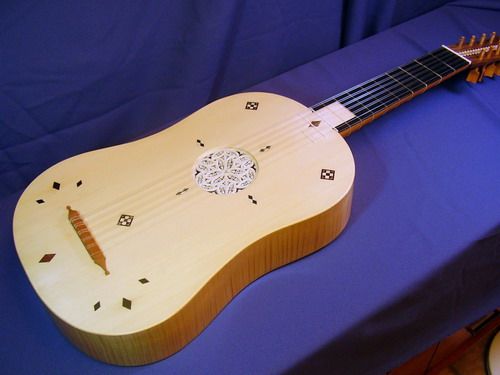
Interestingly, vihuela was really a family of instruments: they came in all sizes. There are only three original Vihuelas in existence today, and each is slightly different in scale length and pitch. Some would even be considered bass-like. There was also a four course guitar that flourished in France during the Renaissance.
The Baroque guitar (around 1600-1800) flourished in many European countries. These guitars are as much works of art as they are instruments. They featured extensive ornamentation and inlays.
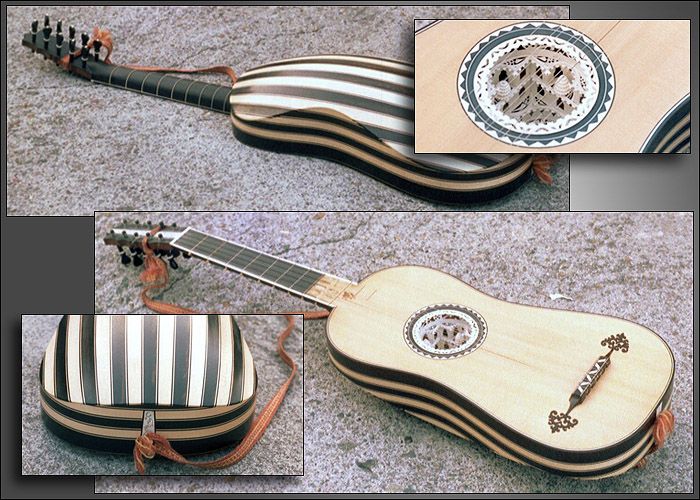
And elaborate rosettes that filled the sound hole.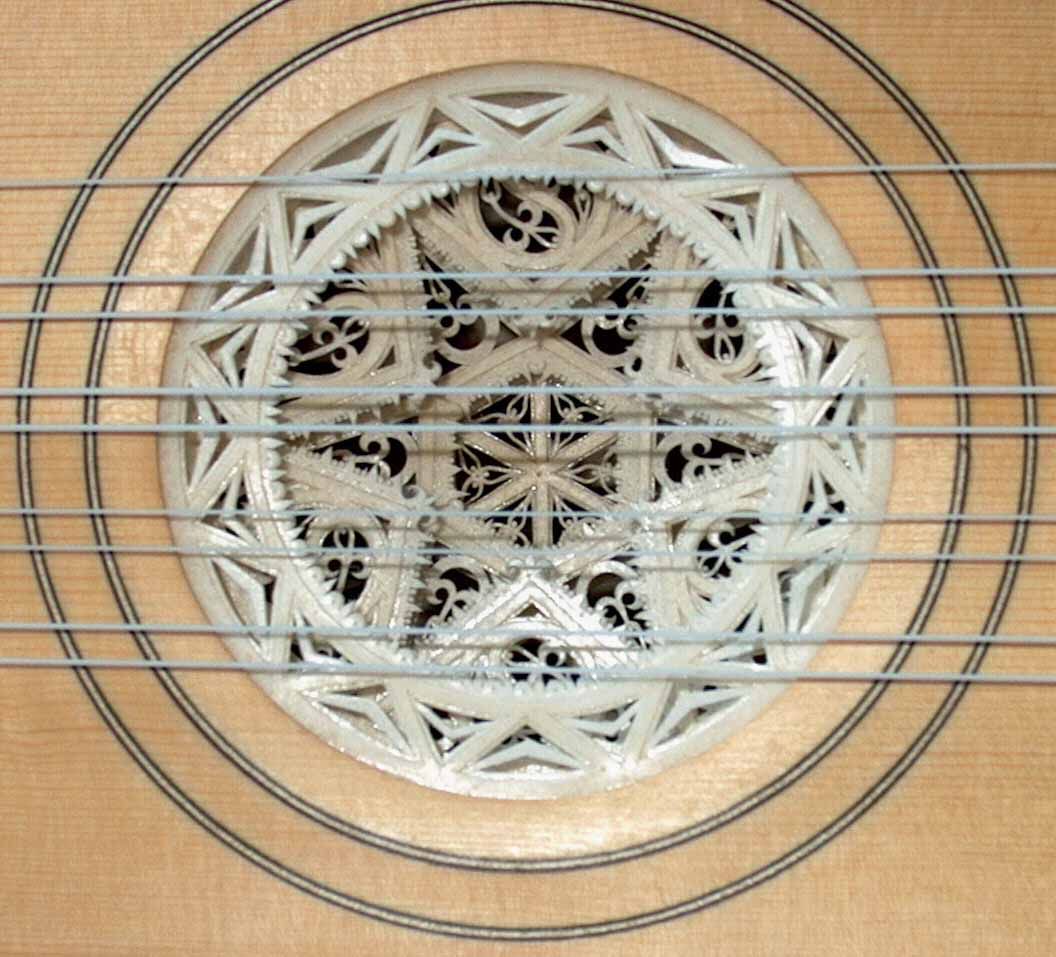
Around 1800 guitar builders gradually added a sixth course, and went to single strings. Check out this instrument, a six course guitar built around 1800.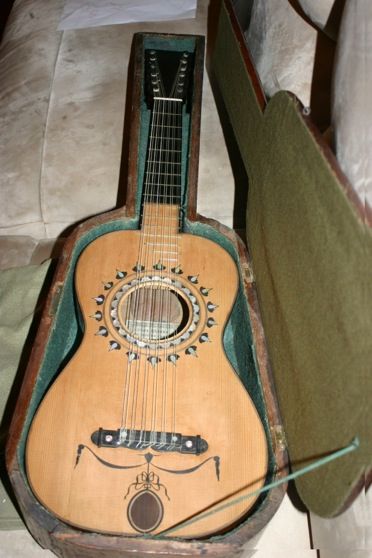
And this one built just a few years later.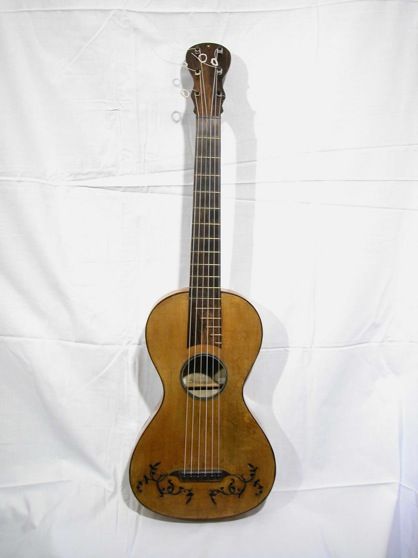
Like guitarists today, guitarists in the later 1800s explored guitars with more than six strings. Composer/Guitarist Johann Kaspar Mertz played on a ten-string instrument similar to the modern harp guitar.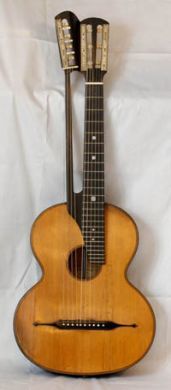
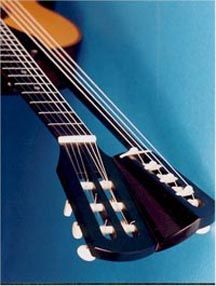
Napoleon Coste also added more strings and wrote music for this seven string guitar.
The ten-string guitar is still alive today thanks to the work of Narciso Yepes.
Classical, nylon-strung guitars today, however, are mostly pretty tame. And they're all descendents of the grand-daddy of the modern guitar, Antonio Torres. Torres built guitars in Spain during the late 19th century, and his instruments are the first that we consider modern. The bodies on his instruments were slightly bigger, and the braces on the underside of the top were arranged in a fan.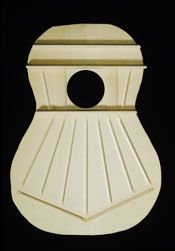
While electric guitars may feature gorgeous wood on the top, the back and sides of a classical guitar are often the most beautiful. Below is my guitar, built in 2009 by Michael Thames.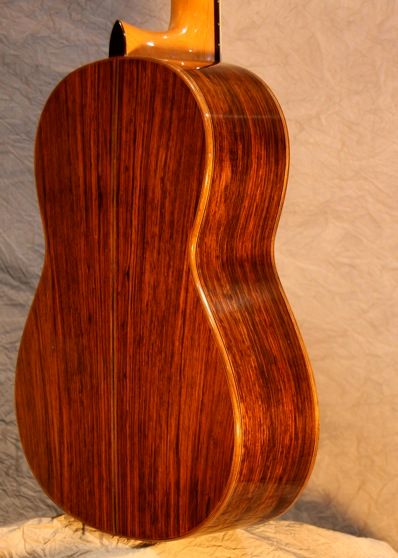
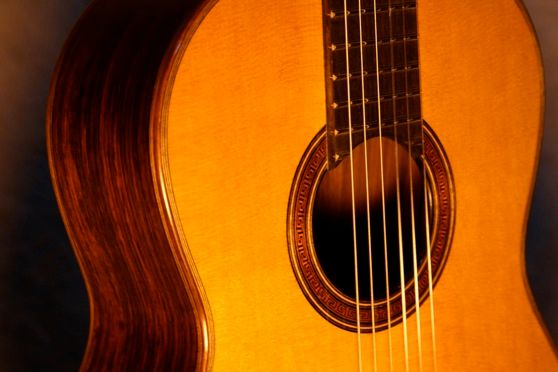
Most professional level classical guitars - called "concert guitars" - are custom shop jobs. They are built specifically for one person, and you choose a guitar builder based on the features you want. Some builders specialize is construction methods that are a bit unorthodox or strange. Check out the inside of this "lattice braced" guitar.
The tops on these guitars are extremely thin (you could puncture it with your finger), and that black stuff inside is carbon fiber. Another popular construction method today is a "double top". These guitars have a thin top, then a layer of honey-comb style material called Nomex, then another thin top is glued on the other side. Here builder John H. Dick shows off the inside of his guitar tops (towards the end).
There's a lot out there in the world of classical and nylon-strung guitars, and it's well worth exploring.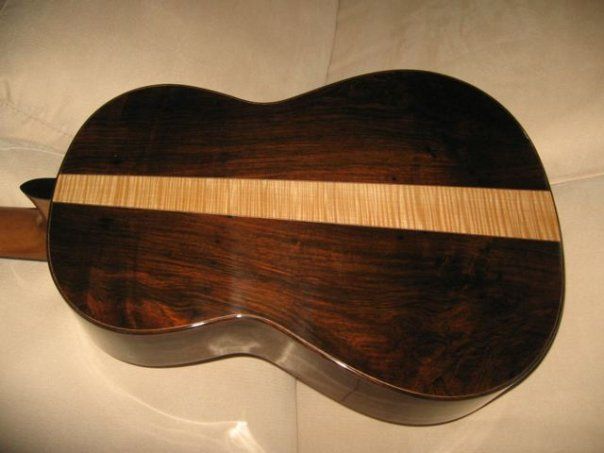
Christopher Davis
Guitarz - The Original Guitar Blog - now in its 9th year!
A brief history of the classical guitar
/

1959 Valco Airline
/

Another original of these vintage Valco Airline guitars re-issued by Eastwood in the 2000s.
Airline was a house brand of department store Montgomery Ward - built by Valco - and we already posted about the complicated cross-brand background of this kind of guitars...
bertram
Guitarz - The Original Guitar Blog - now in its 9th year!
1959 Silvertone 1423 aka Jupiter
/

Another baby of the inevitable cross-brand electric guitar industry in the 60s, this Silvertone 1423 was actually built by Harmony (as the H49 Stratotone Jupiter), equipped with DeArmond pickups and released exclusively in black / gold sparkle finish. Its chambered body made it very light and highly appreciated by beginners.
Silvertone had its models based on Danelectro, Harmony, Kay, National or Teisco guitars - they were actually manufactured by these companies with slight variation and branded by Silvertone that was the music instrument brand of the Sears Department Stores from the 30s until the early 70s.
Bertram
Guitarz - The Original Guitar Blog - now in its 9th year!
Jackson Custom Shop "Black Beauty" Dominion Mark Morton signature
/

This Mark Morton signature Jackson Dominion is a very honorable neck-through, chambered mahogany body, double humbucker guitar with a descent classic no-nonsense design, slightly twisted but without the hint of genius you would expect from this kind of instrument.
It was conceived by Jackson for Mark Morton who plays in some metal band called Lamb of God and who wanted 'a guitar with which he could also play rock or blues'.
The guy just invented electric guitar it seems!
bertram
Guitarz - The Original Guitar Blog - now in its 9th year!
Fender Jaguar Special HH
/

The Fender Jaguar Special HH could seem not so special - well, it's just another Jaguar -, but - beside its name - it's very special to me since I'm the proud and happy owner of one of these babies.
It was love at he first sight (and I was a Fender hater until then - now I'm just a strat hater) after being faithful for about 20 years to my Rickenbacker 620 and my Ovation Breadwinner! It has a kind of perfect look, not with the classicism of a Les Paul or a ES-175, but in its own twisted way despite the venerable age of the Jaguar (see the previous Jaguar post).
So the HH (as it's often nicknamed) has the usual design, 24' scale and typical complex electronics of a Jaguar, but it's mounted with Fender's Dragster Humbuckers - sounding really superb - and a tune-o-matic style stop tail (official name is Adjust-o-matic, must be American humor). It has a simple black nitro finish and black pickguard and lots of chrome, and a super cool 1969 strat headstock with vintage tuners. You put your fingers on the neck and they start to play on their own and to do things you didn't know you can do.
It was made in Japan in the 2000s, and I found contradictory information about it being exclusive to the Japanese market or not. I thought so for a long time and it was sold to me as an import - and you don't see it so often around -, but this is not mentioned on the Fender website so it's doubtful. There is also a baritone version (a real baritone, not a 6-string bass), that I will accept as a present any time.
bertram
Guitarz - The Original Guitar Blog - now in its 9th year!
50s Premier/Multivox Custom doubleneck guitar in gold sparkle finish
/

This Premier doubleneck guitar is one of the craziest looking one I ever saw, and by crazy I don't mean just bizarre for the sake of it, but joyful and eccentric. And it definitely predates the glam era since it's from the 50s - though probably just one of its kind - only the Bigsby and the stoptail have been recently changed.
I would write more about it but I'm mesmerized by the gold sparkle finish. I think that the ETs are trying to contact me!
bertram
Guitarz - The Original Guitar Blog - now in its 9th year!
Henman Bevilacqua S1
/

With this Jazzmaster-looking Henman-Bevilacqua S1, Henman Guitars proposes an interesting combination of classicism and... well, I cannot say modernism or high-tech, since electric guitar is ontologically modern and high-tech, so let's say progressiveness. You could say that there's nothing new in the two humbuckers (tappable though) and Bigsby trem but if you look closely at all the details, you will see that this guitar has clearly something (I just wish they wouldn't spoil a transparent black finish with a figured maple top when the body is made of solid mahogany...).
If you are interested in this Hen-Bev S1, go and have a look at their website, they have plenty of technical specs about stuff like their avant-garde tuners and truss rod, plus a couple of video demos that allows you to hear its terrific sound (very rock/blues though - but it seems that it's what 99% of players expect - ah, and someone should tell the demo player that an emo haircut after 21 is pathetic).
About the Jaguar/Jazzmaster design, it's strange but I have to admit that though it's been introduced in 1958 - shortly after the Telecaster (50), the Les Paul (51) and the Stratocaster (54) - and widely spread in the 60s by European companies (mostly Italian and German), it didn't turn into a boring cliché but kept a radical feel - probably because it wasn't overexploited by Fender. So Henman played it safe when they chose this design, both familiar and with a maverick spirit.
bertram
Guitarz - The Original Guitar Blog - now in its 9th year!
Subscribe to:
Posts (Atom)