 RSS
RSS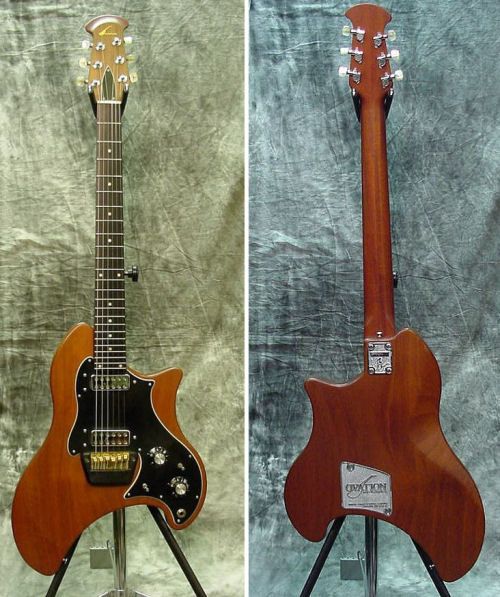 guitarz.blogspot.com:
Here's my eBay tip of the week, if not the whole month! This Ovation Breadwinner Limited is not only in fantastic condition but it's also a quite a rare find, and is currently listed on eBay with a low Buy It Now price of $895.00 (which is approximately £541.28 in my money).
Trust me, this is an absolute steal. Buy it now before one of the Ovation Fan Club members snaps it up - some of those guys have huge collections of Ovations - they don't need any more.
Believe me, if I was in full-time employment right now and had the necessary readies coming in, I would only be telling you about this guitar once it was mine!
The Limited was the final incarnation of the Ovation Breadwinner and features a natural finish and a slightly modified body shape.
G L Wilson
P.S. If you do buy it, please let us know!
Additional (9 December 2009): SOLD. The seller accepted an offer of US $700.00 (approximately £429.41) which was much less than the Buy It Now price. I can't understand this - it's a highly desireable guitar.
NB: There are a lot of blogs STEALING content and bandwidth. If you read this anywhere else but on guitarz.blogspot.com then you are reading a blog that STEALS content. Please support original bloggers!
Ovation Breadwinner Limited ... snap this one up, quickly!
/

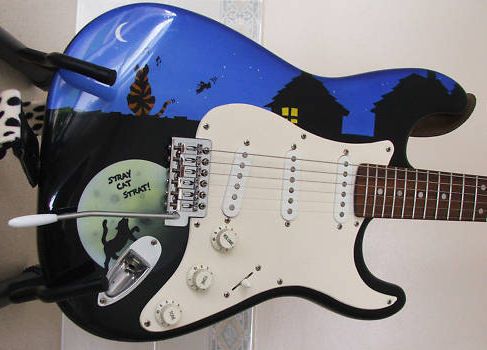
Stray Cat Strat
/
 guitarz.blogspot.com:
Of course most Stray Cats fans would be more interested in a Gretsch hollowbody, but nevertheless the unique artwork on this Squier Stratocaster is very nicely executed.
G L Wilson
NB: There are a lot of blogs STEALING content and bandwidth. If you read this anywhere else but on guitarz.blogspot.com then you are reading a blog that STEALS content. Please support original bloggers!
Gibson Les Paul Personal, 1970
/
 guitarz.blogspot.com:
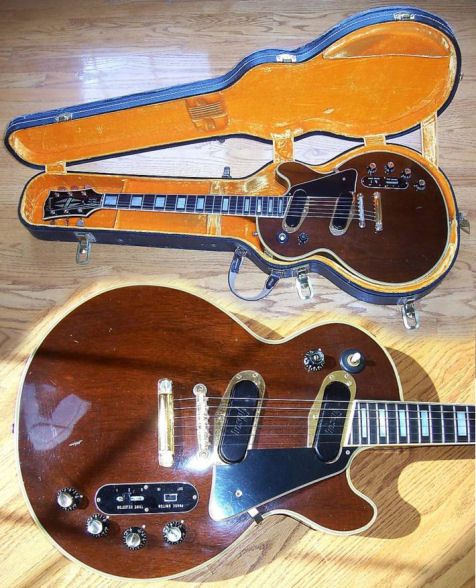
This guitar was for sale on eBay recently. At first glance it appears to be a 70s-era Gibson Les Paul Recording model, but closer inspection reveals several distinct differences from that guitar.
This is in fact a Gibson Les Paul Personal circa 1970 and the main differentiating feature is the XLR microphone input on the upper bout (see photo below).
I remember seeing Les Paul himself on television many years ago playing one of these complete with microphone, and I had always previously thought that it was a Recording model. Obviously it requires a mic with a rigid stem!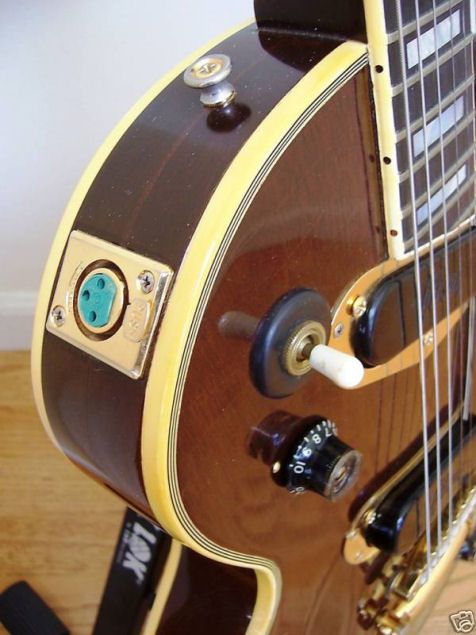 To borrow shamelessy from the eBay listing for the guitar offered for sale, the features of the model inlcude:
Low impedance electronics and pickups. Clear grain British Honduras Mahogany body with center crossband. Three piece laminated British Honduras Mahagony neck construction. The laminations are quarter sawn for maximum strength. Buffed and polished clear walnut finish reveals all the fine grain-line features of the basic wood. Ebony fingerboard with "fretless wonder" frets, mother of pearl block inlays, Gold Plated Deluxe design machine tuning heads with sealed gears, Gold Plated Tune-O-Matic Bridge, 18 1/4 inch long, 14 inches wide, 2 inches deep, 24 3/4 scale, 22 frets, neck joins body at 16th fret. XLR Microphone Input Jack, Microphone volume control next to pickup selector switch. Also Bass, Treble, Decade and Volume Knobs (with 0-10 levels each) and Tone Selector and Phase Switches.
It is believed that only 146 examples of this guitar were built.
G L Wilson
NB: There are a lot of blogs STEALING content and bandwidth. If you read this anywhere else but on guitarz.blogspot.com then you are reading a blog that STEALS content. Please support original bloggers!
The evolution of Lubani RotoNeck guitars
/
guitarz.blogspot.com: In February we took an all-too brief look at a Roberts RotoNeck guitar. I don't think we really knew quite what we were looking at at the time. Such is the beauty of the internet, that one of the guitar's creators has been in touch.
"I am the co-inventor of the RotoNeck and it has evolved quite far from the version you have there on the blog. Our very first RotoNeck was four sided with four 6-string guitars on one neck. Looked like a table leg. [pictured above]
"The evolution of RotoNeck started back in the late 70s while Curt Roberts and Lou 'Lubani' Bonkowski were living in the San Bernardino Mountains. Lake Arrowhead to be exact. The first concept model was cut out of a 4x4 piece of pine wood which later became the 'Roberts RotoNeck', a 4 sided guitar on one neck which each neck had its own tuning and you could rotate the guitar on two lexan discs. I have since then built approximately a dozen other concept models in search of the right model to manufacture. There are so many different models that this whole invention has gotten way too out of hand. The versions of RotoNeck are ENDLESS!!!

"Almost immediately the three-sided and two-sided versions became dreams. We built the two-sided version first. I wanted to put it in a body and Curt wanted to continue using the lexan discs. You have the version just mentioned [on the blog - pictured above] and it is called 'Roberts RotoNeck' I believe there might be as many as 12 to 15 of these. I have one and my son has another plus the very first 10 in the series never even got built. I believe the serial numbers started at 010.
"Anyway soon there after and at our first NAMM Show, we did another run of 13 RotoNecks that were spun in the body, not on the discs. This line was a combination of 6x6 and 6x12 [i.e. 6 and 12-strings]. I think only a few 12-6s, not sure.
"I wanted a line of guitars named after my father 'Lou Bonnie', studio musician and guitar great of the 30s, 40s and 50s. I came up with the name while living in Hawaii and spelled the name Hawaiian style: 'Lubani'.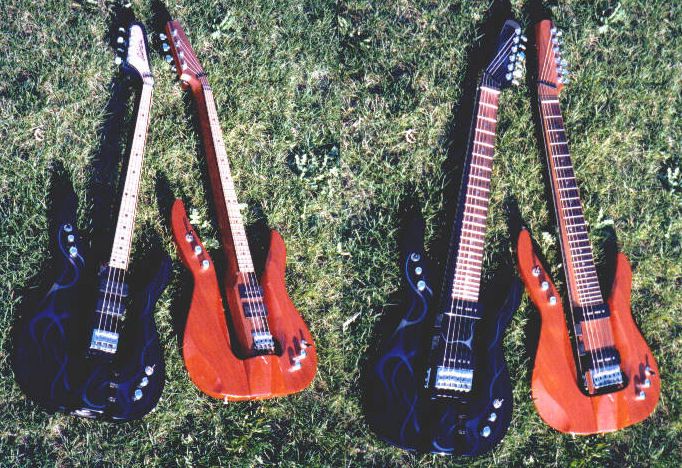 "While living in Hawaii in the early 90s I came up with the concept of just using four strings on the thumb side of the guitar and putting those strings in a tuning so at any given moment during the use of the six string side the notes on the open four string side could be easily accessed or by just using a thumb-over as a capo, compliment the adjacent cord formed on the six string side. Also each side of the guitar is amplified seperately and can be either played separately or together sounding like almost three different instruments. I am calling this version/model 'Lubani Tener' and have another nine string version with only 5 strings on the bottom side and 4 on the thumb side. This is called 'Lubani Niner' and has a very slim neck and feel. The 'Niner' is my favorite because of the thinness of feel. At present Curt Roberts is playing this guitar. He won't give it back to me he likes it so much. He would be the person to demonstrate how to play RotoNeck guitars. Your hand has to reform itself to play certain models which makes the early versions of RotoNeck not very desireable to play. The 'Tener' and the 'Niner' are very much more desireable.
"I have two 'Teners' here with me in Port Orchard, WA and would love to find a couple of shredders to try and learn this instrument. Got any suggestions?"
Lou Bonkowski
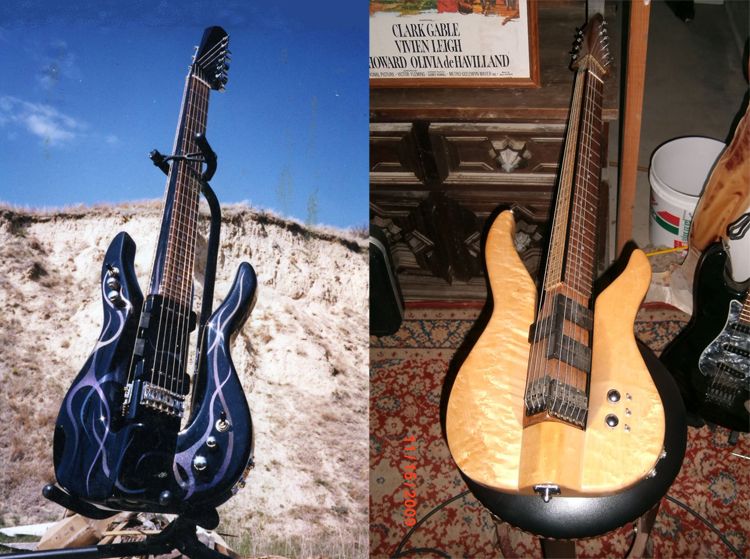

Lou demonstrates a few RotoNeck chords: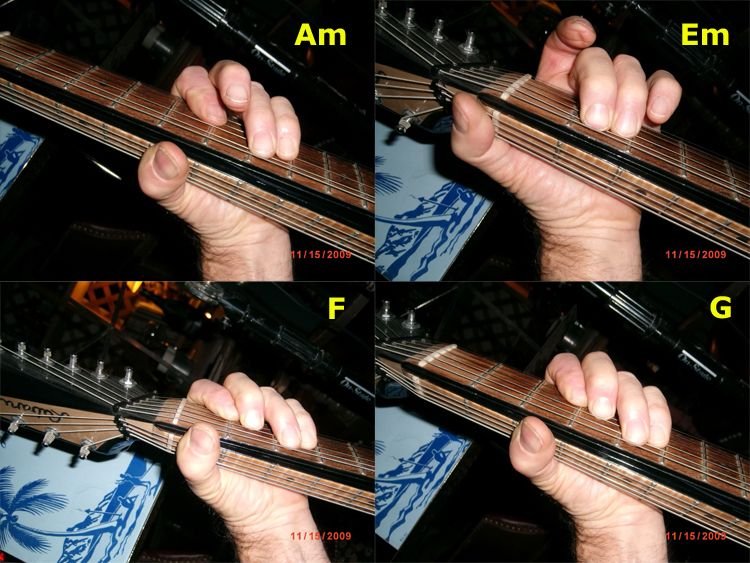 I'd like to thank Lou for taking the time to answer questions about the RotoNeck guitars and for supplying photos from his archive for this article. If any shredders want to take Lou up on his offer, you can contact him via us here at Guitarz.
All photos courtesy of Lou Bonkowski. Please do not copy without permission.
G L Wilson
NB: There are a lot of blogs STEALING content and bandwidth. If you read this anywhere else but on guitarz.blogspot.com then you are reading a blog that STEALS content. Please support original bloggers!
Micro-frets Orbiter - the first wireless guitar?
/
 guitarz.blogspot.com:
Ralph Jones founded Micro-Frets Inc in Maryland in the 1960s. Coming from an engineering background he was an enthusiastic inventor and incorporated several innovations into the company's guitar designs. One such innovation was the "Micro-nut" which allowed for perfect intonation at both ends of the strings. This was DECADES before anyone had ever heard the names Earvana or Buzz Feiten.
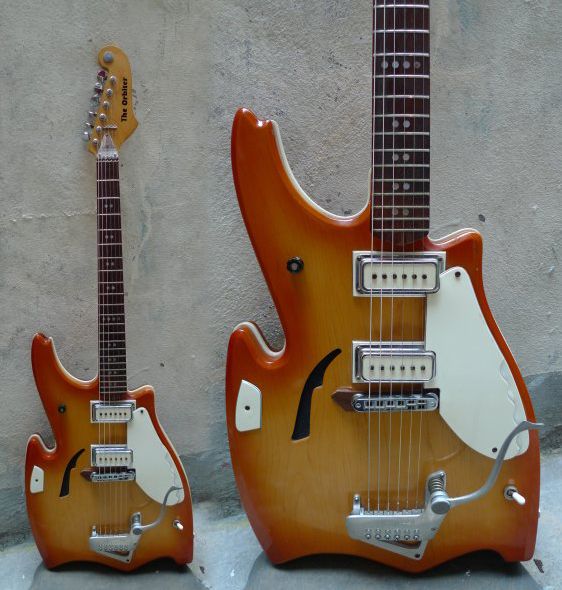
This particular guitar currently being offered for sale on eBay, the Micro-Frets Orbiter, is one of the more eye-catching designs. It dates from 1970 and was designed to be wireless. It would originally have had a radio transmitter fitted into the extended upper body horn.
Other interesting features are the discreet volume and tone controls hidden between the two-layer pickguard, and Micro-Frets' own vibrato, the "Calibrato", which was designed to keep the strings in tune whilst the pitch was being altered.
G L Wilson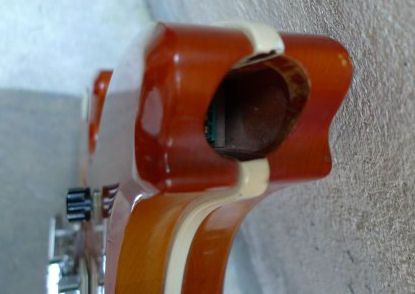 Additional: I just want to include this photo before the auction ends and the pictures are lost forever. This shows the upper horn of the guitar and the recess into which the radio transmitter would have been installed. GLWilson
NB: There are a lot of blogs STEALING content and bandwidth. If you read this anywhere else but on guitarz.blogspot.com then you are reading a blog that STEALS content. Please support original bloggers!
Lowry Modaire custom headless guitar
/
 guitarz.blogspot.com:
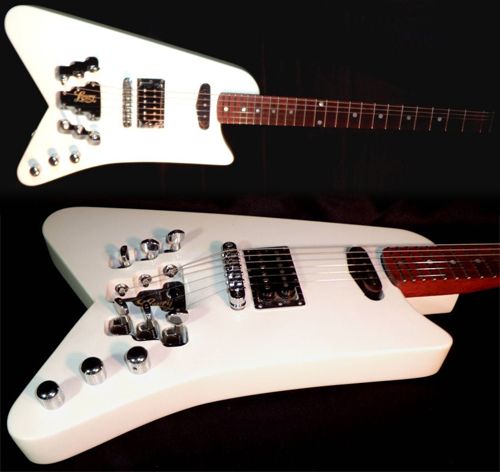
I like the design of this Lowry Custom headless guitar. It is very neat, and cunningly incorporates regular guitar machine heads in cutouts in the body's top behind the bridge. This means the guitar doesn't have the ridiculously small minimalistic body that many headless guitars suffer from. It has a nice amount of body mass - including behind the bridge - thus ensuring a good tone and sustain.
Apparently, Lowry Guitars produced hand-crafted guitars in Concord, CA from 1975 to the early 1990s.
This particular Modaire model, with styling reminiscent of the Gibson Moderne - even the model names are similar - dates to 1994 and is one of the last instruments built by this maker.
G L Wilson
NB: There are a lot of blogs STEALING content and bandwidth. If you read this anywhere else but on guitarz.blogspot.com then you are reading a blog that STEALS content. Please support original bloggers!
Behringer Vintager guitar and amp package
/
 guitarz.blogspot.com:
Christmas is coming - there's deals to be had...
If you're on a budget, one-day only deals like this one for a Behringer guitar starter pack from e-buyer.com in the UK look too good to pass by.
For just £68.99 you get a Behringer Vintager guitar, a Behringer AC108 Vintager 15 watt amp, gig bag, strap, guitar lead, 3 picks, instruction books and chord chart. Oh, and free delivery in the UK.
These are available at this price now, as I type this, and for the next 10 hours.
"So, is it any good?", you may well ask.
I bought one of these last week in a similar promotion. The guitar is so-so, to be honest. More or less what I'd expect from a budget guitar. It's the typical Strat-layout although the makers have tried to go with their own body shape. It looks OK, vaguely PRS-ish in shape.
The guitar is solid enough, although it's quite certainly not made from any quality timber. However, I don't think it's mega-cheap and nasty plywood either. I'd guess it was a low-grade basswood or similar. The neck is maple with a maple fingerboard and feels as if it's not been finished too well. In fact, up near the headstock end of the neck it feels quite uneven in its cross section like a wonky V. However, like the body, it's perfectly solid and - more importantly - straight. The action is quite acceptable. (People will insist on calling cheap guitars like this "junk", but they are fantastic when compared to the budget guitars of yesteryear!)
The pickups aren't so hot, as you may expect on a guitar of this price, but the guitar is perfectly playable although it does require a good setting up first. On my example, the strings hadn't even been wound on properly. I was tuning it up having had just taken it out of the box and the high E string boinnnged right off. As I was winding the machine head, the tension felt all wrong - I thought the string was going to break. Let's face it, it was probably put on by some poor kid in a Chinese sweatshop.
Speaking of the machine heads, they are not great. Obviously cheapies, but what else would we seriously expect? They do the job for now.
Another thing that bugs me about budget guitars which are obviously aimed at beginners is why oh why do they always insist on copying the Strat styling complete with "vintage style tremolo"? A tremolo is the very last thing you want on a guitar for beginners, especially if the guitar has not been set-up in the first place. All it is going to do is to confuse the beginner guitarist and - most likely - send the guitar out of tune.
What I'd like to see on starter guitars would be a simple hardtail bridge, perhaps with the intonation pre-set as on some of the wrap-around bridges you see on student model Gibsons and the like. It is the logical thing to do. However, I'm sticking the guitar on eBay and am going to get a few quid back on my initial investment of £68.99. And if no-one buys it, it's going down one of the local charity shops and they can make some money from it. I simply have no need of a cheap Behringer guitar. The reason I bought this package was for the amplifier.
The Behringer AC108 Vintager 15 watt amp, according to the blurb, has "a hand-selected vacuum tube, vintage-tuned 8" guitar speaker, 2-band EQ plus mid-shift, dedicated headphone output and CD input".
Blimey! It's a real tube amp for peanuts!
I had to buy it, just to check it out. Forget the guitar, that's going on eBay.
Just read through some of the reviews on Harmony Central - folks are rating this little cheapie quite highly. Several of the reviewers have recommended swapping out the vacuum tube for something of better quality and even doing the same for the speaker, but to my ears straight out of the box this amp sounds streets ahead of any practice amp I've tried before. It doesn't have the smoothest distortion in the world when turning up the gain, but it certainly beats the horrible fizz from transistor practice amps. Plugging my Fernandes Sustainer guitar into this baby, it just sings. I don't think I've ever been able to drive any other small amp with a sustainer before, they just can't manage the level of gain to allow the sustainer unit to function properly.
So, my advice is, snap one of these packages up whilst they are nice and cheap. Keep the amp, sell the guitar or give it as a Christmas present to someone who might appreciate it (you might want to give them your old practice amp too!).
Apologies to those outside the UK, but the above still applies as there are deals to be found on these packages.
G L Wilson
NB: There are a lot of blogs STEALING content and bandwidth. If you read this anywhere else but on guitarz.blogspot.com then you are reading a blog that STEALS content. Please support original bloggers!