 RSS
RSSguitarz.blogspot.com:
It's the start of a brand new week, so here's a video to put a smile on your face and help cure those Monday morning blues:
Frank from the Lampeter Fire Station Guitar Club, which I've been attending recently, sent me this link. His comment was that it was "something to work on". Whoah, you mean that's this week's homework?
G L Wilson
© 2012, Guitarz - The Original Guitar Blog - now in its 10th year!
Tommy Emmanuel - 12 bar blues in the key of E
/

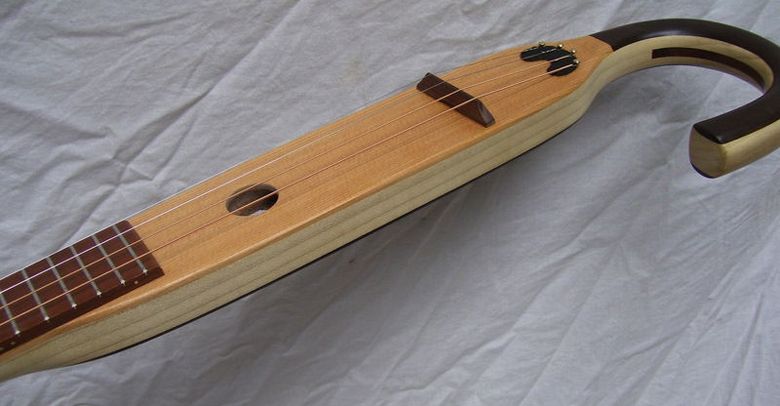
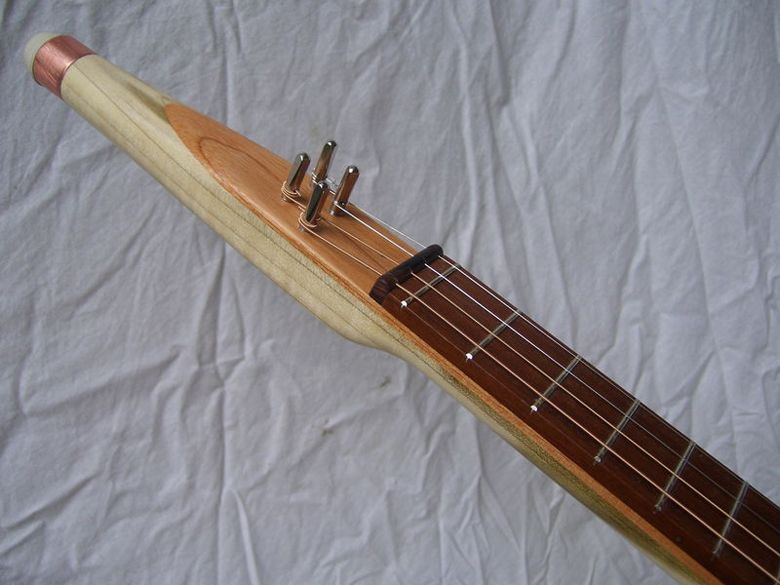
Walking cane tenor guitar/mandola - for those who like music on the move, now here's an instrument you can take hiking
/
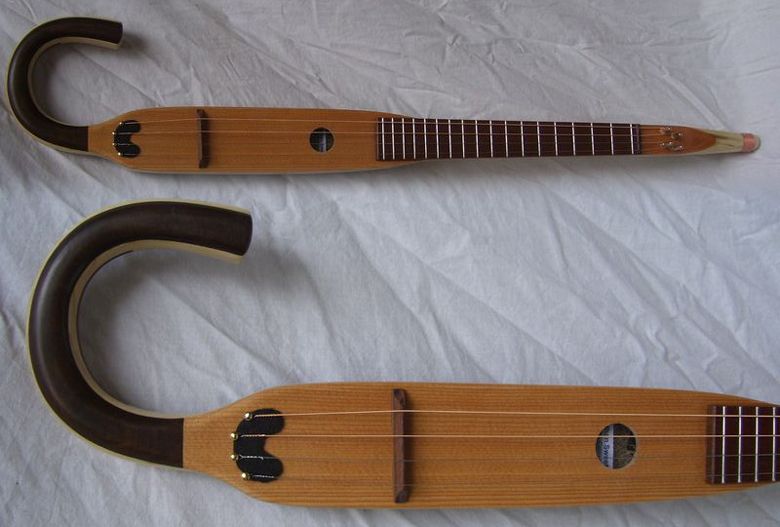
A truly unique instrument, functions as a cane and a Tenor Guitar or 4 string Mandola at the same time. Tuned C-G-D-A, 19 inch scale, so it is a little long for a mandola, and on the short end of a tenor guitar scale, but in the cane design it is very ergonomic. The cane crook acts like a armrest, and it is very comfortable to play. Very light yet strong enough for support, the sound is not as full as a full-bodied instrument yet very sweet and clear. This is a fully acoustic Tenor Guitar, not a solid stick. It has a Spruce soundboard, Mahogany headstock lamination, Rosewood back and crook laminations. The body is hollow. The crook-cane handle is cross laminated for directional grain strength.
G L Wilson
© 2012, Guitarz - The Original Guitar Blog - now in its 10th year!
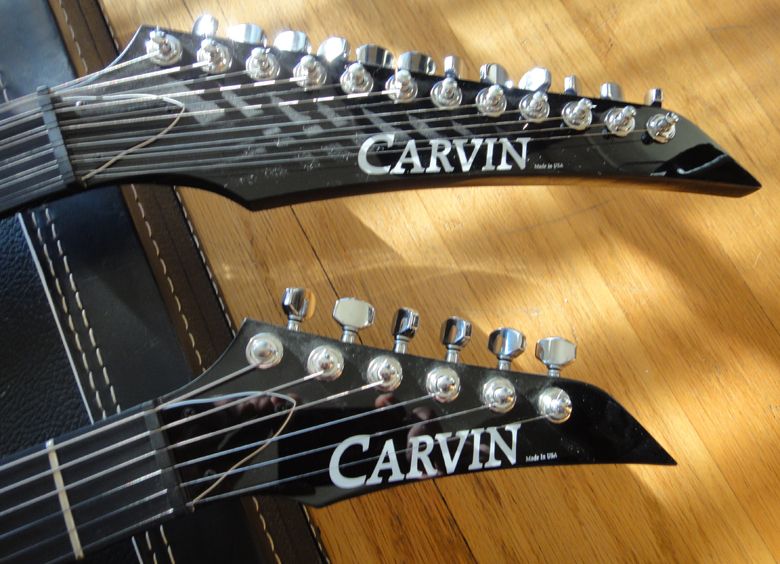
Carvin doubleneck - I wouldn't fancy tuning this up on a darkened stage
/
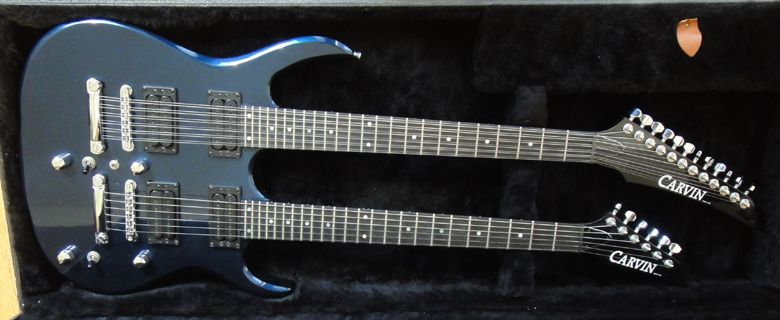
This is a early 90s Carvin doubleneck. It is, as far as I know, the only 6/12 that has the tuners on the 12 string neck inline. It makes for a very weird looking headstock... it looks more like a shovel.
It appears to be the same as the guitar on this catalog page from 1990.
The 12 inline was a option, the 6+6 was standard. The microswitch is the neck selector.
It's very heavy. The neck feels like a cross between an Ibanez RG and a Jackson; it's very thin, flat and wide. It is very much in keeping with the Superstrat/shred guitar design (other than the lack of a Kahler or Floyd). It's well made just like any other Carvin I've run across, but offers little in the way of new ideas. It looks and feels very late 80s if that makes sense.
G L Wilson
© 2012, Guitarz - The Original Guitar Blog - now in its 10th year!
Gibson Moderne - "reissue" of a classic guitar that probably never existed in the first place
/
guitarz.blogspot.com - Guest blog by Steven Williams of www.dawsons.co.uk:
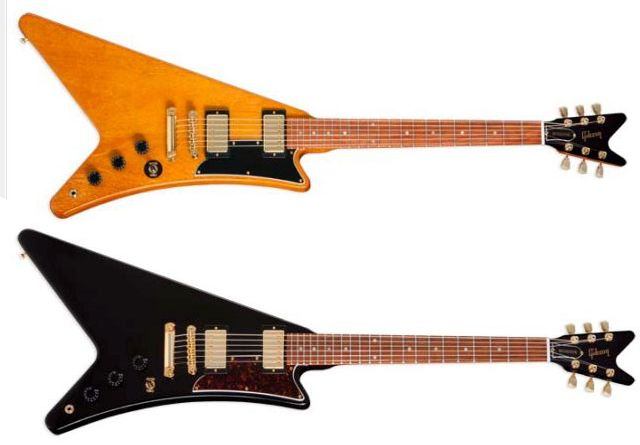
The Gibson Moderne is the closest guitar equivalent of the Bigfoot, in the sense that there is little evidence to prove its existence and there is yet to be solid proof of a real one anywhere on Earth. Guitar collectors consider the original Moderne the holy grail of Gibson collectable guitars. This is because the prototype designed in the late 50s as part of the ‘Futura’ range, along with the Flying V and the Explorer, failed to make it into production and simply vanished with no other prototypes appearing in pawnshops or even any trace of its existence until 1982 where it was released as part of the ‘Heritage Series’, and again later by Epiphone in Korea. Now decades later Gibson have released a new rendition of the fabled Moderne to start the hype, the mystery and the rumours all over again.
From what we know of this mystical creature, it appears to be almost identical to the original guitar. The very distinctive body, which looks like the cross-breed result of the Flying V and the Explorer, is made from mahogany along with its neck, which features a rosewood fingerboard and dot inlays. The Moderne is then finished off with a very cool forked headstock and to make sure it can replicate that vintage Gibson tone it has two ’57 Classic humbuckers.
The Gibson Moderne is going to pretty popular with collectors, as it’s the next best thing to the original, and people who simply like unique guitars. The guitar will be available in amber with a black scratchplate, or ebony with a tortoiseshell scratchplate. For more information on this guitar and its release date check out this site or sign up to the newsletter to be kept posted.
Steven Williams
© 2012, Guitarz - The Original Guitar Blog - now in its 10th year!
Gus G1 baritone guitar - carbon fibre, aluminium tube, flip flop paint, and 001 serial number
/
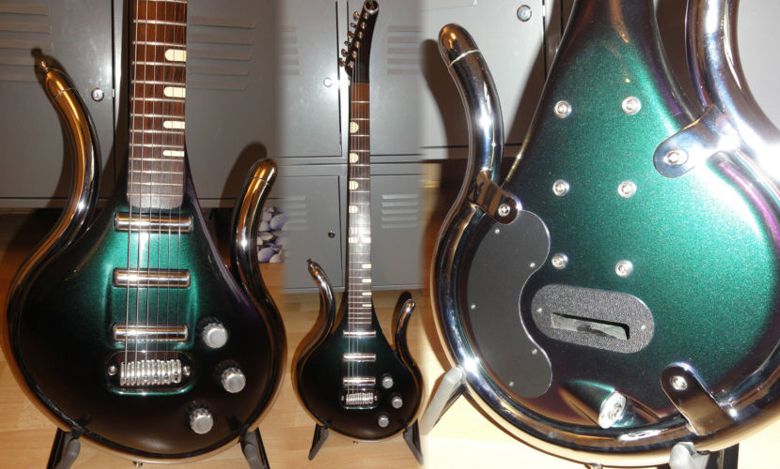
This particular example is a Gus G1 Baritone guitar with the serial number G1/B 001. Built by Simon Farmer in the UK, each Gus guitar or bass is essentially a custom order, although some instruments will have more specific custom features than others. The construction is of cedar with a skin of carbon fibre. All hardware is fabricated in-house a the Gus workshop so these guitars are not going to carry all the same generic hardware that we see everywhere else. The body is basically a teardrop shape and - most notably - is mounted inside a chrome-plated aluminium tube (actually welded in 5 sections). This tube helps give the instrument a more recognisable guitar-like shape and provides the familiar body horns.
The G1 Baritone has a 30" scale length and is designed to be tuned down to B (a fourth below 'normal' guitar pitch). This example has been finished in "Plum Crazy" purple to green flip flop paint from House of Colors.
For more information please check out the Gus Guitars website.
Currently listed on eBay UK with a starting price of £2999.
Thanks to Dirk for suggesting we feature this guitar.
G L Wilson
© 2012, Guitarz - The Original Guitar Blog - now in its 10th year!
Homemade one-string bass guitar with fretless aluminium fingerboard
/
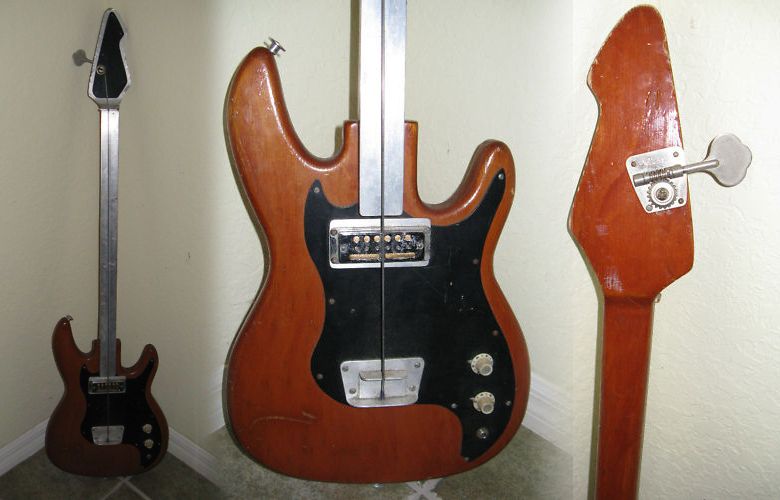
Thanks to Jeremiah for bringing this auction to my attention. He comments that, with a starting bid of $9.99, at least the price is fair.
G L Wilson
© 2012, Guitarz - The Original Guitar Blog - now in its 10th year!
Guyatone LG-11W - another forgotten 1960s Japanese guitar
/
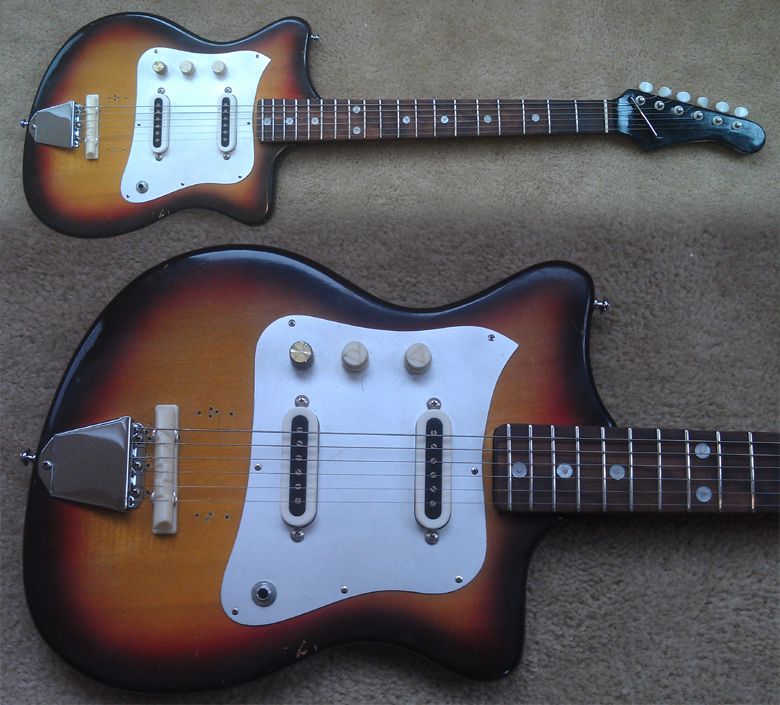
I recently saw your post about the JVC Balladeer and I was surprised to see that I have a Guyatone in this (I think) same body/headstock design. The major difference is the pickguard configuration and it is certainly of a lower level model with no tremolo system. The pickguard is still of metal construction, just a flat finish and the controls on top of the pickups, which is actually quite comfortable. I have looked and looked all over the web and I've yet to see any Kawai/Teisco/Guyatone Japanese guitars with this same exact body design.
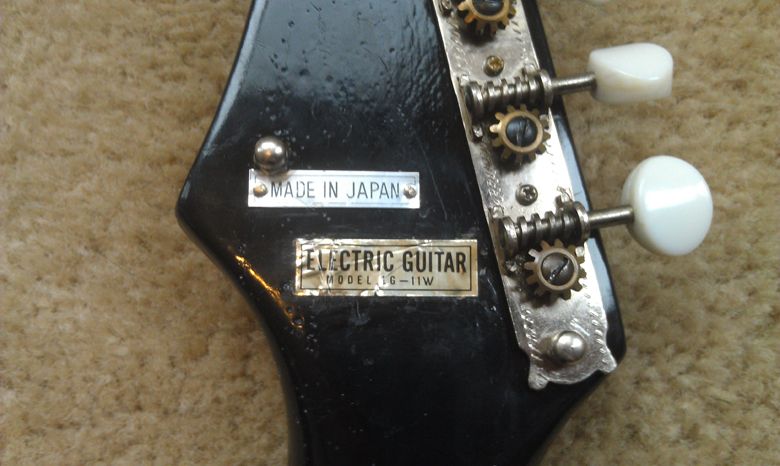
It has model number of LG-11W, which falls in line with Guyatone model numbers and of course has a 'Made in Japan' sticker, but unfortunately it no longer has its headstock badge (just a sticky residue of where one used to live).
In fact, I'm in the middle of refurbishing the neck and fingerboard due to too much lovin'! This thing was played to death and I'm certain whoever attempted to refret the fingerboard was not a pro, as there where large chips in the dried out rosewood. I decided to refinish the black neck paint while I was at it, which showed large stress cracks through the finish. I'm by no means a "pro" luthier, but I am an inspiring luthier who has made his own guitars. And as some may think this is sacrilege, I've decided to turn this 24.5" scale into a 25.5" scale and move the bridge/tail back that extra inch. I liked the feel of 24.5" but it was way too narrow for my liking. If I had any intention of selling the guitar, I would have of course kept it to its original scale.
Joshua
We're always happy to see readers' guitars - the more interesting or unusual the model, the better - so please do keep sending in your photos and stories. Contrary to widely held belief, we at Guitarz can appreciate a nice Strat, Tele, Les Paul or SG the same as the next man, woman or dog; however, I think all our readers already know what they look like and what they can do, so we would prefer to see something just a little bit different from the run-of-the-mill guitars you see everywhere. Having said that, if you do have a Strat, Tele, Les Paul, SG, etc, with a particular story to tell, or an unusual variant or finish, then we wouldn't rule out including it on the blog.
G L Wilson
© 2012, Guitarz - The Original Guitar Blog - now in its 10th year!
Subscribe to:
Posts (Atom)