/
guitarz.blogspot.com:
Joshua writes:
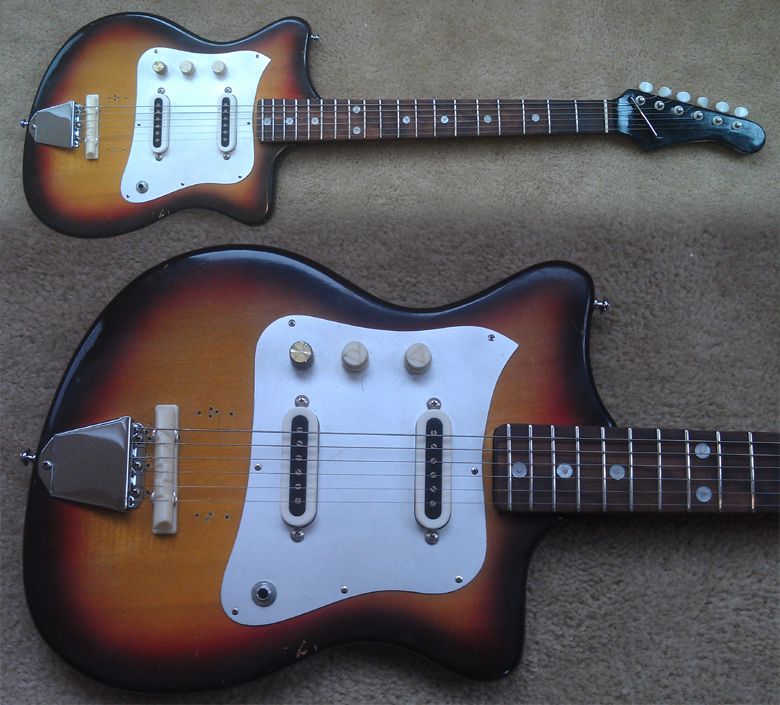
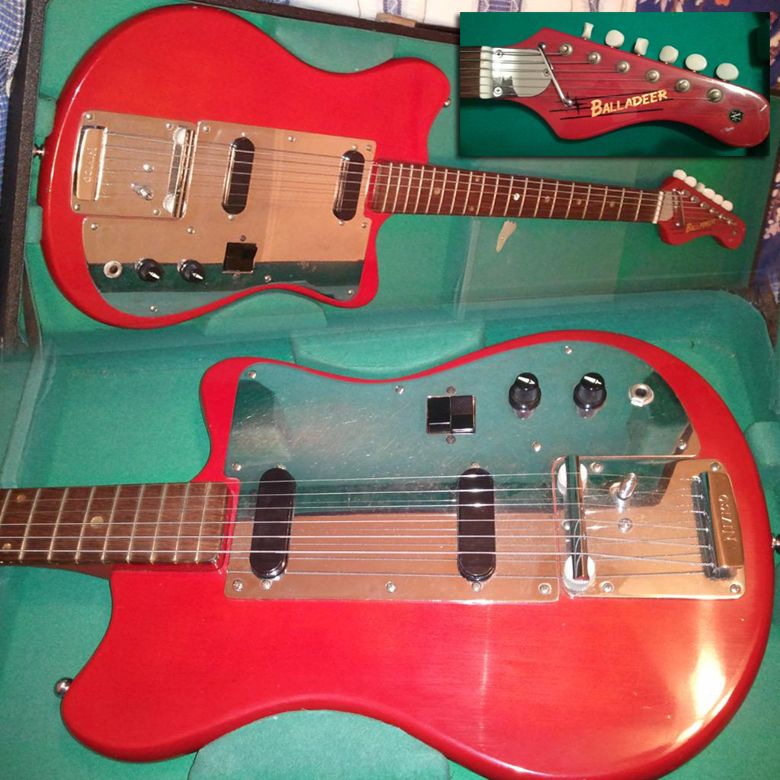
I recently saw your post about the JVC Balladeer and I was surprised to see that I have a Guyatone in this (I think) same body/headstock design. The major difference is the pickguard configuration and it is certainly of a lower level model with no tremolo system. The pickguard is still of metal construction, just a flat finish and the controls on top of the pickups, which is actually quite comfortable. I have looked and looked all over the web and I've yet to see any Kawai/Teisco/Guyatone Japanese guitars with this same exact body design.
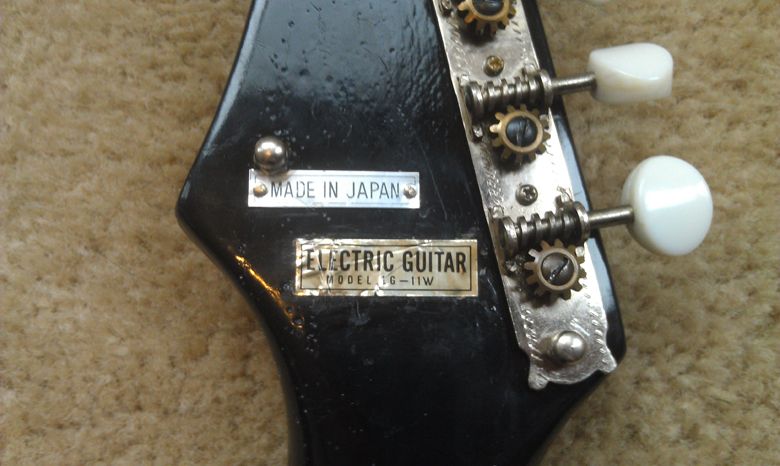
It has model number of LG-11W, which falls in line with Guyatone model numbers and of course has a 'Made in Japan' sticker, but unfortunately it no longer has its headstock badge (just a sticky residue of where one used to live).
In fact, I'm in the middle of refurbishing the neck and fingerboard due to too much lovin'! This thing was played to death and I'm certain whoever attempted to refret the fingerboard was not a pro, as there where large chips in the dried out rosewood. I decided to refinish the black neck paint while I was at it, which showed large stress cracks through the finish. I'm by no means a "pro" luthier, but I am an inspiring luthier who has made his own guitars. And as some may think this is sacrilege, I've decided to turn this 24.5" scale into a 25.5" scale and move the bridge/tail back that extra inch. I liked the feel of 24.5" but it was way too narrow for my liking. If I had any intention of selling the guitar, I would have of course kept it to its original scale.
Joshua

Here's a YouTube video of Joshua demoing the guitar. It just goes to show there's life in some of those old Japanese "pawn shop" guitars, although some of them might need some resuscitation.
We're always happy to see readers' guitars - the more interesting or unusual the model, the better - so please do keep sending in your photos and stories. Contrary to widely held belief, we at
Guitarz can appreciate a nice Strat, Tele, Les Paul or SG the same as the next man, woman or dog; however, I think all our readers already know what they look like and what they can do, so we would prefer to see something just a little bit different from the run-of-the-mill guitars you see everywhere. Having said that, if you do have a Strat, Tele, Les Paul, SG, etc, with a particular story to tell, or an unusual variant or finish, then we wouldn't rule out including it on the blog.
G L Wilson© 2012, Guitarz - The Original Guitar Blog - now in its 10th year!
9:14 AM |
Labels:
Guyatone,
Japanese guitar,
vintage guitars,
vintage modification,
Your Guitars
/
guitarz.blogspot.com:
Just over a year ago we looked at another
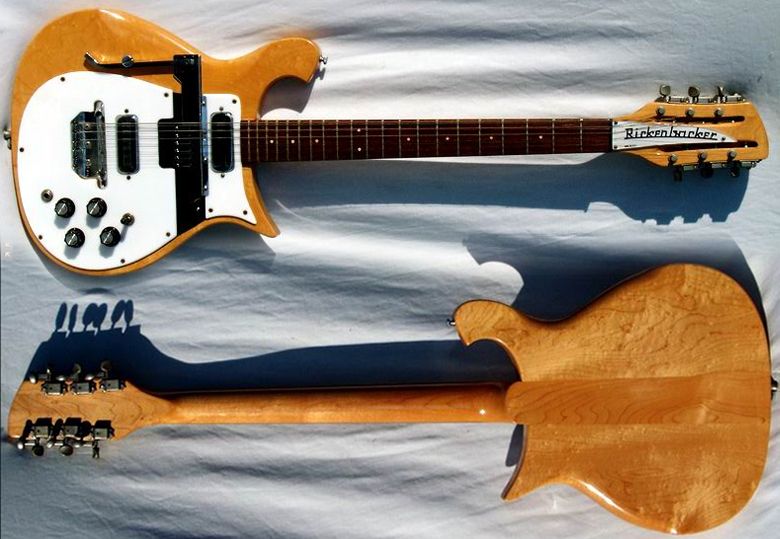
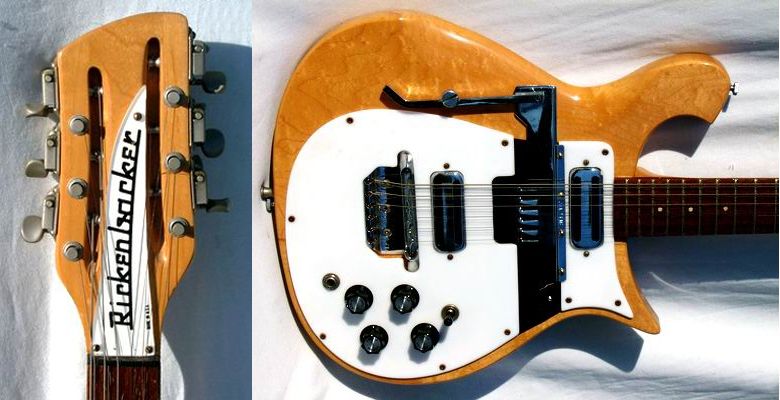
Rickenbacker 366 featuring this cunning mechanism to switch between 6-string and 12-string playing. I've seen similarly equipped Rickenbackers before, but never before have I seen the same mechanism on this model of guitar, the above-pictured
Rickenbacker 456 6/12 Convertible. I don't think the mechanism looks quite as awful on this model as it does on the 366, but still I can't help being reminded of a very pretty girl who has to wear corrective braces to allow her teeth to grow straight.
Looks aside, you have to wonder why a contraption such as this wasn't more successful and why it didn't spawn much imitation. It must surely be a much more convenient way of switching between 12-string and 6-string guitar than using an unwieldy and back-breaking doubleneck guitar. Maybe I have just answered my own implied question, as the Rickenbacker Convertible lacks the visual impact and sheer stage presence of a doubleneck. I guess that rock'n'roll isn't all about the most sensible way of doing something.
This particular Rickenbacker 456 6/12 Convertible is from 1968, is finished in "Mapleglo", and is currently available for sale via
Vintage and Rare with a price of €2800.
G L Wilson© 2012, Guitarz - The Original Guitar Blog - now in its 10th year!
7:11 AM |
Labels:
12-string,
hybrid guitar,
innovations,
Rickenbacker,
Vintage and Rare,
vintage guitars
/
guitarz.blogspot.com:
Regular readers of
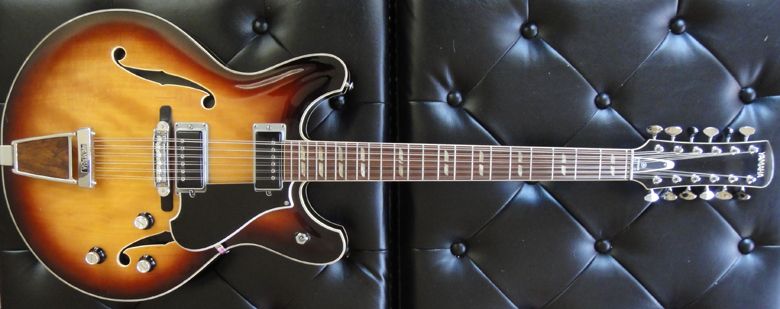
Guitarz will know of my enthusiasm for certain early Yamaha solidbody electrics, but being a recent semi-hollowbody convertee I am wishing I had the chance to sample Yamaha's early semis. In May 2011 we looked at this particularly nice example of a
Yamaha SA-30 semi and now Derek has sent us photos and a few words about his
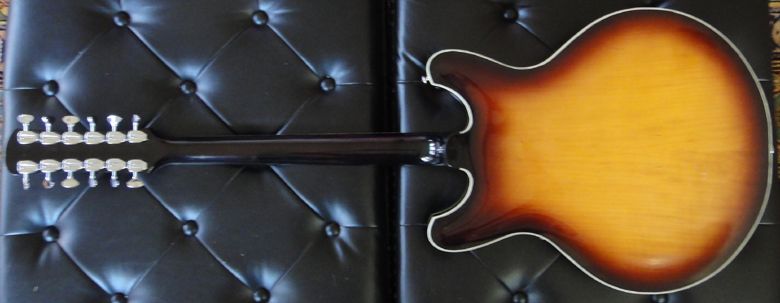
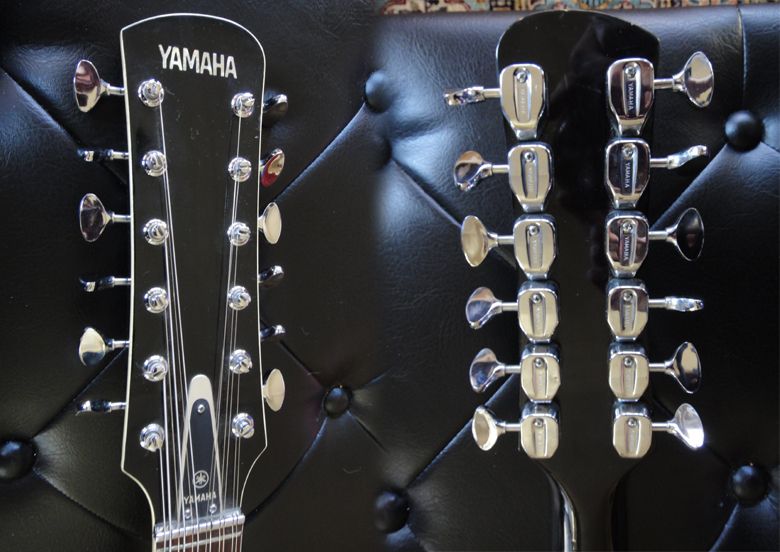
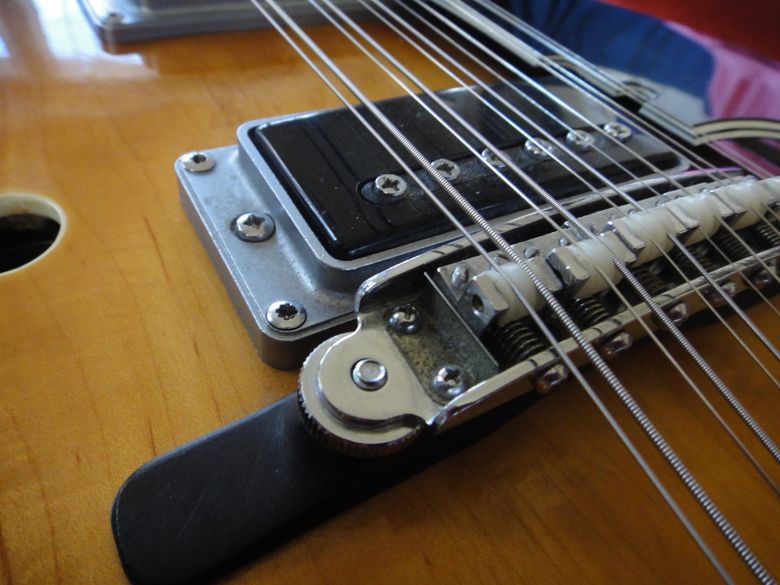
Yamaha SA-20 which is the 12-string version. I'll let him tell you about it:
Having shown the Yamaha SA-30, I thought you might be interested in this 1968 SA-20; it's the same guitar (minus vibrato) as a twelve string. The price in 1968 was $315 according to a catalog you can view here, making it the most expensive of the SA (semi acoustic) line at the time, about $2000 in today's dollars.
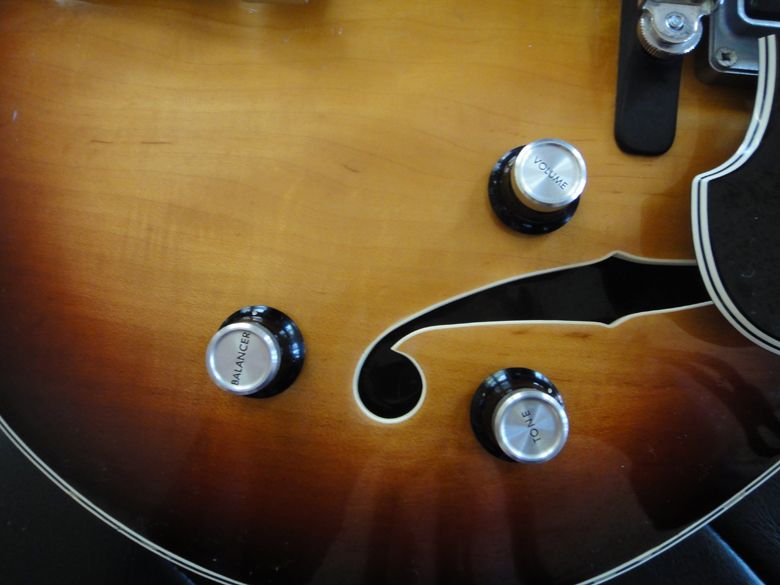
When I first got the guitar, I noticed that there's black plastic inside the F-holes; this, I learned from the catalog, is a baffle intended to suppress feedback (patent pending!). If you've both pickups selected the "mic balancer" lets you blend between the two; the pickups are the size of humbuckers but I think they are single coils. Either way, they're attractively fitted. The neck is very narrow, and the nut (which I don't believe to be original) makes it challenging to play; but overall the workmanship is superb.
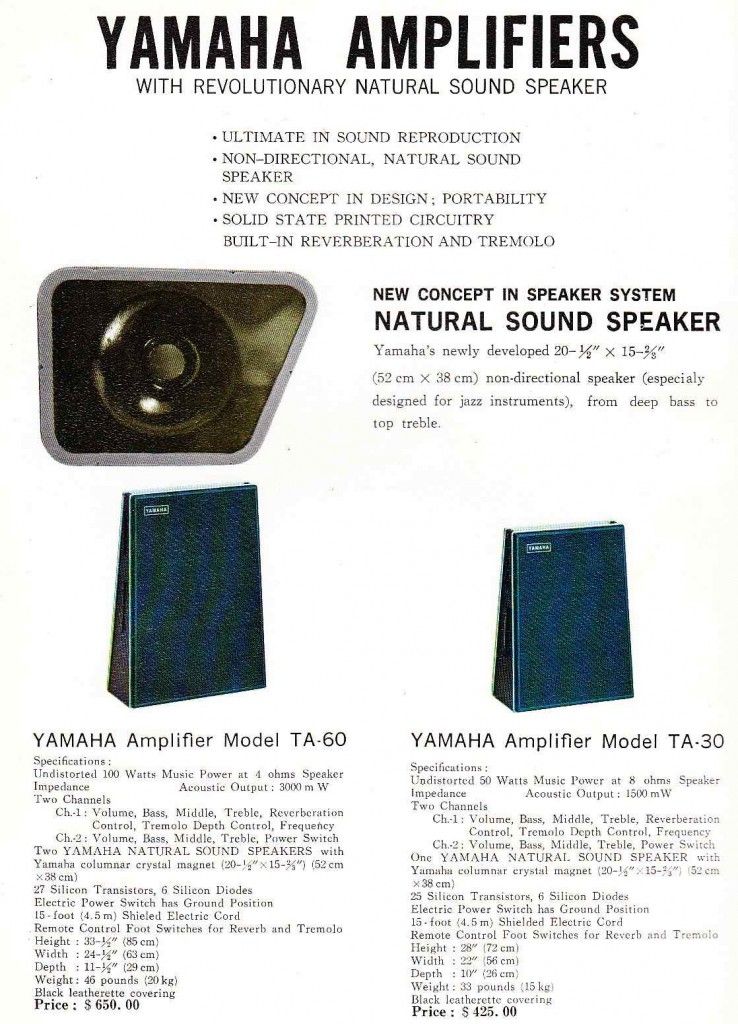
In that same catalog is a very interesting amplifier, the TA-60; I'm including a picture of that as well. I'd really like to find one to compliment the guitar.
Best Regards,
Derek


Thank you, Derek, for sharing this with us. Perhaps one day I'll get my mitts on a similar guitar!
G L Wilson© 2012, Guitarz - The Original Guitar Blog - now in its 10th year!
3:23 AM |
Labels:
12-string,
cool guitars,
Semi Acoustic,
semi-hollow body,
vintage guitars,
Yamaha,
Your Guitars
/
guitarz.blogspot.com:
It never ceases to amaze me how many vintage guitars from little known manufacturers and brand names there are to discover outside of the usual arena. Here's yet another 1960s Japanese guitar, the
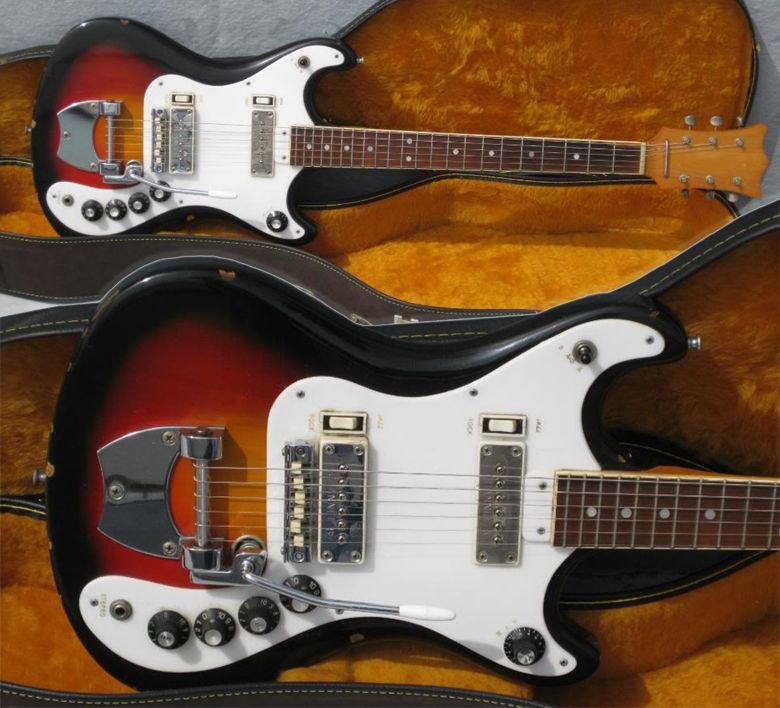
JVC Nivico Balladeer #SG-16 (its interesting but probably just coincidence that it has a Yamaha-like model number). I'm guessing that's the same JVC as are known for their domestic stereo equipment here in the West.
Here's how the seller describes the guitar:
Up for auction is a vintage JVC Nivico Balladeer Electric Guitar (model #SG-16) which appears to originally be intended only for Japanese distribution but has mysteriously been re-branded for US sales. Information on this guitar is conspicuously absent from the internet (a feat in itself) but in-depth research has shown that these guitars, along with a related deluxe model and electric amplifiers, were marketed alongside Japanese "eleki" beat groups (http://www.geocities.jp/a104gs/jvc.nivico.html). This, along side its extreme rarity, support the idea that this guitar was either not intended for distribution outside of Japan or is part of a very early attempt to market Japanese guitars in America. Despite the intial similarities one might find between this guitar and the dirge of Japanese guitars that were soon to flood the US market, such as a surplus of chrome and an overall amoeba-like shape, this guitar has appointments that one does not find on any other Japanese import. Not to mention it plays better than any other Japanese guitar from this era that I have ever laid hands on, weighs twice as much, and has an attention to detail that surpass as well.
It does have a Kawai/Guyatone look to it, but I can't find another guitar that is similar enough to make the comparison with more conviction. It's an interesting guitar for sure, if a bit of an ugly duckling.
This guitar is currently listed on eBay with a quite reasonable Buy It Now price of $400.
By the way, for those interested in Japanese "eleki" music and the development of rock music in Japan, I would heartily recommend the book
Japrocksampler by Julian Cope.
G L Wilson© 2012, Guitarz - The Original Guitar Blog - now in its 10th year!
3:44 AM |
Labels:
cool guitars,
Japanese guitar,
JVC,
vintage guitars
/
guitarz.blogspot.com:
Previously on
Guitarz we have looked at a
Wurlitzer Cougar stereo guitar, part of the Wild One series which also included the
Wildcat and the
Gemini. These guitars all share the same pickups and stereo circuitry which includes jazz/rock settings for each pickup - basically switching between different capacitors for to affect tonal change. Wurlitzer guitars were built alongside the now legendary
LaBaye 2x4 guitar at the Holman-Woodell factory in Neodesha, Kansas in the mid to late 1960s.
However, if you look closely at the Cougar pictured above you'll notice one or two differences from the example we previously featured. The headstock design is quite different, and notice also that the vibrato base plate is missing its Wurlitzer "W" - in fact this vibrato unit looks identical to that employed on the LaBaye six stringer.
The reason behind this is that this particular Cougar is not a Wurlitzer - it instead carried the
Alray brandname. From the information I have gathered, Wurlitzer offered the Wild One series guitars from 1965 to 1966. The seller of this
Alray Cougar on eBay suggests that this guitar is circa 1967/68. Maybe this was assembled from left-over Wurlitzer stock after they had decided to abandon their guitar line?
This guitar is
currently being offered for sale on eBay with a Buy It Now price of $1,200, which is in a similar price bracket to Wurlitzer-branded guitars (if and when they come up for sale).
G L Wilson© 2012, Guitarz - The Original Guitar Blog - now in its 10th year!
6:48 AM |
Labels:
Alray,
cool guitars,
Stereo guitars,
vintage guitars,
Wurlitzer
/
guitarz.blogspot.com:
We seem to be in a blue mood these last couple of days on
Guitarz, and today's guitar is a 1960s
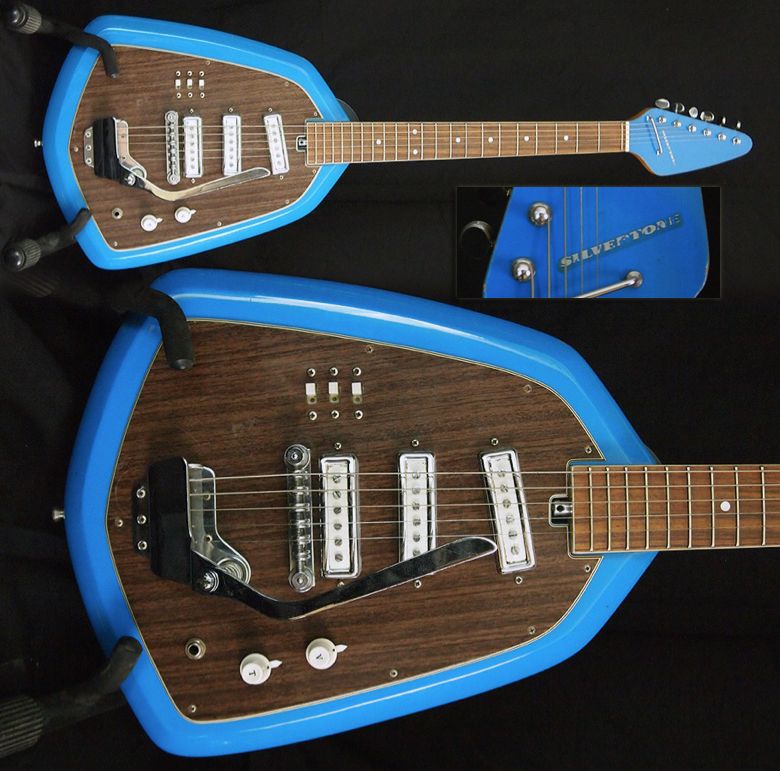
Silvertone-branded "Phantom" which according to the seller is correctly designated as a EV3T. It's obviously inspired by the 1960s Vox guitars - as is further evidenced by the headstock shape - but the body shape is symmetrical as opposed to the offset lozenge of the Vox Phantom. If anything, it's somewhere between a Phantom and Vox's Mark series teardrop-shaped guitars.
As with anything stamped "Silvertone", you can guarantee this is another manufacturer's guitar, re-badged. It has a Domino look to it, although I don't think I've seen a Domino of quite the same design. The neck bolt plate confirms that this guitar is "Made in Japan".
This guitar is currently listed on eBay with what I'd call a slightly optimistic Buy It Now price of $975.
G L Wilson© 2012, Guitarz - The Original Guitar Blog - now in its 10th year!
8:43 AM |
Labels:
Domino,
Japanese guitar,
optimistic sellers,
Silvertone,
vintage guitars,
Vox
/
guitarz.blogspot.com:
Our friend Greg Cadman (who sent us these photos of his
Kapa guitar collection a while back) is interested in the
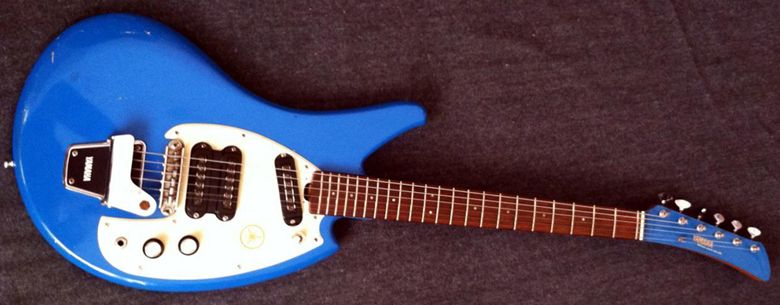
Yamaha SG3C guitar as pictured above and asks:
"Does anyone out there have one of these they would be willing to make a full size tracing of the body for me?"
Which seems a fair enough request. Please respond via the comments below and I'll see to it that Greg gets your message.
The
Yamaha SG3C is indeed a cool guitar, and was introduced a year after my own beloved
Yamaha SG3 (similar model number, very different design), about which I have written plenty already. Both guitars have the same three singlecoil pickups arranged with one coil at the neck and two in the bridge position. However, the SG3C adopts a much simpler switching system than its slightly older sibling's Jazzmaster-like setup and functions only as a two pickup guitar with the two coils at the bridge being wired together in series. For those who are interested
this video gives quite a nice little tour around the insides of the guitar.
This guitar is currently listed on eBay Australia, with five days left to run on the auction and bidding currently at just under AU$300 (Australian dollars) at the time of writing.
G L Wilson© 2012, Guitarz - The Original Guitar Blog - now in its 10th year!
4:09 AM |
Labels:
cool guitars,
Japanese guitar,
vintage guitars,
Yamaha
/
guitarz.blogspot.com:
In our previous blog post here on
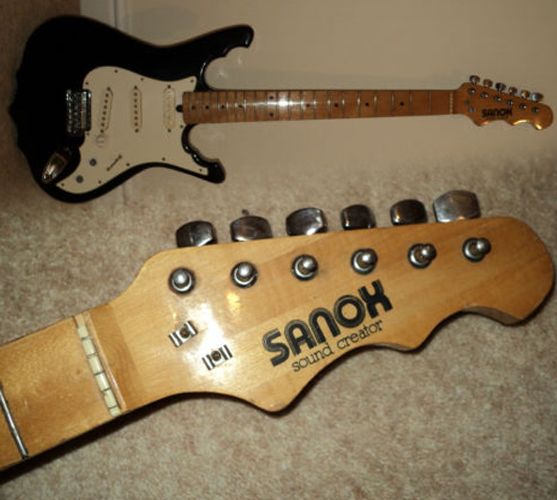
Guitarz we were looking at a Jolana Disco bass that had its body shape modified and cut down to size by a previous owner. That, in effect, is what has happened to the guitar we are looking at today, although in this instance the cutting down to size happened in the factory where it was built. Even with the modifications and the almost "monkey grip" body horns, there's little disguising the fact that this
Sanox Sound Creator has been based on the world's most copied guitar, the Stratocaster.
If anyone out there can shed any light or has any concrete information on the Japanese brand "Sanox Sound Creator", please get in touch, as I would love to find out more and there is a dearth of information about this brand on the internet. In fact, most of the references you will find in a Google search will be about my own see-thru
Sanox Sound Creator acrylic-bodied Strat that I purchased from an eBay seller in Germany back in 2005 (and that is all I know about it).
These guitars do not come up for sale very often which would imply that the brand was short-lived. The example seen here is currently listed on eBay UK with a Buy It Now price of £225 which, I think, may be a tad optimistic seeing as - from what I can make out in the photos - it doesn't appear to be in the best of condition. The nut is broken, the tone knobs are missing (possibly the pots themselves, it's hard to tell), one of the tuners is missing its rear cover, and as it is pictured without strings I have to wonder how long it has been stored like that and what condition the neck might be in now. It definitely would need a good setting up.
G L Wilson© 2012, Guitarz - The Original Guitar Blog - now in its 10th year!
3:47 AM |
Labels:
Japanese guitar,
Sanox Sound Creator,
Stratocaster,
vintage guitars
/
guitarz.blogspot.com:
As a postscript to
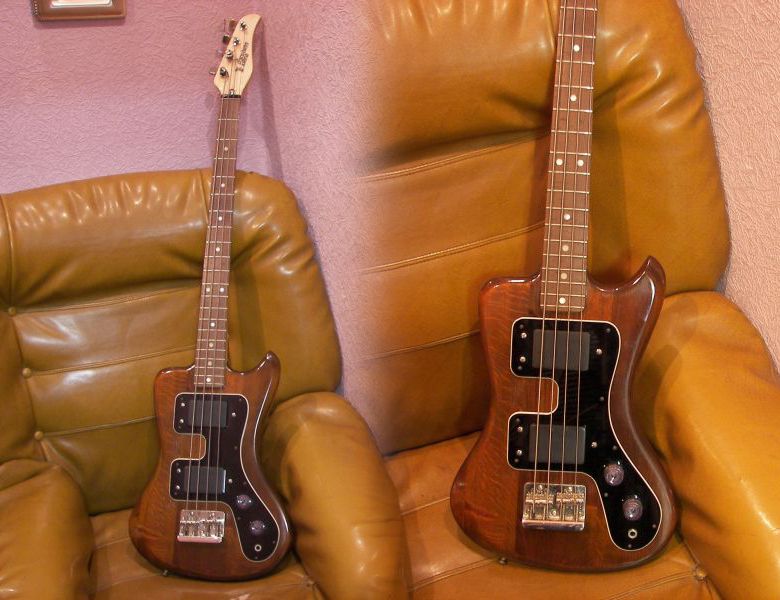
yesterday's blog post, here is another Jolana Disco Bass belonging to
Guitarz reader Philipp Kostov. The bass's previous owner has re-shaped the body and stripped it back to a natural finish - surprisingly it looks like it's made from some pretty nice timber. These old "Behind the Iron Curtain" guitars are getting increasingly collectable as more people discover their existence (and, often, their affordability) but this customisation is likely to incur the wrath of the collectors. Personally - and I know I've written a lot about how people should leave vintage guitars alone and take out their urge to modify on cheap modern-day Chinese-made guitars - I quite like the new shape and finish on this particular Disco Bass. I guess the point is that if you really HAVE to customise something, just make sure you do a first class job.
See here for more of
Philipp's guitar collection (including more Jolana guitars and basses).
G L Wilson© 2012, Guitarz - The Original Guitar Blog - now in its 10th year!
2:55 AM |
Labels:
bass,
cool guitars,
Czechoslovakian guitar,
east-European guitar,
Jolana,
vintage guitars,
Your Guitars
/
guitarz.blogspot.com:
Seriously, if I had the means right now, I would buy this
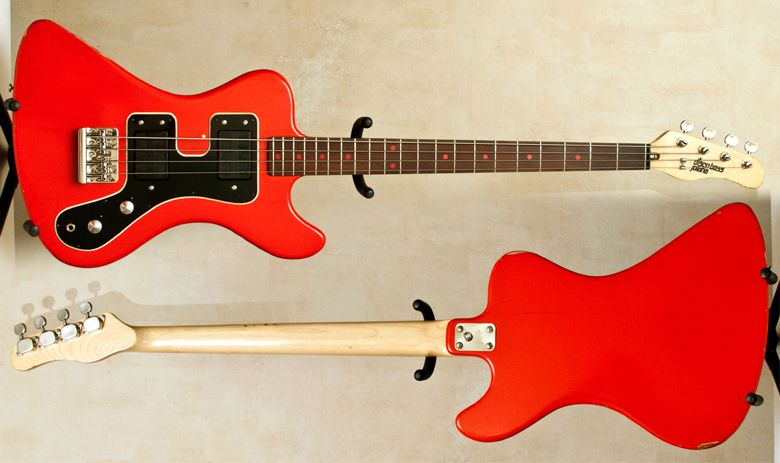
Jolana Disco Bass. The eBay listing has some particularly clear close-up photos and although it's quite apparent that this is a used instrument and shows signs of wear here and there, it is in exceedingly good condition.
Although quite obviously from the same stable, the Jolana Disco Bass has quite a different design to the
Jolana Disco 6-string guitar; whilst the guitar looks to be a Burnsian interpretation of the SG, the bass has been styled after the
Gibson RD Artist. They share the same giant-sized humbuckers although the bass has a pair of these against the guitar's single unit. Tuners and bridge are of the same design and even the pickguard follows the same design rules.
The controls are simple with no pickup selector, no tone controls, but just a volume for each pickup - which couldn't be further away from the instrument that the body shape is copying. I believe that the "1970s transistor-radio" style knobs on this example are not original, and that it would have originally have had the same chunky clear plastic knobs as used on the Disco guitar.
This particular Disco Bass is finished in a vibrant red; I really like how the colour is echoed by the dot inlays on the fingerboard.
Possibly, with a Buy It Now price of $400, this is a little over-priced, but having said that it
is a particularly nice example.
G L Wilson© 2012, Guitarz - The Original Guitar Blog - now in its 10th year!
3:23 AM |
Labels:
bass,
cool guitars,
Czechoslovakian guitar,
east-European guitar,
Jolana,
vintage guitars
/
guitarz.blogspot.com:
Something about this
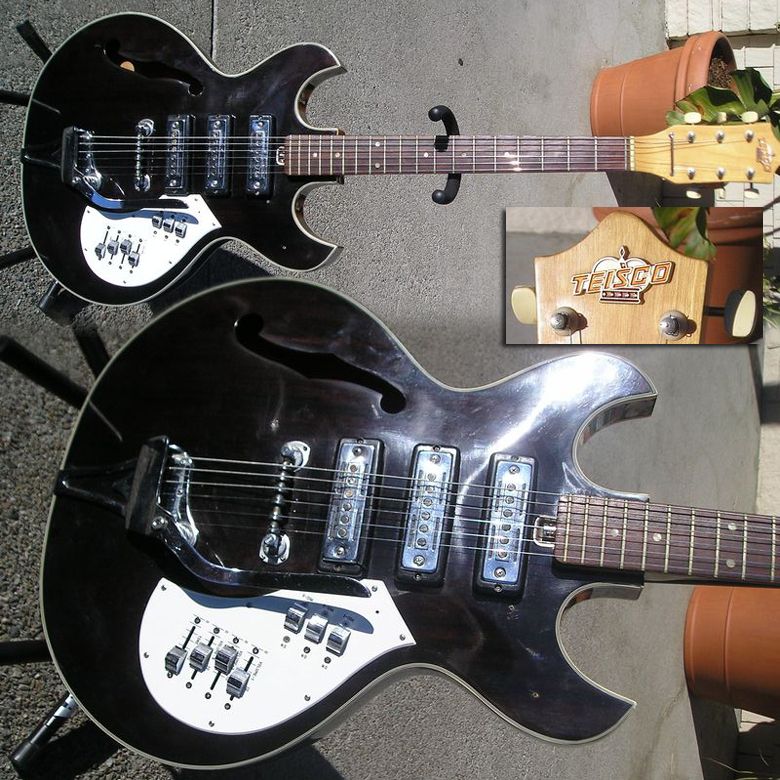
Teisco EP-93T hollowbody electric guitar makes me think it would play like an absolute dog. I'd imagine it would be boxy-sounding and the cheap hardware would make it rattle and buzz, and sure, there's three pickups, but did you ever try those pickups? They were hardly the best; "muddy" is the word I'd use to describe the tone. However, despite all that, I can't help liking the guitar. I like the shape and the general design of the instrument, not to mention those crazy slider controls - you just don't see stuff like that on guitars any more.
Perhaps I'm letting my prejudices have too much say, and maybe - just maybe - this is a great player. Still, I wouldn't like to be the one to shell out the $549 eBay Buy It Now price so as to find out one way or the other.
G L Wilson© 2012, Guitarz - The Original Guitar Blog - now in its 10th year!
6:18 AM |
Labels:
archtop,
hollow body,
Japanese guitar,
semi-hollow body,
Teisco,
vintage guitars
/
guitarz.blogspot.com:
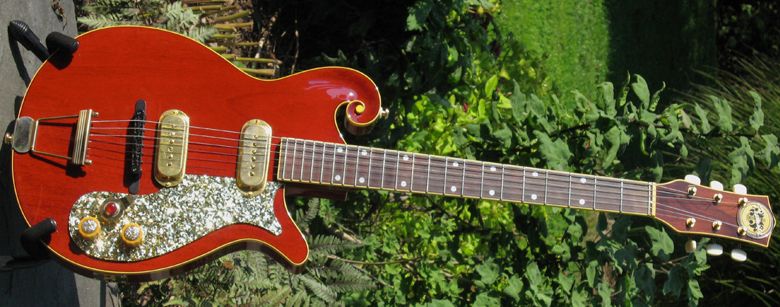
Premier/Multivox started making these carved scroll mahogany solid bodies in 1958. The very earliest version was set-neck, going over to bolt-on pretty quickly. The shape of the treble-side horn evolved from long to stumpy to the version seen in this 1959 example, with its elegant outward curve echoing the wave shape of the scroll side, the perfection of the design. The
later Premiers covered in Italian cellulloid are nice in their way but part of a downward slide in quality, materials, and looks throughout the 1960s.
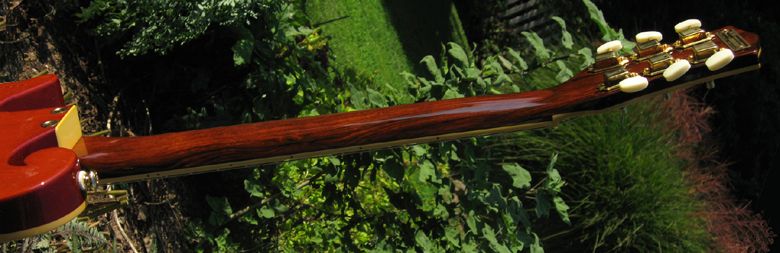
The neck here is solid perfectly vertical tight grain Brazilian rosewood that sustains like nothing else and rings like a bar on a marimba.These earliest necks have an angled scarf-joined headstock (made with a “V” notch cut under the integral fingerboard; a less desirable non-angled scooped headstock with string retainers came shortly thereafter. In Premier's world at this time truss rods were a tone-deadening frill, unnecessary on a good quarter-sawn Brazilian neck. This neck, after almost fifty years of string tension — some of that with hulking flatwounds — had only a slight bow, easily brought to perfect minimal relief by a compression fret job. By the way, the position markers are just cut from aluminum rod, though most people assume they are mother of pearl.

On the down side, the binding on Premiers often deteriorates and the fret spacing is oddly erratic for an otherwise extremely well-crafted guitar with bound body, fingerboard, and headstock, and gold plated hardware standard. You can even see the bad spacing in the upper frets of the
1964 model you posted. I corrected fret spacing problems and replaced the binding when I refurbished this one, which I bought in deteriorated but complete condition in 2005. Unless the frets are repositioned it is only good for slide, and Ry Cooder (see picture) has been known to play this very same two-pickup early model. The “Franz” pickups (as used also on early Guilds) are like dream P-90s. To top it off, it has catalin knobs, a big appliance-style pickup selector switch and a flashy pickguard that leaves no doubt that this instrument was made for show business.
Mark© 2012, Guitarz - The Original Guitar Blog - now in its 10th year!
2:30 AM |
Labels:
cool guitars,
Multivox,
Premier,
vintage guitars
/
Here is a rarely seen
Dan Armstrong London from the early 1970s, quite an unique guitar with its characteristic sliding humbucker. The body is an hybrid of
Les Paul Doublecut and
Rickenbacker 325 cut out of mahogany, the bridge only looks like a wrap-around one but is one of Dan Armstrong innovations, being connected to the ramp on which the pickup slides.
You know, I could tell much about this guitar but I would just summarize what I found on the very complete
website dedicated to Dan Arsmtrong's life with guitars, that I invite you to visit. And for those who would not know who Dan Armstrong is, you probably know how most famous guitar, the
plexiglass model released by
Ampeg and played by all the
Rolling Stones members on their 1969 US tour (and resulting film and record).
© 2012, Guitarz - The Original Guitar Blog - now in its 10th year!
4:07 PM |
Labels:
cool guitars,
Dan Armstrong,
innovations,
vintage guitars
/
guitarz.blogspot.com:
Here from 1971 we have a
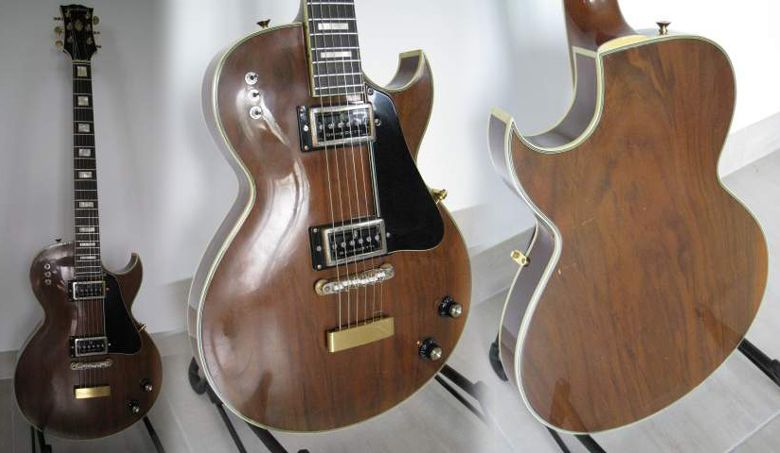
Jacobacci Studio II in a walnut finish and outfitted with a pair of high impedance Benedetti pickups. It is, I believe, a hollowbody guitar, although it sports no soundholes. Although the guitar has been refretted and has replacement Kluson tuners it is still a very desirable piece from this French luthier (we previously looked at a
Jacobacci tenor guitar here on
Guitarz).
This guitar is currently being advertised for sale, and the seller is asking €2300 for it.
Thanks to Dirk for bringing this fine guitar to our attention.
G L Wilson© 2012, Guitarz - The Original Guitar Blog - now in its 10th year!
9:37 AM |
Labels:
cool guitars,
French guitar,
Jacobacci,
vintage guitars
/
guitarz.blogspot.com:
The 7-string guitar has in recent years gained much popularity but I hope that most
Guitarz readers will appreciate that the instrument was not a creation of the new metal movement, nor was it invented by Steve Vai or Alex Gregory. The first electric seven-stringer was probably a Gretsch hollowbody made for jazz guitarist George Van Eps in the late 1960s, although he had been playing acoustic 7-string jazz guitar since the late 1930s when he used a custom-made Epiphone.
But 7-string guitars were around long before this. Both Russian and Brazilian music had developed 7-string guitars as part of their culture. The Russian 7-string dates to beginning of the 19th century and utilised an open G tuning (DGBDGbd). It was said to have been invented by Russian guitarist and composer Andrei Sychra who wrote a method for the 7-sting guitar and a whole wealth of compositions for the instrument.
In Brazil the 7-string guitar was introduced in the early 20th century as an accompaniment instrument in choro and samba music. It is traditionally tuned as a standard 6-string with the addition of a low C string, although some guitarists took this down to a (more logical perhaps) low B.
In 18th century Europe, the baroque guitar evolved from an instrument with 5 courses to one with 6 courses - initially the courses were paired strings but later the consensus of popularity favoured single strings as is common today - so it was perfectly natural that someone would take this a stage further and add a 7th course (or string). Those advocating the 7-string guitar included French guitarist Napoleon Coste (1805–1883) who composed specifically for the instrument, and the Italian guitarist Mario Maccaferri (born 1900) who used additional unfretted bass strings (known as diapasons or bourdons) on his guitars.
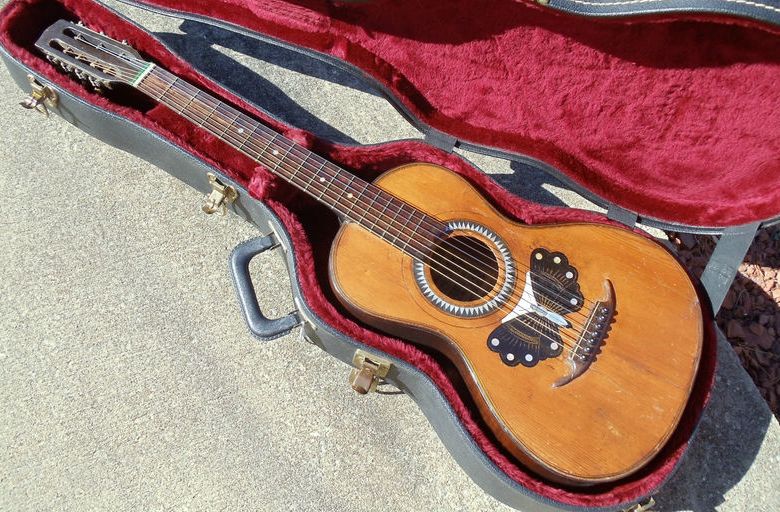
The above pictured guitar is an
Italian 7-string by Ermelinda Silvestri and dates to the mid 1890s. In keeping with most of Silvestri's instruments it bears the butterfly inlay which was a trademark of sorts. The seventh string seems to be very close to the edge of the fingerboard, which suggests that it wasn't intended to be fretted and would have been a diapason (or bourdon if you prefer).
This repaired but still playable antique 7-string guitar is currently listed on eBay with a Buy It Now price of $1,450.
G L Wilson© 2012, Guitarz - The Original Guitar Blog - now in its 10th year!
4:01 PM |
Labels:
7-string,
acoustic,
antique guitars,
classical,
Italian guitars,
Silvestri,
vintage guitars
/
This 1965
Egmond Kansas is both simple and bizarre, it has its own coherence though one could find it like a collage of contradictory elements... I still cannot figure out if
Egmonds were only crap budget guitars or if some higher-end models have a value other than being vintage: the
Kansas was an upgrade of the
Lucky 7 with the addition of a truss rod - you see what I mean - but this one looks much more sophisticated than the
Lucky 7 we looked at a few weeks ago... Why this one has a pointy cutaway instead of the standard round one, I cannot tell (but it's not the only one I saw).
Incidentally, I just learned that Egmond was actually the biggest European guitar company in the 1960s! It bankrupted in 1983 as it couldn't resist to Asian guitars - that were probably of much better quality BTW.
Bertram© 2011, Guitarz - The Original Guitar Blog - now in its 10th year!
4:00 PM |
Labels:
Egmond,
thinline,
vintage guitars
/
guitarz.blogspot.com:
Regular
Guitarz readers may remember that back in September I posted about a
vintage Yamaha SG-12 offered for sale on eBay which had been rather disturbingly and tastelessly customised. I ended that particular blog post by saying:
There was recently another SG-12 on eBay which, alas, was incomplete - there were parts missing such as bridge saddles. That particular guitar sold quite cheaply. It'd be nice to think that whoever bought that one, could buy this example too and assemble a single Yamaha SG-12 as it should be and keep the rest as spares.
Well, imagine my surprise when reading in an email from Chris Fesker that this was indeed what happened and the above pictured Yamaha SG-12 is the resulting restored guitar put together from parts from the two donor instruments. But what happened to the left over parts which obviously included perfectly serviceable body and neck? It'd be a shame to let those lie around unused. I'll let Chris tell you the whole story:
Hi Gavin - my name is Chris Fesker, and I was looking for pictures of Yamaha SG12 guitars, when I ran into your blog...
http://guitarz.blogspot.com/2011/09/vintage-yamaha-sg-12-twelve-string.html
I am the one that bought that guitar, along with the other incomplete SG12 you mentioned that sold around that same time. I did combine the two, using all the good parts from the 'TRoth' guitar to repair the sunburst. Rather than sell the parted out TRoth guitar, and having noticed that the original red finish was still below the new paint, I stripped the black and gold repaint to the original red, and re-built it to the best of my abilities.
Here's some links to some pictures of both in their newly repaired state.
Red SG12 - http://s178.photobucket.com/albums/w263/sonichris_photos/Red%201967%20Yamaha%20SG12/
Sunburst SG12 - http://s178.photobucket.com/albums/w263/sonichris_photos/1967%20Yamaha%20SG-12/
I thought you might get a kick out of seeing them.
Thanks
Chris
I did indeed get a kick out of seeing the photos of Chris's restored SG-12s; it's so good to see something like that having seen so many bad bodge jobs, half-arsed relics, and crappy "customisations" carried out on otherwise beautiful vintage instruments.
Whilst the red (formerly
"TRoth") SG12 pictured above isn't an accurate restoration, it has been finished with respect and reverence to the original design. I like the use of two Jaguar pickups - surely these are in keeping with this style of guitar, and where would you find the original Yamaha pickups outside of buying a re-issue SGV-300 and cannibalising it (which would be a shame in itself)? It certainly has an authentic vintage vibe and I would like to congratulate Chris on a job well done!
Happy New Year to all our readers!
G L Wilson© 2012, Guitarz - The Original Guitar Blog - now in its 10th year!
4:33 AM |
Labels:
12-string,
cool guitars,
customised,
vintage guitars,
Yamaha,
Your Guitars
/
guitarz.blogspot.com:
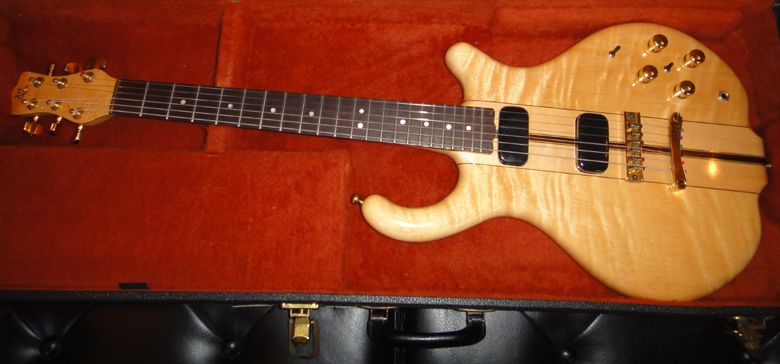
Here are some pictures of my 1978 Veillette Citron. It's a shame that not many people know of this company as this is one of the finest instruments I've ever had the pleasure of owning.
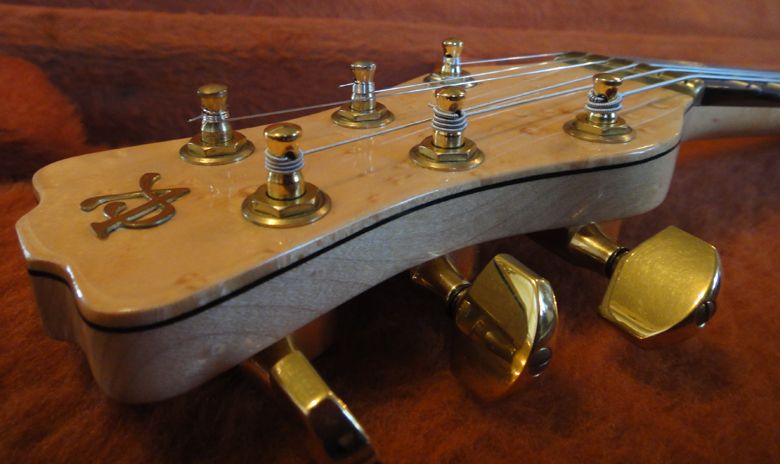
Everything about the guitar is top notch. I'm not much for quilted woods, but this one is more subtle and isn't a quilted maple cap - the body wings are solid quilted maple (the pattern carries across the front and sides to the back). All the hardware is custom made; the brass knobs, strap buttons, control cavity cover, bridge and tailpiece are all deliberate, non-mass produced design choices. The electronics (which appear to be simple) are actually quite sophisticated as each of the volume knobs is a push-pull coil tap affair whereas the smaller switch is a phase reversal switch; however, unlike other manufacturers (B.C. Rich comes to mind) the control layout is still very clean. All of the sounds are genuinely usable.
The neck has a 25 & 5/8" scale length. The action is very, very low and there is absolutely no buzzing; if you hear any buzzing you are playing sloppily and the guitar will let you know.
You can't help but think Alembic when you look at it, which is unfortunate as it really should be considered on its own merits. These guitars are still changing hands fairly cheaply; if you find one you owe it to yourself to try it.
The Veillette Citron company is no longer in business as far as I know, but Veillette still makes instruments, usually with non-standard scale lengths/string arrangements. Some history on the company can be found here:
Best Regards,
Derek Bell
© 2011, Guitarz - The Original Guitar Blog - now in its 10th year!
6:13 AM |
Labels:
cool guitars,
Veillette-Citron,
vintage guitars,
Your Guitars
/
guitarz.blogspot.com:
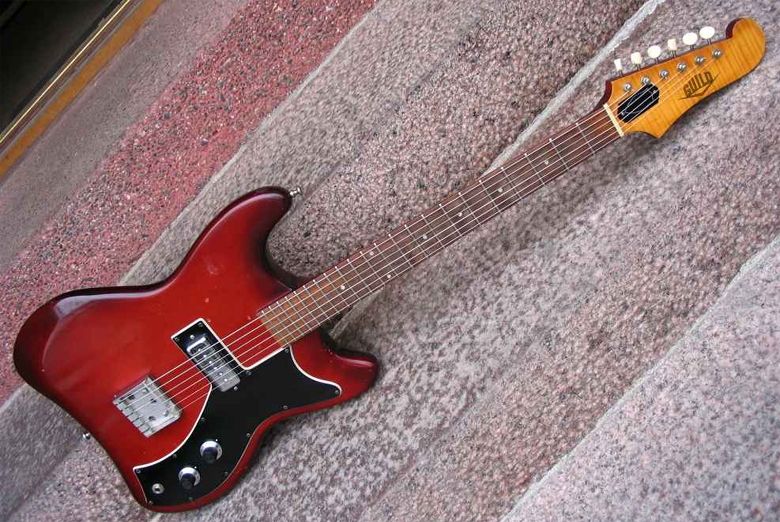
Here's another all-American vintage Guild guitar; it's a no-nonsense single pickup
Guild S-50 Jet Star from 1966. It has a subtle sunburst finish (red burst?), a Firebird-esque headstock and its single pickup is placed decidedly in the centre position - which, as I have argued before, actually makes very good sense tonally if you have to have just the one pickup on a guitar.
This is currently being offered for sale via
Vintage and Rare for a very reasonable €850.
G L Wilson© 2011, Guitarz - The Original Guitar Blog - now in its 10th year!
3:07 AM |
Labels:
cool guitars,
Guild,
Vintage and Rare,
vintage guitars
/
Another video, that gives the opportunity to see an
Hagström Kent in action - played by Pat Place, one of the two guitarists of
James Chance and the Contortions, a late 1970S New York-based
No Wave band that combines jazz-punk with funk (it is said that James Chance differed from many of his
No Wave colleagues, since he was really mastering his instrument - the saxophone - and expected the same from his musicians).
I cannot see the guitar very distinctly for the video is shot in a very... No Wave way, but it must be a PB-24-G model with its bolted acrylate front, the grid between its two single coils and the four switches in a curve. It sports the Hagström logo (you noticed that I write Hagström with a "ö", though it is distributed as Hagstrom in English speaking countries, but Umlauts are cool, aren't they?) but to tell you what it says would be complicated, for the same model had different names in different countries - for example Futurama in UK - the name evolved over time (1962-1966) and there's been at least three different versions of it...
Bertram© 2011, Guitarz - The Original Guitar Blog - now in its 10th year!
12:00 AM |
Labels:
cool guitars,
Hagstrom,
Swedish guitars,
video,
vintage guitars,
YouTube
 RSS
RSS