/
guitarz.blogspot.com:
We've looked at several
Westone guitars previously here at
Guitarz. As we've mentioned before, Westone was the house-brand of Japan's Matsumoku factory with guitars being produced from 1981-1988. The Westone name was later used for the Westone "Prestige" series with guitars being made in the UK, and even later in the 1990s the Westone name was applied to Chinese and Korean-made instruments.
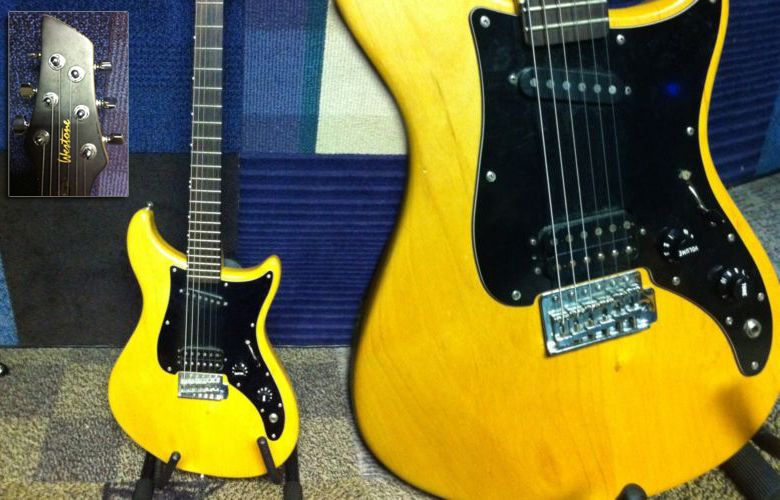
What I have not been sure about, however, is the origin of the Westone name. I had assumed the story started with Matsumoku in the 1980s, but pictured above we see a generic-looking Japanese solidbody electric guitar from the 1960s (this particular example being circa 1964) and which clearly shows the Westone name on the headstock. Evidence that the name was around a lot earlier than the 1980s.
I can only surmise that the brandname was resurrected by Matsumoku in the 1980s from an earlier brandname appearing on certain Japanese-made guitars. The seller of the above-pictured instrument (recently was offered for sale on eBay) has commented that this particular model was also available under the Kent brandname.
So, if anyone out there knows more about these early 1960s-era Westones, please do let us know. The only literature that I can find about this name states that it was a "new" brand of the Matusumoku company as of 1981, but clearly this is not true.
G L Wilson© 2011, Guitarz - The Original Guitar Blog - now in its 10th year!
8:08 AM |
Labels:
Japanese guitar,
vintage guitars,
Westone
/
guitarz.blogspot.com:
On seeing the Westone name you'd be forgiven for thinking that here was another Japanese Matsumoku-made guitar. However, as part of Westone's 1990s-era Prestige series, the
Westone Cutlass was actually made in the UK by Status, known for their Status Graphite basses which started out as a headless design in the 1980s.
(The Westone Cutlass pictured here however, is not headless. It's just a bad photograph. I do wish that eBay sellers would always include at least one photograph of the entire length of the guitar, face-on, and not cut parts off, e.g. the headstock as in this case.)
The design, which appears to be somewhere between a Fender Lead II and a G&L SC-2, was by legendary British guitar maker,
Sid Poole.
This is a quality British-made guitar, which would have orignally retailed at around £500. The auction for this example is ending very soon; with bidding currently at less than £100 at the time of writing, someone could end up with a very nice guitar at a very nice price.
G L Wilson© 2011, Guitarz - The Original Guitar Blog - now in its 10th year!
4:38 AM |
Labels:
British guitars,
cool guitars,
Luthiers,
Sid Poole,
Status,
Westone
/
guitarz.blogspot.com:
Here's another from Japanese guitar-maker Matsumoku's own Westone brandname, the top of the line in the Thunder series, the
Westone Thunder III guitar. It's one of the few production model guitars that I know of to feature three pickups in a S/H/S formation (i.e. single coils at neck and bridge positions and a humbucker in the centre position). Having played a guitar with this pickup formation, I can personally atest that it is a very useful layout with the ability to produce some great tones, so I have to wonder why we don't see more guitars with this layout. I can only assume it's that sense of the unadventurous that plagues the modern-day guitar world; sticking to the tried and tested, and not wanting to try anything just a little different or off the wall.
The controls on this Westone consist of a master volume and two tones, a 3-way pickup selector for the single coil pickups, a 'mix sound' switch for centre humbucker, plus 3-way coil tap switch for the humbucker, and a phase switch. I reckon that ought to make for a pretty damn versatile guitar!
Thanks to James Davies who saw this being auctioned on eBay, where it has a starting price of £249 and with no bids as I type this.
G L Wilson© 2011, Guitarz - The Original Guitar Blog - now in its 10th year!
11:07 AM |
Labels:
80s guitars,
cool guitars,
Japanese guitar,
Westone
/
guitarz.blogspot.com:
Here's another "Spectrum"-named guitar from Japan, this one bringing proof that Haryama weren't the only Japanese guitar makers in the 1980s producing cellophane finishes. This
Westone Spectrum MX is a Matsumoku-made guitar (yes,
them again!), Westone being their house brand. Features are a 25.5" scale length, 22 frets, solid Maple body, Hard Maple neck and fingerboard (so it could well be heavy). Pickups are two Magnaflux III singlecoils, and a Magnaflux I UBC (unbalanced coil) humbucker in the bridge position. Controls are a 5-way pickup selector, single volume and single tone - the latter being a push/pull switch for coil tap. The guitar also features a floating tremolo system.
The Westone Spectrum MX was produced between 1985-1986 and was also offered in an all-over blue finish.
This guitar is currently being offered for sale on eBay with a Buy It Now price of $429, and the seller points out that the middle pickup is currently not working and so will need some attention.
G L Wilson© 2011, Guitarz - The Original Guitar Blog - now in its 10th year!
10:46 AM |
Labels:
80s guitars,
Japanese guitar,
Westone
/
guitarz.blogspot.com:
...and there was a
Westone Raider bass too, seen here in the afore-mentioned two-tone silver flake finish! This is currently being offered for sale on eBay UK with a Buy It Now price of £275, which is well over twice what it would have cost back in 1983 when it was new.
G L Wilson© 2011, Guitarz - The Original Guitar Blog - now in its 10th year!
4:03 AM |
Labels:
80s guitars,
bass,
Japanese guitar,
pointy guitar,
vintage guitars,
Westone
/
Recently on
Guitarz we've been looking at several of the 1980s Matsumoko-made Westone guitars. The above-pictured guitar is another of the pointier examples of the species, the
Westone Raider I, this one currently being offered for sale on eBay UK, with the auction ending in just over 12 hours as I type this.
Of course, with a pointy guitar of this age there are the inevitable knocks to the extremities, but that considered this example looks to be in very good condition.
When we looked at the
Westone X5RD Monark the other day, Grk! commented "I've a soft spot for Westone's pointy guitars. The only really gruesome one is the Raider, especially with that two-tone sparkle. Have you ever seen any actual metallers play one of those? I've only seen it on the cover of a Culture Club single & being twanged by one of We've Got a Fuzzbox & We're Gonna Use It!"
Well as I recall, it was one of the cheapest guitars in the Westone catalogue at the time so perhaps many bands thought it was too "budget" to be seen with. But I also remember The Damned appearing on the BBC comedy show
The Young Ones in 1984 with guitarist Roman Jugg using a Westone Raider I in two-tone glitter finish. (The Damned later toured their "Phantasmagoria" album with lead singer Dave Vanian playing this same guitar for one song each night.)
G L Wilson© 2011, Guitarz - The Original Guitar Blog - now in its 10th year!
2:17 AM |
Labels:
80s guitars,
Japanese guitar,
pointy guitar,
vintage guitars,
Westone
/
guitarz.blogspot.com:
Now do you see what I mean about Westones often being ugly?
Yes, this is another Japanese Matsumoko-made Westone guitar from the 1980s. I'd guess mid-80s because it seemed that about then every guitar manufacturer was trying to come up with some twist of their own on the V-design. This
Westone X5RD Monark looks like a sawn-off Flying V, or else an inverted Jackson Randy Rhoads style. In keeping with guitars of this ilk it is very very pointy; it's another one you could impale yourself on.
G L Wilson© 2011, Guitarz - The Original Guitar Blog - now in its 10th year!
1:52 AM |
Labels:
80s guitars,
Japanese guitar,
pointy guitar,
Westone
/
guitarz.blogspot.com:
Westone Guitars, built by the now legendary Matsumoko factory of Japan, were hugely popular in the 1980s and rightly so. They were exceedingly well built but at the same time were usually very affordable. The one drawback, for me at least, was that many of their models were decidedly ugly looking (which didn't stop me owning a Westone Thunder I-A fretless bass). This one, however, the
Westone Rainbow from 1981 is quite a beauty, which I guess is understandable seeing as it was their top of the range model at the time. Obviously it's inspired by the Gibson 335 semi-hollow body, and I'd guess that it'd have the same construction featuring the solid block through the middle of the body. This example also features a discrete flower design, which is said to be original to the guitar and not a later addition (the seller says it was a "review model").
This guitar is currently being offered for sale on eBay, and with less than eight hours to go as I type this it has garnered quite a lot of interest and bids already.
G L Wilson© 2011, Guitarz - The Original Guitar Blog - now in its 10th year!
4:48 AM |
Labels:
80s guitars,
cool guitars,
Japanese guitar,
semi-hollow body,
vintage guitars,
Westone
/
guitarz.blogspot.com:
 Steve Conner writes:
I was reading your Guitarz blog and came across a picture of a Westone Super Headless! I have one too, which I bought second-hand 2 years ago, in McCormack's Music in Glasgow. I couldn't resist the bird's eye maple finish. The frets were badly worn from the previous owner's slapping and popping, but it plays fine, and I used it for quite a few gigs with my old band.
I've attached a pic and would be very happy if you'd feature it.
Steve
Nice one, Steve. I think I prefer that finish to the red and black example we looked at before, as striking as that was.
I notice that this one has different pickups - they were more Jazz Bass-like on the red and black bass (X900TPR). Do you know if yours has a different model designation?
G L Wilson
ADDITIONAL - Steve replies:
Re your question, the Super Headless came in a few different versions:
http://www.westone.info/cats/1985headless/p3.html
The "FS" with single coil pickups and a choice of red or light oak finishes, and the "RC" with humbuckers and birdseye maple, which is the one I've got.
Mine is missing the cover plate with the Westone logo.
Steve
NB: There are a lot of blogs STEALING content and bandwidth. If you read this anywhere else but on guitarz.blogspot.com then you are reading a blog that STEALS content. Please support original bloggers!
9:13 AM |
Labels:
bass,
cool guitars,
headless,
Westone,
Your Guitars
/
guitarz.blogspot.com:
 In the 1980s Westone guitars and basses seemed to be everywhere. Built in the now legendary Matsumoko factory in Japan, these instruments offered high quality at an affordable price. Another factor in their favour was that they had their own original designs and were not merely copies of the same old Fender and Gibson models. I remember when I was looking for a bass guitar on a budget, I ended up buying a new Westone Thunder I-A fretless for £175. There was no way that I was going to buy a "copy", that would not have been cool. Even though I thought the Westone was ugly (and to be honest, I think a lot of their designs were) I could see that it was a well-made instrument.
It's nice to see that these old Westones have kept their value. If I'd kept my old Thunder I-A fretless, I could probably sell it now for over £200. Bearing that in mind, the above-pictured top of the line Westone X900TPR Super Headless Bass seems a mere snip at a Buy It Now price of £299. It is of through-neck construction, as were Westone's higher-end instruments, and features an active EQ. Unlike many Westones, this isn't ugly at all. The curves of the body are quite attractive, to my eyes at least. Note the interesting contouring with a lower-levelled area around the lower horn. This was probably designed to aid the slap and popping style of playing that was popular in the 1980s, but we won't let that detract from the beauty of this bass.
It's nice also to see a headless bass from this period with a full-size body instead of being another minimalist rectangular-shaped Steinberger rip-off.
G L Wilson
NB: There are a lot of blogs STEALING content and bandwidth. If you read this anywhere else but on guitarz.blogspot.com then you are reading a blog that STEALS content. Please support original bloggers!
5:19 AM |
Labels:
bass,
cool guitars,
headless,
vintage guitars,
Westone
/
 Following the introduction of the revolutionary Steinberger bass in the mid-80s the market was soon flooded with cheap copies and clones of these minimalistic small-bodied headless basses.
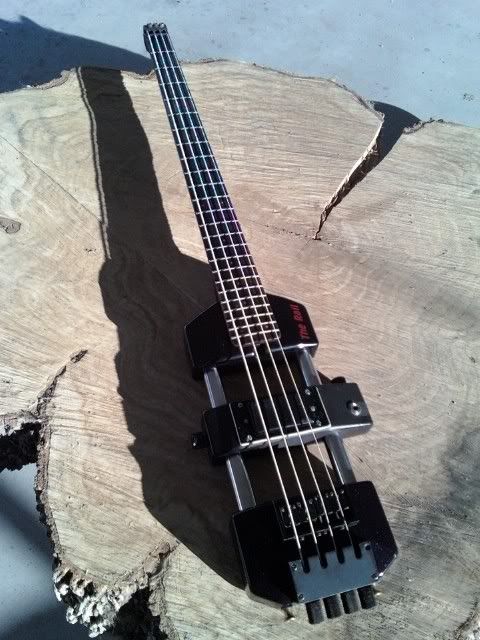
One of the more unusual was Westone's Rail Bass, as seen here.
The minimalist body looks especially peculiar as it is divided into two sections connected only by two metal rods - the "rails" in the bass's name - upon which sits a sliding pickup. This is a very cunning way of getting a whole bunch of different tones out of a single pickup.
Of course, sliding pickups have been done before - Gibson's Ripper Bass, and Wilkes Guitars "The Answer", but the Westone Rail must be the oddest looking. There was also a Rail 6-string guitar, although this may have been a prototype only, I don't think it ever went into production.
3:01 PM |
Labels:
bass,
cool guitars,
headless,
Weird guitars,
Westone
/

This Gene Simmons autographed Westone Warlock bass is quite neat, as apparently he won't sign guitars any more. Being a Westone it ought to be a nice quality instrument too. I had a Westone Thunder I-A fretless bass years back and it was a fantastic bass. I always regret getting rid of that one.
Pictured below is another bass that looks like it should (or could) be played by the Kiss bassmeister himself. Apparently it's a Toshiya bass (never heard of them) and to my eyes it looks as if the design has been based on a left-handed Rickenbacker.

4:55 AM |
Labels:
bass,
cool guitars,
signed guitars,
Westone
/
 Andy's done it again! Following his Les Pew guitar build, Andy found he still had some offcuts of the church pew he'd used left over.
I'll let him take over and tell you the story in his own words:
Here's my home made headless bass. It has a pine body made from wood from a 1856 church pew and keeps the original finish! (We've been there before haven't we?) The hardware and neck are from a Westone Thunder I-A. Unlike other headless designs it uses the original standard bass tuners which are spaced apart by running the outer (E & G) strings around rollers which were made from the Westone's brass control knobs!
The body is largely hollow and contains the active electronics and two 9 volt batteries (the lower fin or wing unbolts to access them). I feel my mini head is a better idea than the 'standard' headless design as it does away with any wood screws going straight into the neck's end grain and weakening it, also it prevents any string tension being transmitted into the fingerboard which could cause the glue to fail and the board detach from the neck.
It has a great vibrant tone (far better than the Westone's muddy thud!) and sounds quite loud acoustically. It also balances perfectly on a strap and on your lap. (More by luck than judgment!)
Please post you comments, either good or bad I'm interested in what you make of it! And I'll try to answer any questions.
Andy

More guitars, etc, on my myspace.
It's nice to see imaginative recycling such as this in action. Andy claims that this build didn't cost him a penny!
UPDATE: Andy has provided some more photos so as to better illustrate how the tuners are located.


Andy says that the roller support bracket in the tuners photos was made from a bracket from an old school chair!
7:55 AM |
Labels:
bass,
cool guitars,
headless,
one-offs,
Westone,
Your Guitars
 RSS