Posts RSS RSS

Welcome to our site

You can replace this text by going to "Layout" and then "Page Elements" section. Edit " About "
Showing posts with label modular guitar. Show all posts

Staccato MG bass, circa 1986, made from magnesium alloy and fibreglass

/

guitarz.blogspot.com:

This Staccato MG bass from 1986 is one of approx 200 guitars/basses built in the UK by Pat Townshend. I recall these guitars well from when they were first introduced, and remember seeing them at a music show in London, I'm guessing, in 1986. As I remember Chris Jagger (Mick's brother) was also involved in the company, and no doubt it was through his connections that these guitars were used by Mick Jagger and Bill Wyman in the Rolling Stones. Other endorsees included Gene Simmons of Kiss, and Motorhead's Lemmy (and if memory serves me correct, I saw Lemmy's bass exhibited at the above-mentioned music show).

The neck and centre body section is cast in one piece from magnesium alloy. Perhaps some more knowledgable readers can confirm this, but I seem to recall reading something to the effect that all the magnesium used in these guitars was filtered from sea water (magnesium being an element dissolved in sea water) and as such provides a material that made these guitars very environmentally friendly. Depending on the process employed to extract magnesium from water, that is.

The outer part of the body is made from fibreglass and seems to have been sculpted to provide for an ergonomic and body-fitting shape. Note that the strings are anchored at the headstock whilst the tuners are situated at the other end of the instrument behind the bridge. Pickups are double-bladed sealed units which are concealed within the magnesium centre body block with only the blades themselves protruding through to the front.

The fingerboard is made from an industrial plastic material and is fitted with 22 very low flat frets, which almost brings to mind the strange fretboard of the Lane Poor bass.

Unless my memory is playing more tricks on me, I believe Staccato offered basses and guitars with exchangable bodies / necks where the centre neck section could be swapped out for another guitar or bass (or converserly the body could be changed for say one in a different colour).

This eBay auction for this bass is finishing in 11 hours as I write; the starting price is $1,999 and Buy It Now price is $2,499.

G L Wilson

© 2011, Guitarz - The Original Guitar Blog - now in its 10th year!

Mercurio S-type guitar with interchangeable pickups

/

guitarz.blogspot.com:

Mercurio Guitars were made from 2003-2006 in Chanhassen Minnesota USA, and have a particularly innvovative feature of interchangeable pickup modules. A set of DIP switches on the rear of the guitar allow the pickups to be selected in series, parallel, coil tap, in phase and out of phase modes. This particular example is currently being offered for sale on eBay with a Buy It Now price of $1,250.

I remember seeing these a few years back and it's a great idea for the session guitarist who wants access to an endless number of pickup combinations without having to cart around a whole arsenal of different guitars.

For most of us though, or at least people like me, as with the Variax modelling guitars it's just too much happening on one guitar.

Incidentally, I've seen similar interchangeable pickups on Gibson "test bed" guitars.

G L Wilson

Guitarz - The Original Guitar Blog - now in its 9th year!

Two become one: Tiago's modular doubleneck

/

guitarz.blogspot.com:
Doublenecks always look impressive on stage and are a sure temptation to any guitarist afflicted with GAS (Guitar Aquisition Syndrome), but in use they can be quite cumbersome and unwieldy.

If you've got to have a doubleneck the best option would be to have a modular instrument that can be split into two individual single-necked guitars when desired. That way you have two guitars for the studio and a doubleneck for live performances.

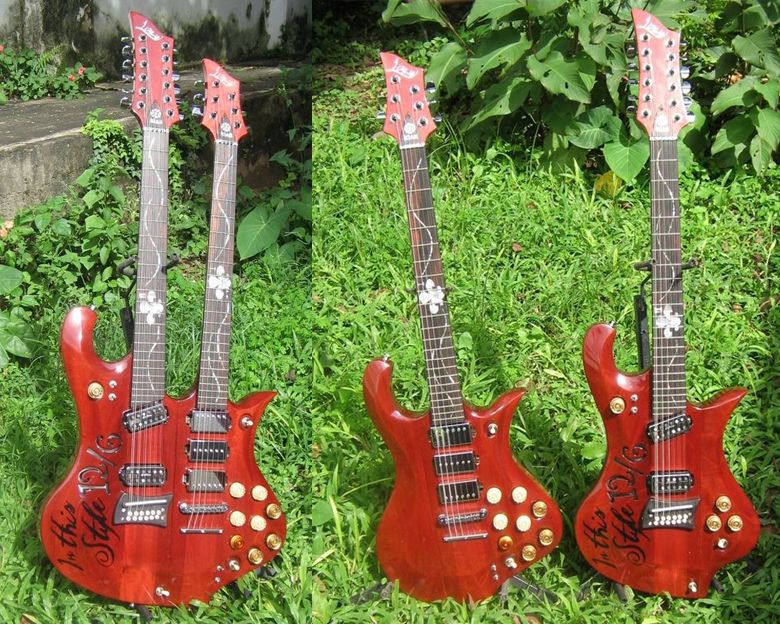
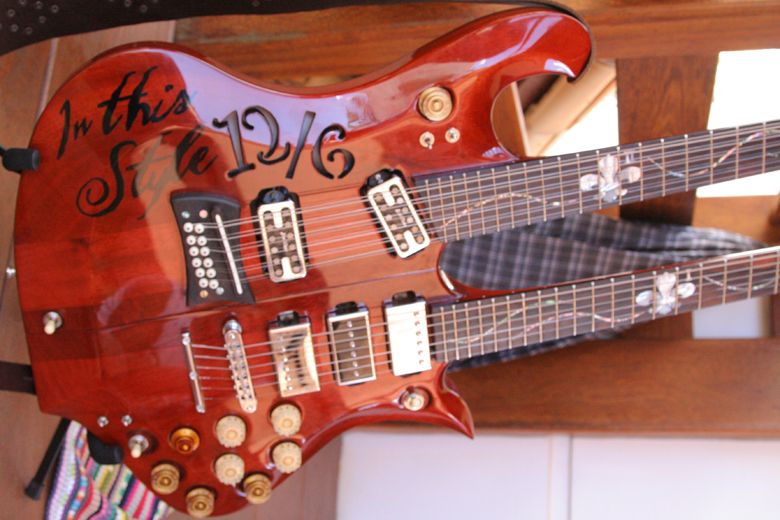
The guitar(s) pictured here belong(s) to Guitarz reader Tiago Sarmento from Brazil. Here's what he has to say about it/them [note: a modular doubleneck plays merry havoc with semantics - is it a single object or two?]... Anyway:

Mahogany body with two (now you can help me in english terms) ipê-tobacco stringers. Is that the right term, with those stripes on the back with different woods? Anyway, ipê is a national tree from Brazil, and it adds sort of a higher vibrations to compensate the dense mahogany body. The neck is brazilian rosewood.

The 12 string part has a "12/6" F-hole. Is that after the Mad Hatter sign on his top hat, since I'm a big fan of Alice in Wonderland book. In the book, the hat says "10/6", but I added a "poetic license" there and put the 12 instead. Quite obviously why. The "In this style" adhesive - was supposed to be a pirograph - is complementary to the tag on Hatter's hat.

The inlay is slightly different from the 6 strings part, and has tha Fleur-de-Lis and a roman numeral "II" in mother-of-pearl and the branches in abalone. The pickups are a custom made from Brazil called Stelfner and they are built after the burstbuckers. It has a piezo pick up. The mini toggles are on for the piezzo (position 1= only piezzo; 2= piezzo plus electric and 3= only electric). The f-hole has a blue led light inside, and looks quite psychedelic in the dark. The second mini-toggle splits the pick ups into single.

The 6 string is quite the same, but when they're together, the lower part controls all the electronics. So it has 9 knobs. Each different so it facilitates the know which is which. The leds now are blue and likewise the 12, is on the top of each knob and on the scale, side-by-side with those white dots. The pick ups here are all gibson: 490t, p-94 and busrtbucker II. Mini toggles works the same way.

Each, of course, has its complementary parts. The luthier signs as KIAN GUITARS and these is my personal brand, Lizzie. In the back of the headstock there's a drawing. 12 = a mad hatter caricature and the 6 of mine, in a artistic design similar to my project's logo.
I've not edited the above because I'd prefer to leave it in Tiago's voice, as it were. However, I think it's all quite clear what he's talking about, and I'd like to thank him for sharing this with us.

Keep those interesting pictures and stories of your guitars coming in, guys!

G L Wilson

NB: Please make sure you are reading this Guitarz post at guitarz.blogspot.com and not on a Scraper blog that copies posts without permission (and steals bandwidth) so as to profit from advertising. Please support original bloggers!

Zoybar Open Source Guitar

/


Find more videos like this on Zoybar

Inspired by the open source movement within the world of computing, Zoybar is a modular hardware platform for creating custom electric string instruments and effects (such as the Kaoss Pad).

In essence this would appear to be a modular guitar system. In the words of Zoybar founder and designer Ziv Bar Ilan, "The Zoybar components provide research and development tools as a sustainable, playable prototype platform. The same modular parts can be assembled as different instruments, can be changed during the performance and also be mounted with numerous special effects, just by adding and changing their position across the profile groves."

For more, see zoybar.net, check out the videos, and learn how you could win one of three limited edtion kits.

MEG Transformer Guitar

/

MEG Transformer Guitar
We've seen modular guitars before, but nothing quite like this MEG Custom Transformer Guitar.

To quote from the eBay listing:
"There's only one MEG Transformer. There’s never been anything like it before, and there will never be anything like it again. The product of over 20,000 total man hours, it's destined to be the last machine prototype of MEG research and development.

The MEG Transformer is the most mechanically advanced guitar on the planet. It assumes the character of single or double neck, with the choice of multiple string configurations using three universally adaptable necks: standard six, baritone and octave twelve. The standard six has an ABM hardtail with roller saddles on a Tune-a-matic style bridge. The sustain is enhanced by the MEG design; the baritone is tuned four steps lower than the six string and has the characteristic big voice that is great for a bedrock sound; the octave 12 is an amazing experience - it has a sound comparable to an autoharp, zither or dulcimer - and it's tuned like a guitar."
MEG Transformer Guitar
Now, here's an observation. Curiously, the interchangeable "neck tailpiece continuum" sections seem to resemble the now legendary LaBaye 2X4 guitar as used by Devo's Bob 1. Even the headstock shape is very similar. Coincidence?