1971 Jacobacci Studio II from France
/
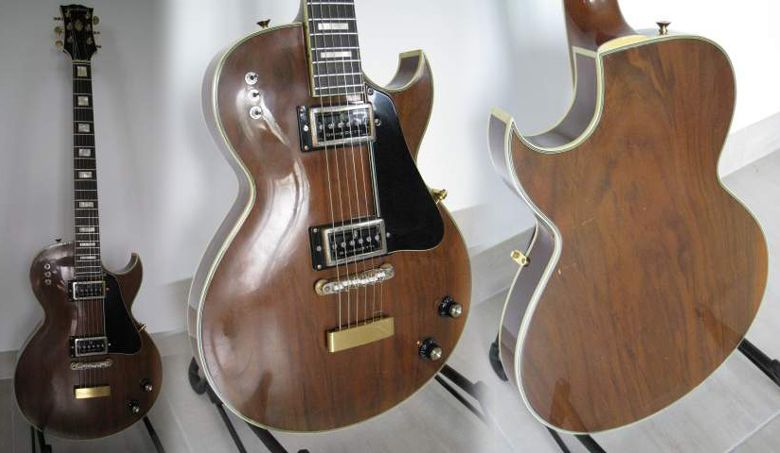
Here from 1971 we have a Jacobacci Studio II in a walnut finish and outfitted with a pair of high impedance Benedetti pickups. It is, I believe, a hollowbody guitar, although it sports no soundholes. Although the guitar has been refretted and has replacement Kluson tuners it is still a very desirable piece from this French luthier (we previously looked at a Jacobacci tenor guitar here on Guitarz).
This guitar is currently being advertised for sale, and the seller is asking €2300 for it.
Thanks to Dirk for bringing this fine guitar to our attention.
G L Wilson
© 2012, Guitarz - The Original Guitar Blog - now in its 10th year!
This guitar is currently being advertised for sale, and the seller is asking €2300 for it.
Thanks to Dirk for bringing this fine guitar to our attention.
G L Wilson
© 2012, Guitarz - The Original Guitar Blog - now in its 10th year!
9:37 AM | Labels: cool guitars, French guitar, Jacobacci, vintage guitars
Antoniotsai's Dinosaur 5-string bass with shockingly bad oil painted top
/
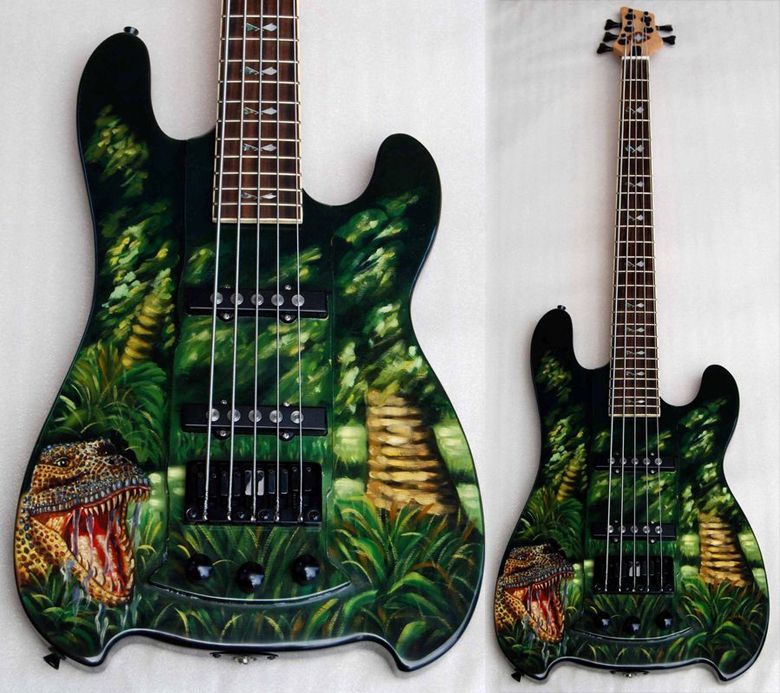
Here at Guitarz we've looked - and laughed - at Vietnamese maker Antoniotsai's guitars before (see here, here and here), and whilst this Dinosaur 5-string bass is quite tame compared to some of their other creations, it's still pretty dreadful. Not only is the dinosaur oil painting rather inexpertly realised (and let's face it, if you've absolutely got to have a Tyrannosaurus Rex on your guitar, then you'd want it as BIG and BOLD as possible, and not merely a head creeping into the bottom left-hand corner of the picture) but also look closely at the woodwork which appears irregular and wonky, as if very crudely cut out by hand.
One very strange feature is the position of the control knobs and output jack, slap bang in the middle of the body behind the bridge. One might argue that this would make the bass more readily adaptable for left-handed players, which I would understand if it didn't have Precision-esque offset body horns.
Currently listed on eBay with a starting bid of $0.99.
G L Wilson
© 2012, Guitarz - The Original Guitar Blog - now in its 10th year!
One very strange feature is the position of the control knobs and output jack, slap bang in the middle of the body behind the bridge. One might argue that this would make the bass more readily adaptable for left-handed players, which I would understand if it didn't have Precision-esque offset body horns.
Currently listed on eBay with a starting bid of $0.99.
G L Wilson
© 2012, Guitarz - The Original Guitar Blog - now in its 10th year!
8:05 AM | Labels: Antoniotsai, bass, Hideous guitars, wacky finishes
Vintage & Rare guitar of the week: 1955 Fender Esquire single pickup wonder
/
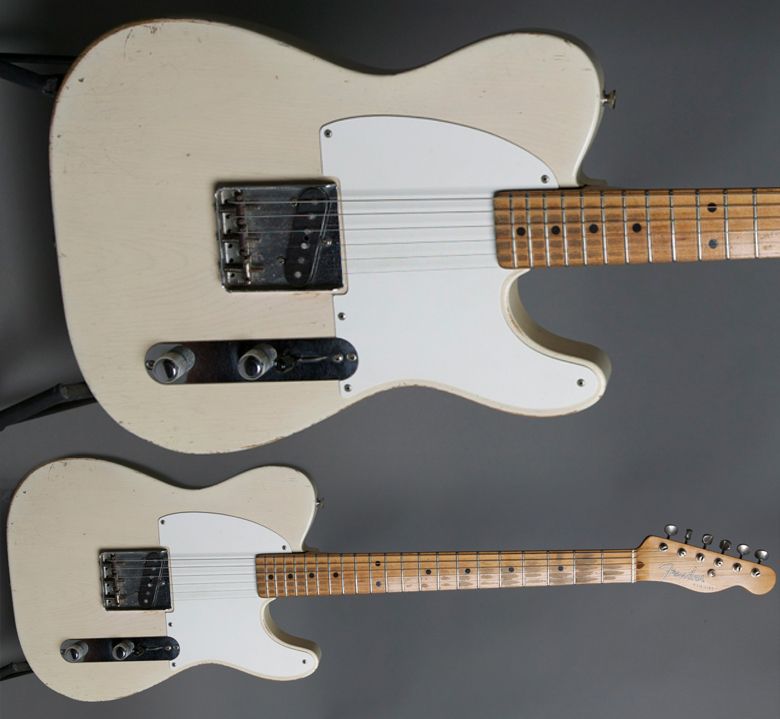
I found the gorgeous Fender Esquire from 1955 being sold via our good friends at Vintage & Rare after Guitarz reader Andrew suggested that I feature one of these all too forgotten Fenders, a guitar that has unjustly languished in the shadows of the Telecaster despite being a pretty damn nifty guitar in its own right.
It seems Andrew is quite the fan, as he waxes lyrical about this often neglected Fender in his email to me:
G L Wilson
© 2012, Guitarz - The Original Guitar Blog - now in its 10th year!
It seems Andrew is quite the fan, as he waxes lyrical about this often neglected Fender in his email to me:
During one of my slow days (all of them around this time of year) I decided to plough through your archives and check out some unique guitars. While doing this I realised you had left something out. This something? An Important piece of guitar history and an extremely odd and unique guitar. The Fender Esquire.Thanks for that, Andrew. That is what we need more of on this blog: passion! The Esquire pictured above looks to be in great condition for a guitar from 1955, although it appears to be missing its original "ash tray" bridge/pickup cover. It's currently available for purchase via Vintage & Rare priced at €17,000.
Yes, it is a mass produced guitar, yes it made by Fender, yes it is only available in fairly dull standard spec or ludicrously expensive VOS spec (spec not needed I know, VOS says it all). But it is underappreciated and relatively unknown. Its most famous users are Syd Barratt and Bruce Springsteen for god's sake!
It was the ORIGINAL Solid-Body Guitar, produced before the Telecaster in both single and dual pickup models. But it is the single pickup model which is unique. Not only did it originally ship without a truss rod in the neck, its seemingly superfluous pickup selector allowed tonal modification on a guitar in the most elegantly simple of ways, and still remains an underused feature among many single pickup guitars. As you may well know, the switch modifies the tone of the pickup by making it bassier in the forward position, while enabling use of the tone control knob in the middle position. With the switch in the rear position, these tone controls are bypassed entirely for "hotter" lead tone. This is something you still don't see very often on guitars. It's studio varitone before studio varitone!
You need to feature this guitar for one reason above all: to stop complete *&$£@#s of vintage guitar collectors from taking advantage of the unused neck pup routing (it had the same routig as a Tele) and converting vintage 50s/60s models to a Telecaster setup through the addition of a lipstick pickup and the removal of the tonal circutry. We don't need more damn Springsteen-style Esquires!
G L Wilson
© 2012, Guitarz - The Original Guitar Blog - now in its 10th year!
11:30 AM | Labels: cool guitars, Fender, Telecaster, vintage, Vintage and Rare
Silvestri 7-string guitar from the 1890s
/
The 7-string guitar has in recent years gained much popularity but I hope that most Guitarz readers will appreciate that the instrument was not a creation of the new metal movement, nor was it invented by Steve Vai or Alex Gregory. The first electric seven-stringer was probably a Gretsch hollowbody made for jazz guitarist George Van Eps in the late 1960s, although he had been playing acoustic 7-string jazz guitar since the late 1930s when he used a custom-made Epiphone.
But 7-string guitars were around long before this. Both Russian and Brazilian music had developed 7-string guitars as part of their culture. The Russian 7-string dates to beginning of the 19th century and utilised an open G tuning (DGBDGbd). It was said to have been invented by Russian guitarist and composer Andrei Sychra who wrote a method for the 7-sting guitar and a whole wealth of compositions for the instrument.
In Brazil the 7-string guitar was introduced in the early 20th century as an accompaniment instrument in choro and samba music. It is traditionally tuned as a standard 6-string with the addition of a low C string, although some guitarists took this down to a (more logical perhaps) low B.
In 18th century Europe, the baroque guitar evolved from an instrument with 5 courses to one with 6 courses - initially the courses were paired strings but later the consensus of popularity favoured single strings as is common today - so it was perfectly natural that someone would take this a stage further and add a 7th course (or string). Those advocating the 7-string guitar included French guitarist Napoleon Coste (1805–1883) who composed specifically for the instrument, and the Italian guitarist Mario Maccaferri (born 1900) who used additional unfretted bass strings (known as diapasons or bourdons) on his guitars.
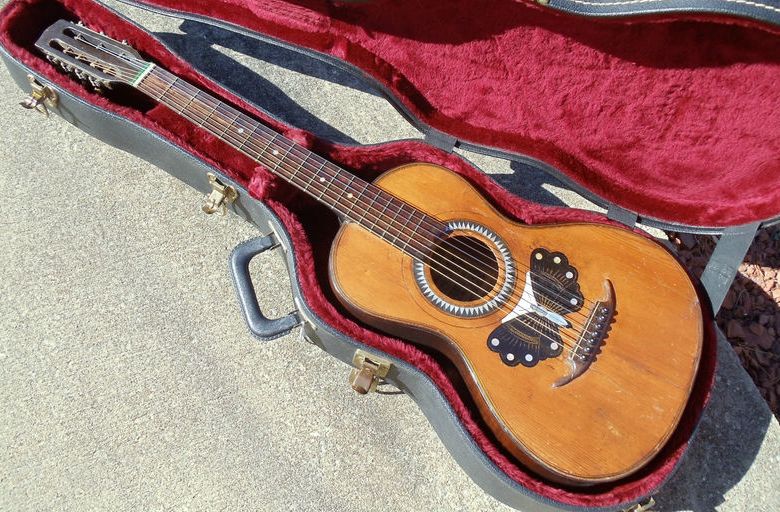
The above pictured guitar is an Italian 7-string by Ermelinda Silvestri and dates to the mid 1890s. In keeping with most of Silvestri's instruments it bears the butterfly inlay which was a trademark of sorts. The seventh string seems to be very close to the edge of the fingerboard, which suggests that it wasn't intended to be fretted and would have been a diapason (or bourdon if you prefer).
This repaired but still playable antique 7-string guitar is currently listed on eBay with a Buy It Now price of $1,450.
G L Wilson
© 2012, Guitarz - The Original Guitar Blog - now in its 10th year!
But 7-string guitars were around long before this. Both Russian and Brazilian music had developed 7-string guitars as part of their culture. The Russian 7-string dates to beginning of the 19th century and utilised an open G tuning (DGBDGbd). It was said to have been invented by Russian guitarist and composer Andrei Sychra who wrote a method for the 7-sting guitar and a whole wealth of compositions for the instrument.
In Brazil the 7-string guitar was introduced in the early 20th century as an accompaniment instrument in choro and samba music. It is traditionally tuned as a standard 6-string with the addition of a low C string, although some guitarists took this down to a (more logical perhaps) low B.
In 18th century Europe, the baroque guitar evolved from an instrument with 5 courses to one with 6 courses - initially the courses were paired strings but later the consensus of popularity favoured single strings as is common today - so it was perfectly natural that someone would take this a stage further and add a 7th course (or string). Those advocating the 7-string guitar included French guitarist Napoleon Coste (1805–1883) who composed specifically for the instrument, and the Italian guitarist Mario Maccaferri (born 1900) who used additional unfretted bass strings (known as diapasons or bourdons) on his guitars.
The above pictured guitar is an Italian 7-string by Ermelinda Silvestri and dates to the mid 1890s. In keeping with most of Silvestri's instruments it bears the butterfly inlay which was a trademark of sorts. The seventh string seems to be very close to the edge of the fingerboard, which suggests that it wasn't intended to be fretted and would have been a diapason (or bourdon if you prefer).
This repaired but still playable antique 7-string guitar is currently listed on eBay with a Buy It Now price of $1,450.
G L Wilson
© 2012, Guitarz - The Original Guitar Blog - now in its 10th year!
4:01 PM | Labels: 7-string, acoustic, antique guitars, classical, Italian guitars, Silvestri, vintage guitars
1965 Egmond Kansas
/
This 1965 Egmond Kansas is both simple and bizarre, it has its own coherence though one could find it like a collage of contradictory elements... I still cannot figure out if Egmonds were only crap budget guitars or if some higher-end models have a value other than being vintage: the Kansas was an upgrade of the Lucky 7 with the addition of a truss rod - you see what I mean - but this one looks much more sophisticated than the Lucky 7 we looked at a few weeks ago... Why this one has a pointy cutaway instead of the standard round one, I cannot tell (but it's not the only one I saw).
Incidentally, I just learned that Egmond was actually the biggest European guitar company in the 1960s! It bankrupted in 1983 as it couldn't resist to Asian guitars - that were probably of much better quality BTW.
Bertram
© 2011, Guitarz - The Original Guitar Blog - now in its 10th year!
4:00 PM | Labels: Egmond, thinline, vintage guitars
Japanese Mustang copy with Competition stripe converted to fretless
/
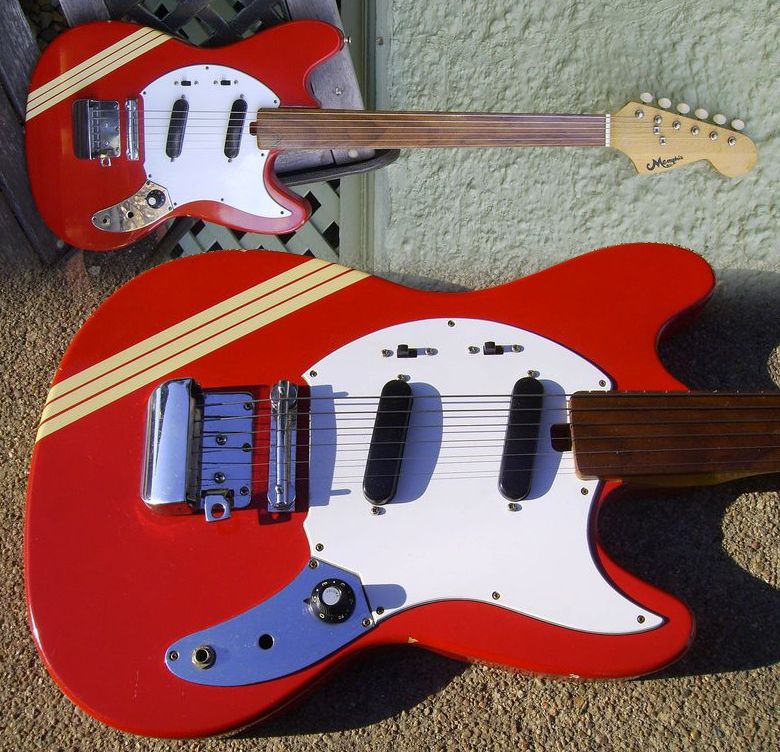
We've looked at a 1960s/70s Japanese-made Mustang copy before here on Guitarz but this Memphis-branded example currently listed on eBay is a bit more interesting. The body shape on the Memphis is still too crude and slab-like with not enough rounding over of the edges, and the pickguard looks like it should belong to an even-waisted guitar rather than one with an offset body like this. However, the guitar has been converted to fretless and this is what makes it interesting. Whoever has done this conversion seems to have made a nice job of it. They haven't merely lifted out the old frets and filled in the slots; it would appear that the whole fingerboard (you can't call it a fretboard on a fretless!) has been replaced. Note the discreet fret position markers along the bass edge of the fingerboard.
I understand I might be confusing some readers out there. In the previous post I was complaining about the desecration of vintage guitars with thoughtless customisations, but here I would seem to be applauding it. It's a very difficult topic, I guess, and we need to remember that often when such "customisations" were carried out a long time ago before the guitars in question could even have been considered one-day potentially "vintage" material by anyone. In my eyes the Japanese Mustang copy, being a real cheapy and not a particularly good "copy", would have been fair game for modification. If I wanted to customise a guitar today, I would avoid what were obviously quality instruments and choose something generic and commonplace from China or Korea perhaps. I guess that back when the Yamaha SG-12 we looked at yesterday was originally modified it wasn't considered to be a guitar of any particular importance or rarity because it was only something "Made in Japan".
But there's Made in Japan and there's Made in Japan. There are the quality guitars and then there's the cheap rubbish. Sometimes it can take some finesse to spot which is which as it is not always screamingly obvious. For example, some early Japanese Telecaster copies are not copied too accurately but are very nice players. (I wouldn't be too surprised if someone comments below that these Memphis Mustangs are also "nice little players", but I still wouldn't consider them the most exciting of "vintage" finds.) In fact, nowadays, I would be wary of butchering any MIJ guitar, because it seems that even the lowliest unplayable Teiscos (or Woolworths guitars as we used to call them) have their fans and now can fetch more money than they originally retailed for.
There are, I'm afraid, no definitive answers about which guitars are ripe for modification; which of today's guitars might be future classics, highly sought after "Holy Grails" even, and which will be considered firewood. I guess it all boils down to the fact that the owner has paid money for the guitar and it is theirs to do with as they please; some people will like it, others won't.
I have to wonder if in 20 or 30 years time, guitar enthusiasts will be searching vainly for an unadulterated Squier '51 and bemoaning the fact that this guitar was a favourite for modification and that an example in original factory condition is near impossible to find.
I suppose that on the Memphis Mustang, if a collector wanted it badly enough in near to original condition as possible, it would be possible to re-fret it. The fingerboard wouldn't be original but it would almost certainly be of better quality than the original! Anyway, this guitar is currently listed on eBay - the auction finishes later today and bidding is at $142.50 at the time of writing.
G L Wilson
© 2012, Guitarz - The Original Guitar Blog - now in its 10th year!
I understand I might be confusing some readers out there. In the previous post I was complaining about the desecration of vintage guitars with thoughtless customisations, but here I would seem to be applauding it. It's a very difficult topic, I guess, and we need to remember that often when such "customisations" were carried out a long time ago before the guitars in question could even have been considered one-day potentially "vintage" material by anyone. In my eyes the Japanese Mustang copy, being a real cheapy and not a particularly good "copy", would have been fair game for modification. If I wanted to customise a guitar today, I would avoid what were obviously quality instruments and choose something generic and commonplace from China or Korea perhaps. I guess that back when the Yamaha SG-12 we looked at yesterday was originally modified it wasn't considered to be a guitar of any particular importance or rarity because it was only something "Made in Japan".
But there's Made in Japan and there's Made in Japan. There are the quality guitars and then there's the cheap rubbish. Sometimes it can take some finesse to spot which is which as it is not always screamingly obvious. For example, some early Japanese Telecaster copies are not copied too accurately but are very nice players. (I wouldn't be too surprised if someone comments below that these Memphis Mustangs are also "nice little players", but I still wouldn't consider them the most exciting of "vintage" finds.) In fact, nowadays, I would be wary of butchering any MIJ guitar, because it seems that even the lowliest unplayable Teiscos (or Woolworths guitars as we used to call them) have their fans and now can fetch more money than they originally retailed for.
There are, I'm afraid, no definitive answers about which guitars are ripe for modification; which of today's guitars might be future classics, highly sought after "Holy Grails" even, and which will be considered firewood. I guess it all boils down to the fact that the owner has paid money for the guitar and it is theirs to do with as they please; some people will like it, others won't.
I have to wonder if in 20 or 30 years time, guitar enthusiasts will be searching vainly for an unadulterated Squier '51 and bemoaning the fact that this guitar was a favourite for modification and that an example in original factory condition is near impossible to find.
I suppose that on the Memphis Mustang, if a collector wanted it badly enough in near to original condition as possible, it would be possible to re-fret it. The fingerboard wouldn't be original but it would almost certainly be of better quality than the original! Anyway, this guitar is currently listed on eBay - the auction finishes later today and bidding is at $142.50 at the time of writing.
G L Wilson
© 2012, Guitarz - The Original Guitar Blog - now in its 10th year!
5:03 AM | Labels: customised, fretless, Japanese guitar, Memphis, vintage, vintage modification
A tale of two Yamaha SG-12 solidbody 12-stringers
/
Regular Guitarz readers may remember that back in September I posted about a vintage Yamaha SG-12 offered for sale on eBay which had been rather disturbingly and tastelessly customised. I ended that particular blog post by saying:
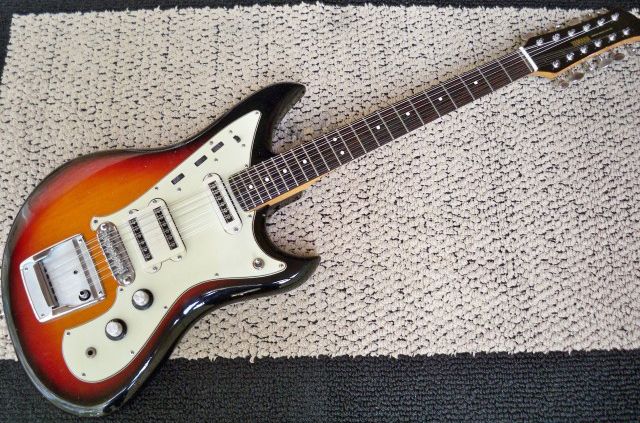
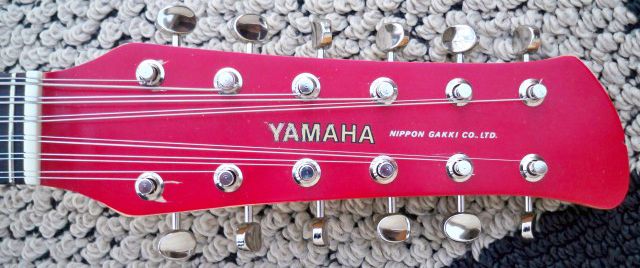
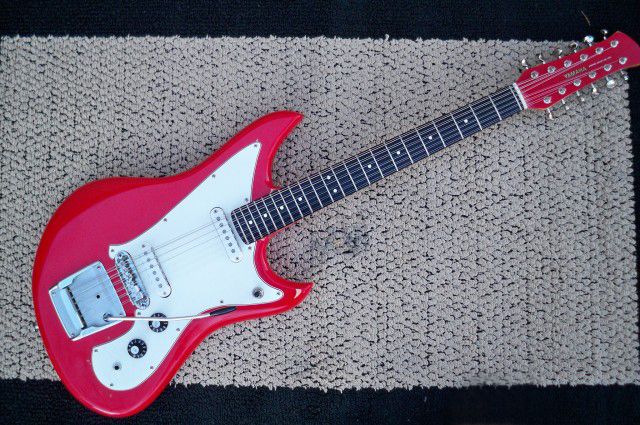
Whilst the red (formerly "TRoth") SG12 pictured above isn't an accurate restoration, it has been finished with respect and reverence to the original design. I like the use of two Jaguar pickups - surely these are in keeping with this style of guitar, and where would you find the original Yamaha pickups outside of buying a re-issue SGV-300 and cannibalising it (which would be a shame in itself)? It certainly has an authentic vintage vibe and I would like to congratulate Chris on a job well done!
Happy New Year to all our readers!
G L Wilson
© 2012, Guitarz - The Original Guitar Blog - now in its 10th year!
There was recently another SG-12 on eBay which, alas, was incomplete - there were parts missing such as bridge saddles. That particular guitar sold quite cheaply. It'd be nice to think that whoever bought that one, could buy this example too and assemble a single Yamaha SG-12 as it should be and keep the rest as spares.Well, imagine my surprise when reading in an email from Chris Fesker that this was indeed what happened and the above pictured Yamaha SG-12 is the resulting restored guitar put together from parts from the two donor instruments. But what happened to the left over parts which obviously included perfectly serviceable body and neck? It'd be a shame to let those lie around unused. I'll let Chris tell you the whole story:
Hi Gavin - my name is Chris Fesker, and I was looking for pictures of Yamaha SG12 guitars, when I ran into your blog...I did indeed get a kick out of seeing the photos of Chris's restored SG-12s; it's so good to see something like that having seen so many bad bodge jobs, half-arsed relics, and crappy "customisations" carried out on otherwise beautiful vintage instruments.
http://guitarz.blogspot.com/2011/09/vintage-yamaha-sg-12-twelve-string.html
I am the one that bought that guitar, along with the other incomplete SG12 you mentioned that sold around that same time. I did combine the two, using all the good parts from the 'TRoth' guitar to repair the sunburst. Rather than sell the parted out TRoth guitar, and having noticed that the original red finish was still below the new paint, I stripped the black and gold repaint to the original red, and re-built it to the best of my abilities.
Here's some links to some pictures of both in their newly repaired state.
Red SG12 - http://s178.photobucket.com/albums/w263/sonichris_photos/Red%201967%20Yamaha%20SG12/
Sunburst SG12 - http://s178.photobucket.com/albums/w263/sonichris_photos/1967%20Yamaha%20SG-12/
I thought you might get a kick out of seeing them.
Thanks
Chris
Whilst the red (formerly "TRoth") SG12 pictured above isn't an accurate restoration, it has been finished with respect and reverence to the original design. I like the use of two Jaguar pickups - surely these are in keeping with this style of guitar, and where would you find the original Yamaha pickups outside of buying a re-issue SGV-300 and cannibalising it (which would be a shame in itself)? It certainly has an authentic vintage vibe and I would like to congratulate Chris on a job well done!
Happy New Year to all our readers!
G L Wilson
© 2012, Guitarz - The Original Guitar Blog - now in its 10th year!
4:33 AM | Labels: 12-string, cool guitars, customised, vintage guitars, Yamaha, Your Guitars
Subscribe to:
Posts (Atom)